Canara Bank, a prominent public sector bank in India, continues to attract the attention of investors in July 2025. Known for its extensive reach across the country and consistent dividend payouts, the bank has recently faced headwinds due to weakening margins and a cautious economic environment. The stock is trading in a narrow band, with investors closely monitoring both fundamental developments and technical signals to assess the bank’s near-term direction.
In this article, we present a detailed analysis of Canara Bank, combining recent financial results, corporate actions, macroeconomic environment, and a deep technical study of the current chart patterns and indicators.
Current Market Status
Canara Bank is currently trading around ₹113.78 as of July 8, 2025. The stock has witnessed marginal volatility in recent sessions, moving within a tight range between ₹113 and ₹115. The daily price movement has turned largely sideways, reflecting investor caution and the absence of strong directional cues.
On the intraday chart, the stock made a high of ₹114.04 and a low of ₹113.60, indicating compressed volatility. Market participants are carefully watching key levels for a breakout or breakdown before initiating significant positions.
Price Action and Resistance Zone
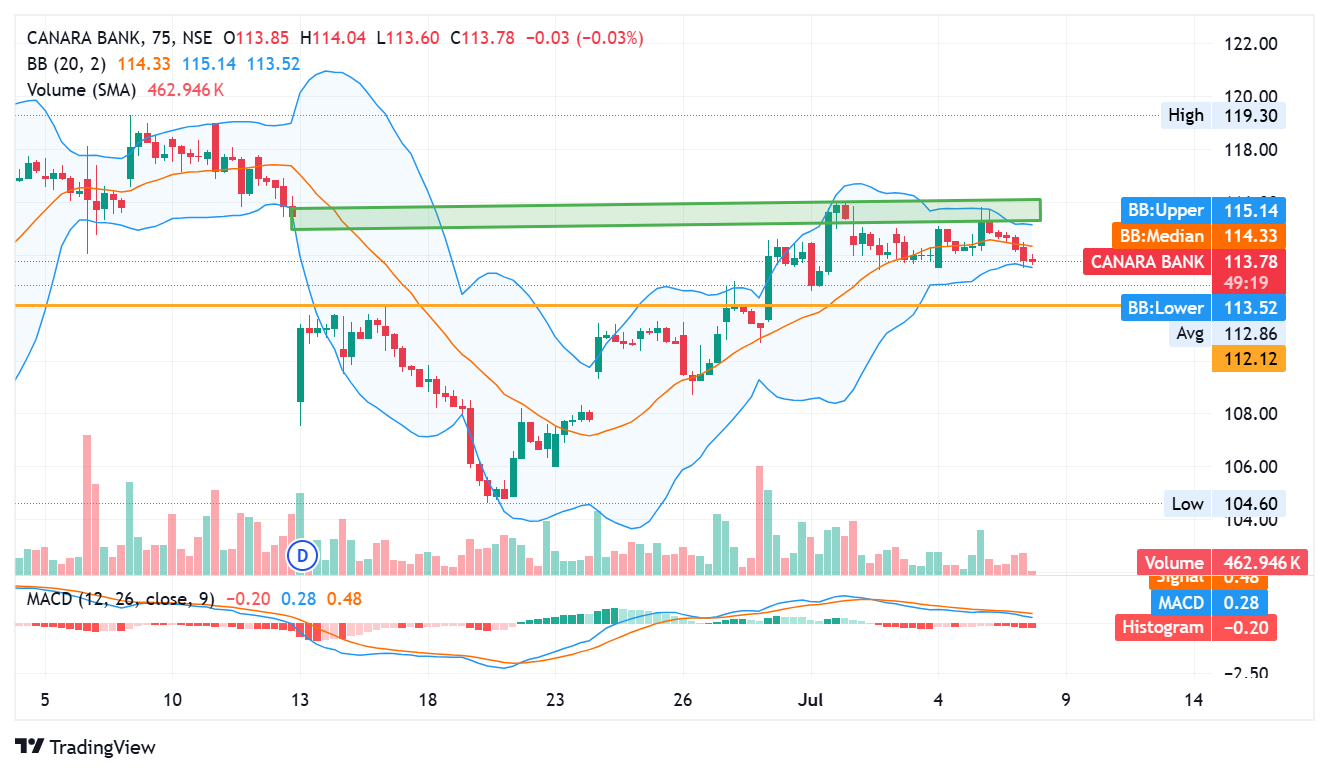
Technically, the most critical development is the repeated rejection of price action near the ₹114.80 to ₹115.30 zone. This area, marked clearly on recent charts, has acted as a strong resistance where sellers have stepped in. Multiple attempts to break through this green resistance zone have failed, confirming it as a supply region.
The consolidation near this level, with no breakout so far, shows that bulls are lacking momentum. Any close above ₹115.50 would need to be accompanied by high volume and bullish candle formations to confirm a valid breakout. Until then, the stock may remain range-bound or face a pullback to lower support levels.
Technical Indicators in Focus
Bollinger Bands
The Bollinger Bands applied to Canara Bank’s 75-minute chart are narrowing, indicating low volatility and potential for an upcoming directional move. The upper band lies at ₹115.14, and the lower band is near ₹113.52. The price is currently hovering near the lower band, having recently moved below the median line (₹114.33), which acts as a dynamic resistance.
This behavior implies that downside pressure may continue unless there is a strong bounce from the lower band supported by volume.
Moving Averages
The 20-period simple moving average on the intraday chart is also aligned near ₹114.30. The price has stayed below this average in recent sessions, signaling weakness. If the price can reclaim and sustain above this moving average, it would indicate short-term strength. Otherwise, bears may continue to dominate.
The long-term 200-day simple moving average remains well below, around the ₹104–₹106 range, reflecting the stock’s overall uptrend from earlier months. However, the short-term trend is now clearly neutral to slightly bearish.
MACD (Moving Average Convergence Divergence)
The MACD indicator is showing a bearish crossover, with the MACD line below the signal line and histogram values in negative territory. This setup typically suggests weakening momentum and could result in a short-term correction unless reversed soon.
If the histogram continues to expand on the downside, it would further validate bearish dominance in the near term.
Volume Analysis
Volume trends have not supported bullish movements. The stock’s average daily volume is around 462,000 shares, but recent sessions have shown reduced participation during rallies. This indicates a lack of institutional interest at current levels and reduces the probability of an imminent breakout.
For a sustainable upmove, a rise in both price and volume is essential. Otherwise, any minor rallies may face quick selling.
Support and Resistance Levels
The technical chart shows that Canara Bank has immediate resistance at ₹115.30, followed by the recent 52-week high at ₹119.30. On the downside, ₹113.52 serves as short-term support as per the Bollinger Band lower range.
The next major support zone lies near ₹112.12. If this level is breached, the stock may slide further toward ₹110 and even ₹108 in a bearish scenario. A bounce from ₹112, however, could keep the stock in a sideways to mildly bullish trajectory.
Fundamental Overview
Q1 FY26 Earnings Highlights
Canara Bank reported its earnings for the quarter ended June 2025 (Q1 FY26), which presented a mixed picture.
Net interest income (NII) declined to ₹9,638.8 crore, a 4.2 percent drop quarter-on-quarter. Non-interest income also contracted by 3.8 percent to ₹7,792.8 crore. Profit before tax (PBT) fell by 17.5 percent to ₹5,422 crore, highlighting pressures on core banking profitability.
Earnings per share (EPS) came in at ₹4.48, down from ₹5.59 in the previous quarter. Analysts have attributed the dip in performance to margin compression, lower fee income, and weaker loan growth in the corporate segment.
Despite this softness, the bank has managed to maintain a solid operating base, driven by a healthy deposit book and strong cost control.
Asset Quality and Efficiency
One of the bright spots in Canara Bank’s performance is the steady improvement in asset quality. Gross non-performing assets (GNPA) are at 2.94 percent, while net NPA has dropped to just 0.70 percent. This trend reflects better loan recovery mechanisms and improved underwriting practices.
The bank has also reported a 19 percent increase in profit per employee, indicating higher operational efficiency and better human resource utilization.
Dividend and Shareholder Returns
For FY25, the bank declared a final dividend of ₹4 per share, representing a 200 percent payout on the face value of ₹2. The dividend record date was June 13, 2025. This reflects the bank’s focus on delivering shareholder value despite near-term earnings fluctuations.
The dividend yield based on current prices stands between 3.5 and 6 percent, making the stock attractive for income-seeking investors.
Capital Raising Plans
Canara Bank’s board has approved a fundraising of up to ₹9,500 crore through debt instruments during FY26. This includes ₹3,500 crore via Additional Tier 1 bonds and ₹6,000 crore through Tier II bonds under Basel-III norms.
The move is seen as a proactive step to strengthen the capital adequacy ratio and prepare for future growth. While this may dilute short-term returns slightly, it strengthens long-term sustainability.
Lending and Deposit Adjustments
In line with changing monetary policy dynamics, Canara Bank reduced its Marginal Cost of Funds based Lending Rates (MCLR) by 15 to 20 basis points across tenors effective June 12, 2025. This reduction benefits borrowers and may aid credit growth, particularly in the retail and MSME segments.
The bank also lowered interest rates on fixed deposits under ₹3 crore from June 1, 2025. While this aligns with easing interest rates globally, it also reflects pressure on deposit mobilization and margin outlook.
Sectoral and Macro Considerations
The banking sector as a whole is facing margin pressure due to slowing credit offtake and soft fee income. Several brokerage reports suggest that Q1 FY26 earnings across PSU banks could show modest declines on a sequential basis.
Canara Bank’s performance, though not exceptional this quarter, remains well-aligned with sector expectations. Its improving asset quality and dividend payout provide stability in an otherwise cautious environment.
There has been some impact on the stock due to its recent exclusion from the BSE Bankex index during the June 2025 reshuffling. This has affected passive fund flows slightly but is not expected to have a long-term impact on investor sentiment.
Key Metrics Summary
Stock Price: ₹113.78
Canara Bank’s stock is currently trading at ₹113.78, reflecting a phase of consolidation after a rally earlier in the year. The price has remained in a narrow band for the past few sessions, primarily due to profit booking, sector-wide cautiousness, and global uncertainties. This level is also slightly below the resistance zone of ₹114.80–₹115.30, which the stock has struggled to surpass in recent attempts. The muted movement indicates that investors are waiting for stronger cues—either from earnings upgrades, macroeconomic policy changes, or a shift in technical momentum—before committing to new positions.
52-Week Range: ₹78.58 – ₹119.30
The 52-week low of ₹78.58 reflects the lows seen during a broader market correction and sector-specific challenges around late 2024. Since then, the stock has gained more than 40 percent at its peak of ₹119.30, which was recorded earlier this quarter. This wide price range underscores the stock’s volatility over the past year. The high of ₹119.30 now acts as a psychological barrier and key resistance. As the stock trades closer to the upper band of this range, the risk-reward ratio becomes less attractive for short-term entries, unless a breakout is confirmed.
Market Capitalization: ₹1,03,224 crore
Canara Bank’s market capitalization has crossed ₹1 lakh crore, placing it among India’s most valuable public sector financial institutions. This valuation reflects the market’s confidence in the bank’s stable asset quality, operational efficiency, and dividend-paying record. It also signifies growing institutional interest, especially from domestic mutual funds and pension funds that favor large-cap banking stocks for stability and income.
Gross NPA: 2.94% | Net NPA: 0.70%
One of the strongest aspects of Canara Bank’s financial health is its asset quality. The Gross Non-Performing Asset (GNPA) ratio of 2.94 percent and the Net NPA ratio of 0.70 percent are among the best in the public sector banking space. These figures indicate that the bank has successfully reduced stressed assets through effective recoveries, better loan monitoring, and prudent provisioning. A Net NPA under 1 percent signals robust credit risk management and boosts investor confidence. This also improves the bank’s provisioning coverage ratio and frees up capital for growth.
Dividend Declared: ₹4 per share
For FY25, Canara Bank declared a dividend of ₹4 per share, a 200 percent payout on the face value of ₹2. At the current share price of ₹113.78, this translates to a dividend yield of approximately 3.5 percent, which is highly attractive for income-focused investors. This consistent dividend policy reflects the bank’s profitability and its intent to reward long-term shareholders. In an environment where interest rates on fixed deposits are moderating, such dividend yields make the stock more appealing to conservative investors seeking stable returns.
Capital Raise Approved: ₹9,500 crore (AT1 + Tier II)
To bolster its capital adequacy and fuel future loan growth, Canara Bank’s board has approved a capital raise of ₹9,500 crore in FY26. This includes ₹3,500 crore through Additional Tier I (AT1) bonds and ₹6,000 crore via Tier II bonds, both compliant with Basel-III norms. The bank’s proactive capital raising strategy strengthens its ability to absorb future credit losses, if any, and maintain regulatory buffers. While bond issuance adds to debt, it does not dilute equity capital. However, higher borrowing costs from these instruments could impact net interest margins slightly, depending on market rates at issuance.
EPS (Q1 FY26): ₹4.48
Earnings per share (EPS) for the quarter ended June 2025 stood at ₹4.48, down from ₹5.59 in the previous quarter. The decline was driven by a combination of lower net interest income, softer fee-based revenue, and increased provisions. Although the fall is sequential, the year-on-year comparison still shows moderate growth. This number, while not alarming, indicates pressure on margins and highlights the challenges posed by slower credit growth and rising competition in the lending space. A recovery in earnings will depend on improvement in loan demand and better treasury income in subsequent quarters.
MACD: Bearish
The Moving Average Convergence Divergence (MACD) indicator for Canara Bank currently shows a bearish crossover. The MACD line has moved below the signal line, and the histogram has turned negative. This technical pattern suggests declining momentum and potential for short-term price correction unless reversed by positive triggers. Traders typically interpret this as a signal to avoid fresh long positions or to consider hedging existing exposures. A reversal in MACD would require a strong move above ₹115.50 accompanied by rising volume.
Bollinger Bands: Near Lower Band
The stock is trading near the lower Bollinger Band on the 75-minute chart, indicating that it is nearing a short-term support area. This suggests that the stock is slightly oversold in the short term, and a bounce may occur if buying emerges near the ₹113–₹113.50 zone. However, continued trading along the lower band without a bounce could confirm bearish sentiment. If the stock crosses back above the median line (currently at ₹114.33), it would indicate recovery. Traders often watch for price action confirmation near the lower band to decide entry or exit points.
Volume: Moderate but Declining
Average trading volume stands at around 462,000 shares. However, recent sessions have seen declining participation, especially during intraday rallies. This weakening volume trend indicates low conviction among buyers. Lack of volume on upward price moves reduces the probability of a strong breakout. For any sustained rally, the stock would need to see higher-than-average volume along with price strength. Institutional flows are expected to increase closer to quarterly result season or major policy announcements, which could reignite buying interest.
Outlook and Investment Perspective
Canara Bank is currently in a consolidation phase with no clear breakout above the ₹115 resistance. While fundamentals remain broadly stable, short-term challenges in earnings and loan growth are weighing on sentiment. Technical indicators support a cautious view until a strong directional move emerges.
Investors with a long-term horizon may view the current levels as an accumulation zone, especially considering the dividend yield and strong asset quality. However, short-term traders should wait for a breakout above ₹115.50 or breakdown below ₹112 before making directional bets.
From a macro perspective, a favorable shift in credit demand or easing inflation could support future earnings recovery. Any positive surprise in Q2 numbers or clarity on global trade and interest rate trends may also act as triggers for upward movement.
Conclusion
Canara Bank, as of July 2025, stands at a pivotal point. It faces resistance on the charts and margin headwinds in its books, but its underlying fundamentals, efficient operations, and healthy capital position remain strong. Investors must watch for price action confirmation, volume surges, and macroeconomic cues before building aggressive positions.
For now, Canara Bank reflects a classic case of a fundamentally sound stock undergoing short-term consolidation, waiting for a breakout to define its next move.