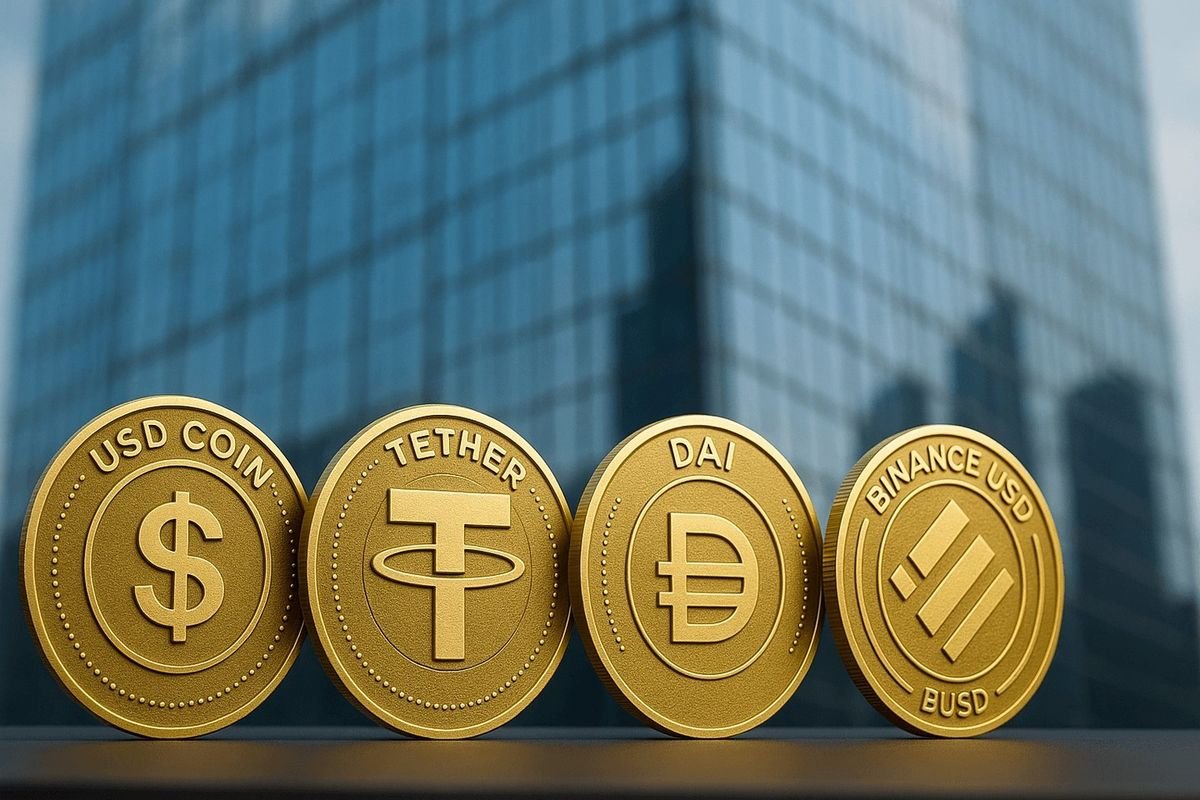
The global digital finance market is shifting fast, and stablecoins now stand at the center of this financial transformation. According to a recent report from JPMorgan, stablecoins could add $1.4 trillion in new demand for the U.S. dollar by 2027. This forecast marks one of the most powerful signals yet that blockchain-based digital money might become a core pillar of global finance.
Let’s dive deep into what this means, why JPMorgan sees this happening, and how it could reshape the crypto and banking landscape over the next two years.
The Rise of Stablecoins
Stablecoins are digital tokens pegged to a stable asset, usually the U.S. dollar. Unlike Bitcoin or Ethereum, which often fluctuate wildly, stablecoins maintain a fixed value. Traders, institutions, and fintech platforms use them to move money quickly without the volatility of traditional cryptocurrencies.
In 2020, stablecoins represented a small fraction of global crypto circulation. By 2025, their total market capitalization crossed $160 billion, according to CoinMarketCap data. Top players like Tether (USDT), USD Coin (USDC), and PayPal USD (PYUSD) dominate the market. But now, with governments, banks, and corporations entering the field, stablecoins are evolving from crypto convenience to financial infrastructure.
JPMorgan’s Forecast: $1.4 Trillion More USD Demand
In its October 2025 report, JPMorgan’s Global Digital Finance Division analyzed transaction flows, cross-border settlements, and global stablecoin reserves. The report predicts that stablecoins could create an additional $1.4 trillion in demand for the U.S. dollar by 2027.
How? Because every dollar-backed stablecoin requires real U.S. dollar reserves. When users buy stablecoins, issuers like Tether or Circle deposit equivalent dollars in U.S. banks or Treasury bills. As global adoption rises, these reserves will keep expanding — effectively locking more liquidity inside the U.S. financial system.
This means that as more people use stablecoins, the demand for actual dollars grows, strengthening the USD’s dominance as the world’s reserve currency.
Why the Dollar Stands to Benefit
The U.S. dollar already anchors about 60% of global trade and reserves. Stablecoins enhance this power because most are denominated in USD, not euros, yen, or yuan. Even when users in Africa or Southeast Asia transact in digital tokens, the backing often comes from U.S. assets.
JPMorgan analysts explain that “stablecoins serve as an indirect export of the U.S. dollar.” Every time someone in another country holds or uses a stablecoin, they’re effectively using a digital dollar—without relying on local banking systems or U.S. regulators.
This creates a self-reinforcing loop:
-
More people use dollar-backed stablecoins.
-
More U.S. dollars or Treasury bills enter issuer reserves.
-
The USD strengthens as the world’s default digital settlement currency.
Institutional Interest Grows
Major institutions now view stablecoins as more than speculative tools. They see them as bridges between traditional finance (TradFi) and decentralized finance (DeFi).
For example:
-
BlackRock holds U.S. Treasuries for Circle’s USDC reserves.
-
PayPal launched its own stablecoin, PYUSD, to simplify cross-border payments.
-
Visa and Mastercard started testing settlement systems using USDC on the Solana and Ethereum networks.
JPMorgan also runs its private JPM Coin, used for corporate payments within its Onyx blockchain network. The bank processes billions of dollars in daily transactions using this digital token—proof that even conservative financial giants now rely on blockchain for efficiency.
Why Adoption Keeps Accelerating
Three major drivers fuel the rise of stablecoins:
1. Global Payment Efficiency
Traditional cross-border payments take days and involve multiple intermediaries. Stablecoins transfer instantly, at a fraction of the cost. A U.S. freelancer can receive payment from a European client in seconds using USDC or USDT.
2. DeFi Integration
Decentralized finance platforms like Aave, Compound, and Uniswap rely heavily on stablecoins for lending, borrowing, and liquidity. Traders prefer them because they combine the speed of crypto with the stability of fiat.
3. Emerging Market Demand
In countries with weak currencies—such as Argentina, Nigeria, and Turkey—citizens use stablecoins to protect savings from inflation. Instead of holding unstable local currency, they convert to dollar-backed tokens that maintain purchasing power.
The Regulatory Landscape
Regulation plays a key role in shaping the future of stablecoins. Governments worldwide are racing to define rules around reserves, audits, and transparency.
In the U.S., the Stablecoin Regulation Act of 2025 requires issuers to maintain 100% cash or Treasury-backed reserves. The law also mandates monthly audits and on-chain proof of reserves.
Europe, meanwhile, introduced MiCA (Markets in Crypto-Assets Regulation), which took effect in mid-2025. It forces issuers of euro-pegged stablecoins to disclose reserve details and maintain strict capital requirements.
JPMorgan’s report notes that stronger regulation could actually boost confidence in stablecoins. If investors trust that each token truly represents one dollar, adoption will accelerate across retail and institutional markets.
Competition from Central Bank Digital Currencies (CBDCs)
While stablecoins expand, central banks are developing their own digital currencies. China’s Digital Yuan, India’s Digital Rupee, and the European Digital Euro aim to offer state-controlled alternatives to private stablecoins.
However, JPMorgan argues that CBDCs might not replace stablecoins. Instead, both will coexist. Private companies innovate faster, while central banks focus on policy stability and regulation. In fact, stablecoins might even act as gateways for CBDC integration, enabling hybrid payment systems.
The Geopolitical Impact
The growing demand for USD-backed stablecoins carries geopolitical implications. Countries like Russia and China view this as an expansion of U.S. financial power through digital channels.
Still, many emerging economies accept it as a necessary reality. The dollar remains the world’s trusted store of value, and stablecoins offer access to it without traditional barriers. In effect, the U.S. extends its monetary influence—digitally, seamlessly, and globally.
Challenges Ahead
Despite the optimism, stablecoins face real challenges:
-
Reserve transparency: Tether and others must maintain strict auditing standards.
-
Cybersecurity risks: Hacks and smart contract vulnerabilities remain a concern.
-
Regulatory uncertainty: Sudden changes in U.S. or EU policy could disrupt issuers.
-
Competition: CBDCs and alternative payment networks could limit market share.
JPMorgan stresses that success depends on trust. If users believe that every token equals one real dollar, the market will expand naturally. But one major collapse could trigger global skepticism, just as the TerraUSD crash did in 2022.
The Road to 2027
Looking ahead, JPMorgan projects stablecoin transaction volumes could exceed $8 trillion annually by 2027. This figure would rival or surpass Visa’s global payment network. As tokenized finance integrates with retail, banking, and cross-border systems, the boundary between “crypto” and “traditional finance” will disappear.
In simple terms, money will move on blockchains just as easily as data moves on the internet.
Final Thoughts
JPMorgan’s prediction of $1.4 trillion in extra U.S. dollar demand highlights a powerful reality: stablecoins are no longer experimental assets. They are reshaping how the world moves money, trades value, and interacts with digital finance.
Every stablecoin minted adds another digital thread to the global financial web — one that ties tightly to the U.S. dollar. As adoption grows, the dollar’s digital shadow stretches further across borders, economies, and technologies.
By 2027, the world may not talk about “crypto” and “fiat” as separate things anymore. We’ll simply talk about money that moves faster, cheaper, and smarter — powered by stablecoins.
Also Read – Theranos’ lab test result manipulations