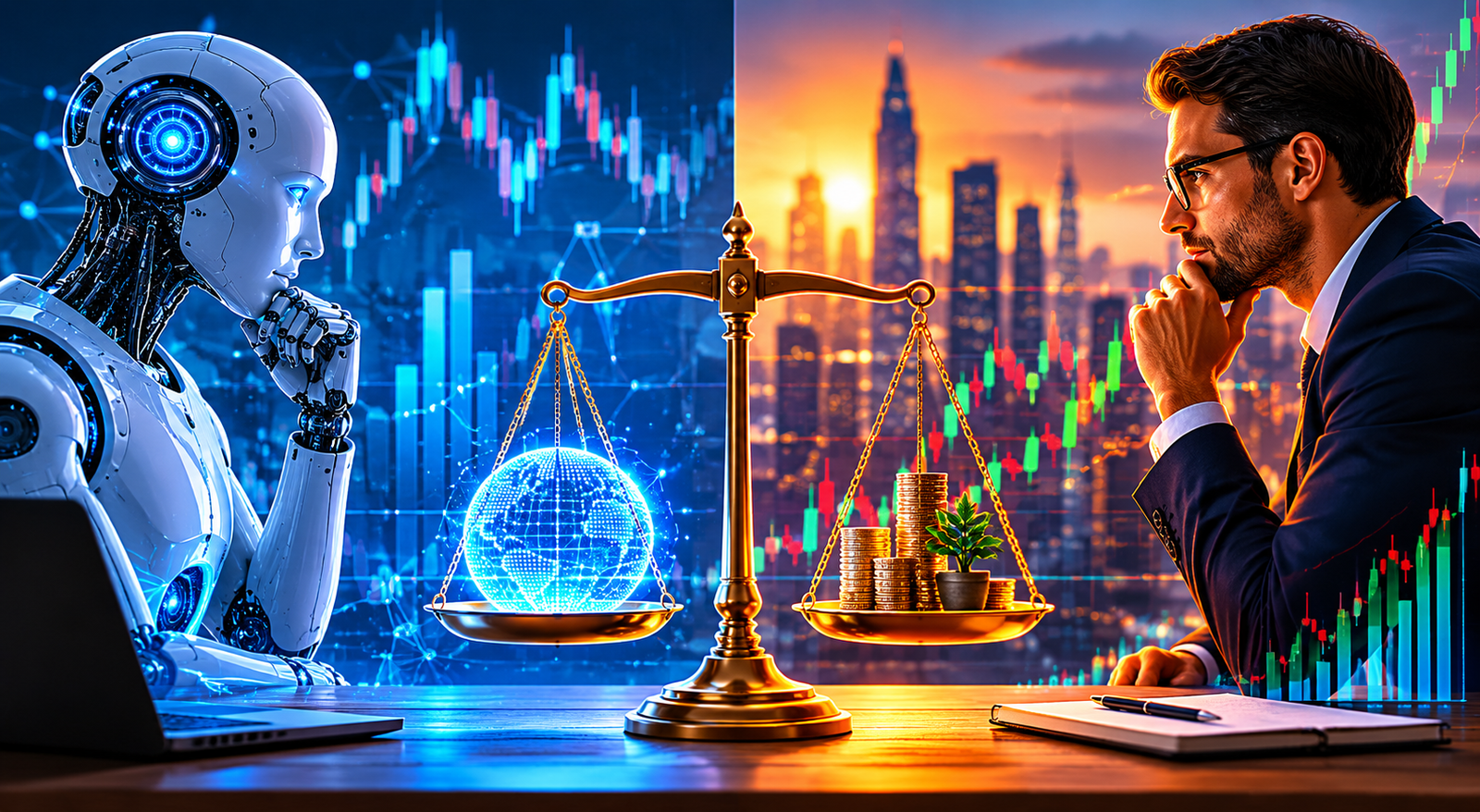
Artificial Intelligence has become a major force in the investment world. Large fund houses now use AI to study market data, company reports, news updates, and investor behavior. At the same time, human fund managers still control trillions of dollars across global markets.
This has created a big question for investors. Can AI deliver better returns than human fund managers?
The latest data shows that the answer is not simple. Both AI systems and human experts have strengths. Their results often depend on market conditions, risk levels, and investment style.
Why AI Has Become Popular
AI can study huge amounts of information in seconds. It can scan thousands of stocks, compare financial data, and spot patterns that people may miss.
Many asset management companies now use AI in their research process. Recent industry surveys show that more than half of large asset managers use AI in portfolio management. This number has grown quickly during the last few years.
AI also helps reduce emotional decisions. It follows data instead of fear, greed, or market rumors.
Because of these benefits, investment firms continue to spend billions on AI tools and research.
What Human Fund Managers Still Do Better
Even with advanced technology, human fund managers still have important advantages.
People can understand business quality, leadership changes, political events, and economic shifts in ways that computers often cannot. They can also react to unexpected events that have no historical data.
For example, a skilled manager may understand how a new government policy could affect a company long before financial numbers show the impact.
This type of judgment remains difficult for AI systems.
What Recent Performance Data Shows
Recent research compared AI-driven funds with human-managed funds across different market periods.
The study found that AI funds performed better during market declines because they handled risk more effectively. However, human-managed funds produced stronger results during market recovery periods and bullish phases.
Researchers concluded that AI works well when markets become difficult and uncertain. Human managers often do better when market sentiment improves and investors become more confident.
This shows that neither side dominates every market environment.
Stanford Study Created Major Attention
One of the biggest AI investment stories came from a Stanford Graduate School of Business study released in 2025.
Researchers tested an AI analyst on mutual fund portfolios from 1990 to 2020. The AI adjusted stock selections made by human managers.
The results surprised many experts.
According to the study, the AI-enhanced strategy outperformed about 93% of human fund managers. Researchers also found that the AI version generated much higher benchmark-adjusted returns over the 30-year period.
The findings showed how powerful AI can become when it works alongside investment professionals.
Most Active Managers Still Face Problems
The larger challenge is that many active fund managers struggle to beat market indexes.
According to the SPIVA U.S. Year-End 2025 report, 79% of actively managed large-cap U.S. equity funds failed to beat the S&P 500 index. This was one of the weakest years for active fund managers in the history of the report.
The same trend appears across many global markets.
SPIVA Australia reported that 74% of Australian equity funds failed to beat their benchmark in 2025. Over a 15-year period, 87% of funds underperformed their benchmark.
These numbers show that active management remains difficult, whether managers use AI or traditional methods.
A Better Year for Active Managers
While long-term results remain challenging, 2025 brought some positive news for active managers.
During the first half of 2025, only 54% of actively managed large-cap U.S. funds underperformed the S&P 500. This was a major improvement compared with previous years.
Experts believe higher market volatility created more opportunities for stock selection. More stocks moved independently instead of following the same trend. This gave skilled managers a better chance to find winning investments.
Even so, active funds as a group still found it difficult to beat passive index funds.
AI Is Changing the Investment Industry
The investment industry no longer sees AI as an experimental tool.
Large firms now use AI for market research, portfolio construction, risk analysis, and compliance checks. Industry reports show that AI has become a core part of modern asset management operations.
Many hedge funds also believe AI will improve future performance. Surveys show that nine out of ten investors expect generative AI to improve hedge fund returns during the next few years.
This strong confidence explains why firms continue to increase AI investments.
Why Humans Are Not Going Away
Despite rapid progress, AI has not replaced fund managers.
Markets often react to events that machines cannot fully understand. Political tensions, regulation changes, global conflicts, and consumer trends may require human judgment.
Investors also prefer accountability. People usually feel more comfortable when experienced professionals oversee investment decisions rather than leaving everything to a computer model.
For this reason, most firms continue to place humans at the center of the decision process.
The Future Looks Like a Partnership
The latest trend is not AI versus humans. It is AI plus humans.
Many firms now combine machine analysis with human expertise. AI handles large data sets and finds hidden patterns. Human managers review the information and make final decisions.
This hybrid model gives investors the speed of technology and the judgment of experienced professionals.
Perfect Finserv and many other financial research platforms have highlighted this shift as one of the biggest trends in modern investing.
Final Thoughts
AI has already changed the investment industry. Research shows that AI can identify opportunities, control risk, and process information much faster than people.
At the same time, human fund managers continue to offer experience, market understanding, and decision-making skills that machines cannot fully copy.
Recent studies suggest that AI may outperform many managers in specific situations. However, real-world investing still benefits from human judgment.
The strongest results may come from a combination of both. Instead of replacing fund managers, AI is becoming a powerful partner that helps them make smarter investment decisions.
Also Read – IndiGo Faces Q4 Loss but Experts See Better Days Ahead