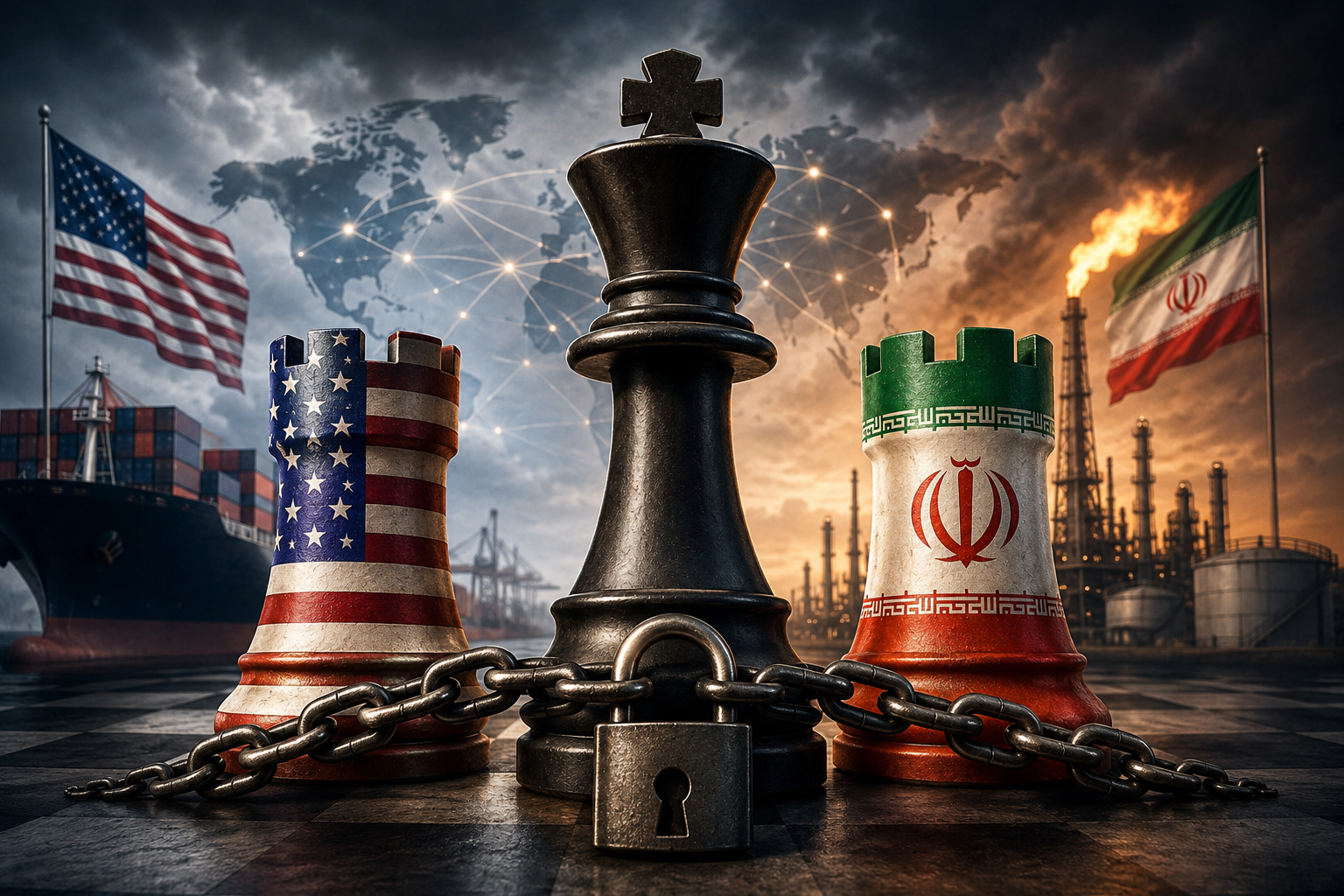
U.S. Treasury Secretary Scott Bessent has said that the United States plans to impose what he calls the “toughest sanctions in history” against Iran. He has also urged China and other countries to support the U.S. effort. The full details of the new measures are due at a press conference on Monday, August 24, 2026.
The statements mark a serious step in the U.S. economic campaign against Iran. They also raise a wider question: how far can Washington use financial pressure before the cost falls on other countries, global trade, and energy markets?
This analysis uses cautious language because the final sanctions package is not yet public. Some statements from U.S. officials describe policy aims rather than confirmed results. A claim that sanctions may cause the Iranian regime to collapse should therefore be treated as a stated policy objective, not as a certain outcome.
What Bessent Has Said
Bessent has described the new policy as part of a wider effort to place Iran under extreme economic pressure. The reported approach would target Iran’s oil income, financial access, shipping links, and other channels that allow Tehran to earn foreign currency.
The United States already has a broad sanctions system against Iran. Treasury actions have targeted oil networks, vessels, banks, money channels, crypto exchanges, and firms that help Iran move funds or goods. Treasury has also said that more than 100 vessels tied to Iran’s so-called shadow fleet have faced sanctions this year.
The proposed policy therefore does not start from zero. It would add pressure to an already large sanctions structure.
Bessent has also linked economic pressure to the wider security crisis. The U.S. position, as reported, is that stronger financial pressure may reduce Iran’s ability to fund military activity and regional proxy groups. The administration has also connected the economic campaign with the wider dispute over the Strait of Hormuz.
That connection matters because sanctions and physical disruption can affect the same economic system. Iran depends heavily on energy exports for foreign income, while the world depends on stable energy routes from the Gulf.
Why China Matters So Much
China is the most important outside country in this debate.
Reuters reported that China buys more than 80% of Iran’s shipped oil. That gives Chinese buyers a central role in Iran’s ability to earn export income despite U.S. restrictions.
The basic picture can be set out in simple form:
| Issue | Reported position |
|---|---|
| U.S. policy | Tougher sanctions against Iran |
| Iran’s key export | Oil |
| China’s role | More than 80% of Iran’s shipped oil purchases, according to Reuters |
| U.S. concern | Iran’s access to foreign revenue |
| Possible tool | Secondary sanctions |
| Next major announcement | Monday, August 24, 2026 |
| Main market concern | Oil supply and price risk |
The figure above is important, but it should not be read as a precise measure of all Chinese-Iranian trade. It refers to Iran’s shipped oil purchases as reported by Reuters. Trade data can differ by source, time period, and method.
The policy challenge for Washington is clear. If the United States wants to cut Iran’s oil income further, it may need to pressure firms outside Iran. That could include Chinese firms, banks, shipping companies, insurers, traders, and other commercial actors.
This is where the term “secondary sanctions” becomes important. Such measures can punish a foreign company for certain transactions with a sanctioned country even when that company is not based in the United States.
The China Problem
A direct confrontation with China would carry a much larger economic cost than a new action against a small Iranian trading firm.
The United States and China have major trade and financial links. A broad sanctions dispute could affect more than Iran. It could add pressure to global trade, commodity markets, banks, shipping firms, and other commercial networks.
Reuters has reported that the U.S. has already used secondary sanctions against smaller China- and Hong Kong-based entities tied to Iranian oil flows. Treasury has also warned two larger Chinese banks about possible exposure to Iran-linked funds, although those banks had not been designated at the time of the report.
That creates a possible policy ladder.
Washington could first target smaller companies and networks. It could then expand the scope to larger firms. A much more serious step would involve major Chinese banks or other institutions with deep links to the international financial system.
The economic and diplomatic effects would grow at each stage.
For this reason, the most important test may not be whether Washington can impose more sanctions on Iran. It may be whether Washington can persuade China to reduce Iran-related trade without causing a much wider dispute.
What “Economic Oblivion” Means
The phrase “economic oblivion” is political language rather than a precise legal or economic term.
In practical terms, the policy appears to seek a major reduction in Iran’s ability to earn foreign currency and use international financial channels.
That could involve more limits on oil sales, more vessel designations, tighter controls on banks, stronger action against intermediaries, and greater pressure on firms that help Iran move money or goods.
The U.S. Treasury has already pursued several parts of this approach. Recent actions have targeted Iran’s shadow banking system, crypto exchanges, oil networks, shipping assets, and other channels.
The important legal point is that each new action needs its own authority, designation process, evidence, and scope. A political statement about future sanctions does not itself establish a final legal rule.
Therefore, the final Treasury notices and related U.S. government documents will matter more than broad public statements when firms assess their actual legal exposure.
The Oil Market Risk
Oil is one of the largest areas of concern.
The U.S. policy seeks to reduce Iran’s ability to sell oil. At the same time, the wider conflict has placed pressure on energy flows around the Persian Gulf and the Strait of Hormuz.
Recent reports placed Brent crude near $88 per barrel after a tanker incident and fresh U.S. sanctions warnings. Another report said Brent had moved into the high-$80s and that the price had risen more than 5% during that week.
These figures should be treated as market observations for specific dates, not as a fixed forecast.
The policy has a basic economic tension. If sanctions reduce Iran’s oil exports but the global market has enough spare supply, the effect on world prices may remain limited. If sanctions reduce supply at the same time as Gulf shipping faces disruption, the effect could be much larger.
That creates a difficult balance for Washington.
The United States may want lower Iranian oil revenue without a major rise in global oil prices. Those two goals can conflict if Iran remains a large source of supply and the wider Gulf faces transport problems.
Sanctions Do Not Guarantee Political Change
One of the most important points for a careful analysis is the difference between economic damage and political change.
Sanctions can reduce revenue. They can increase costs. They can limit access to foreign currency and make trade harder.
But none of these results automatically means that a government will leave power.
Iran has lived under U.S. sanctions for decades. The country has developed alternative trade routes, informal financial systems, discounted oil sales, and other methods to reduce the effect of restrictions.
Recent U.S. Treasury actions show that Washington continues to find new networks to target. That fact also shows that sanctions can create a cycle in which restrictions lead to new methods of evasion, followed by new U.S. enforcement.
The administration may believe that the new level of pressure will produce a different result. That is a policy judgment. It is not a result that can be stated as certain.
Possible Effects on Iran
If the new measures prove effective, Iran could face lower oil revenue, less access to foreign currency, higher trade costs, and greater difficulty with international payments.
The effect on ordinary people could also be serious. A weaker currency, higher import costs, lower investment, and reduced access to goods can place pressure on households and businesses.
At the same time, the effect may not fall equally across Iranian society. Sanctions can affect government revenue, private firms, banks, importers, exporters, and consumers in different ways.
A legally safe assessment should therefore avoid saying that sanctions will either “destroy Iran” or “have no effect.” Both claims go beyond the available evidence.
A more defensible conclusion is that stronger sanctions are likely to increase economic pressure, while the size and political effect of that pressure remain uncertain.
The Strait of Hormuz Factor
The Strait of Hormuz adds another layer to the issue.
The waterway is a major route for global energy trade. Any prolonged disruption can create a risk premium in oil prices.
The U.S. administration has linked its economic campaign with efforts to address the wider Hormuz crisis. Reports have described a combination of sanctions, economic pressure, and maritime measures.
This creates two separate but connected risks.
The first is the direct loss of Iranian oil revenue.
The second is the possibility that pressure on Iran contributes to further disruption of Gulf energy flows.
The second risk matters to countries that have little direct involvement in the Iran dispute. Higher oil prices can raise transport costs, inflation, and household energy costs across many economies.
The United States Also Faces Costs
It is easy to view sanctions as a tool with no cost to the country that imposes them. That would be too simple.
The United States can face higher enforcement costs, diplomatic friction, market volatility, and pressure from companies that must comply with complex rules.
A broad secondary sanctions policy can also create tension with countries that do not accept the U.S. approach.
China has already rejected the U.S. sanctions approach and has called for diplomacy.
If Washington expands its sanctions to major Chinese institutions, the issue could move beyond Iran policy and become part of the wider U.S.-China economic dispute.
That would make the consequences much harder to control.
What Investors May Watch
Financial markets will likely focus on the details of the August 24 announcement rather than the broad language used before it.
The most important questions will concern which sectors face new restrictions, whether major foreign banks are at risk, how the U.S. defines prohibited Iran-related activity, and whether the measures apply to firms in China and other countries.
Oil markets will also watch the effect on actual export volumes.
A threat of sanctions can move prices. Actual enforcement can have a larger effect if it removes physical supply from the market.
The following framework may help:
| Factor | Possible effect |
| Lower Iranian oil exports | Could reduce global supply |
| More secondary sanctions | Could reduce Iran’s access to buyers |
| Chinese compliance | Could weaken Iran’s oil income |
| Chinese resistance | Could limit U.S. policy effect |
| Hormuz disruption | Could raise oil price risk |
| More diplomatic talks | Could reduce escalation risk |
| Broader U.S.-China dispute | Could create wider economic costs |
These are possible outcomes, not forecasts.
The Legal Position Needs Care
Sanctions policy can involve complex U.S. laws, executive orders, Treasury rules, export controls, and financial restrictions. The exact legal effect depends on the text of each measure.
For businesses, a public statement from a U.S. official is not the same as a final sanctions rule.
Companies that deal with Iran, Iranian oil, related shipping, or financial transfers should rely on the actual rules and official notices that apply to their transactions. They should also obtain advice from qualified sanctions counsel where the risk is material.
This is especially important for foreign companies. A company may face different risks based on its ownership, banking links, U.S. operations, U.S. persons, dollar transactions, and the exact nature of its Iran-related activity.
The Larger Strategic Question
The central strategic question is whether economic pressure can produce a political result without a wider military or economic crisis.
The U.S. government appears to believe that stronger economic pressure can reduce Iran’s ability to sustain military activity and may create conditions for a political settlement. Reports also show that some officials have used language that points toward regime change.
That is a major policy objective.
But the path from sanctions to political change is not automatic. Iran can attempt to find new buyers, new financial routes, and new forms of trade. China can choose how far it will cooperate. Other countries can decide whether the economic cost of compliance is acceptable.
The result may therefore depend less on the size of the sanctions list and more on how many important countries and firms comply with it.
What August 24 Could Clarify
The August 24 announcement should provide the clearest indication of how far the United States intends to go.
The key details will include the names of targeted entities, the sectors covered, any new restrictions on oil trade, the treatment of Chinese firms and banks, and the timetable for enforcement.
Until those details become public, it would be premature to describe the policy as certain to cause economic collapse or political change.
The strongest evidence at present supports a narrower conclusion: Washington intends to raise the economic cost of Iran’s external trade and financial activity, and it wants China and other countries to play a larger role in that effort.
Final Assessment
Bessent’s latest statements show a clear move toward a more aggressive economic strategy against Iran. The policy appears to seek much tighter control over Iran’s oil income, financial access, shipping links, and foreign commercial relationships.
China is central because it is reported to buy more than 80% of Iran’s shipped oil. That makes Chinese cooperation highly valuable to Washington and equally important to Tehran.
The main risk is that a policy meant to isolate Iran could also create wider pressure on China, global trade, and energy markets.
The safest conclusion is therefore measured rather than absolute. Stronger sanctions can raise economic pressure on Iran. They can also raise costs for firms and countries that retain Iran-related business. But the final political result remains uncertain.
The next major test will come from the actual measures announced on August 24. Their scope, legal basis, enforcement method, and effect on China will matter more than the strongest language used before the announcement.
For now, the phrase “economic oblivion” is best understood as a description of the administration’s intended level of pressure, not as a verified prediction of Iran’s economic or political future.
ALSO READ: Ashok Leyland Q1 FY27: Strong Volume, Mixed Profit