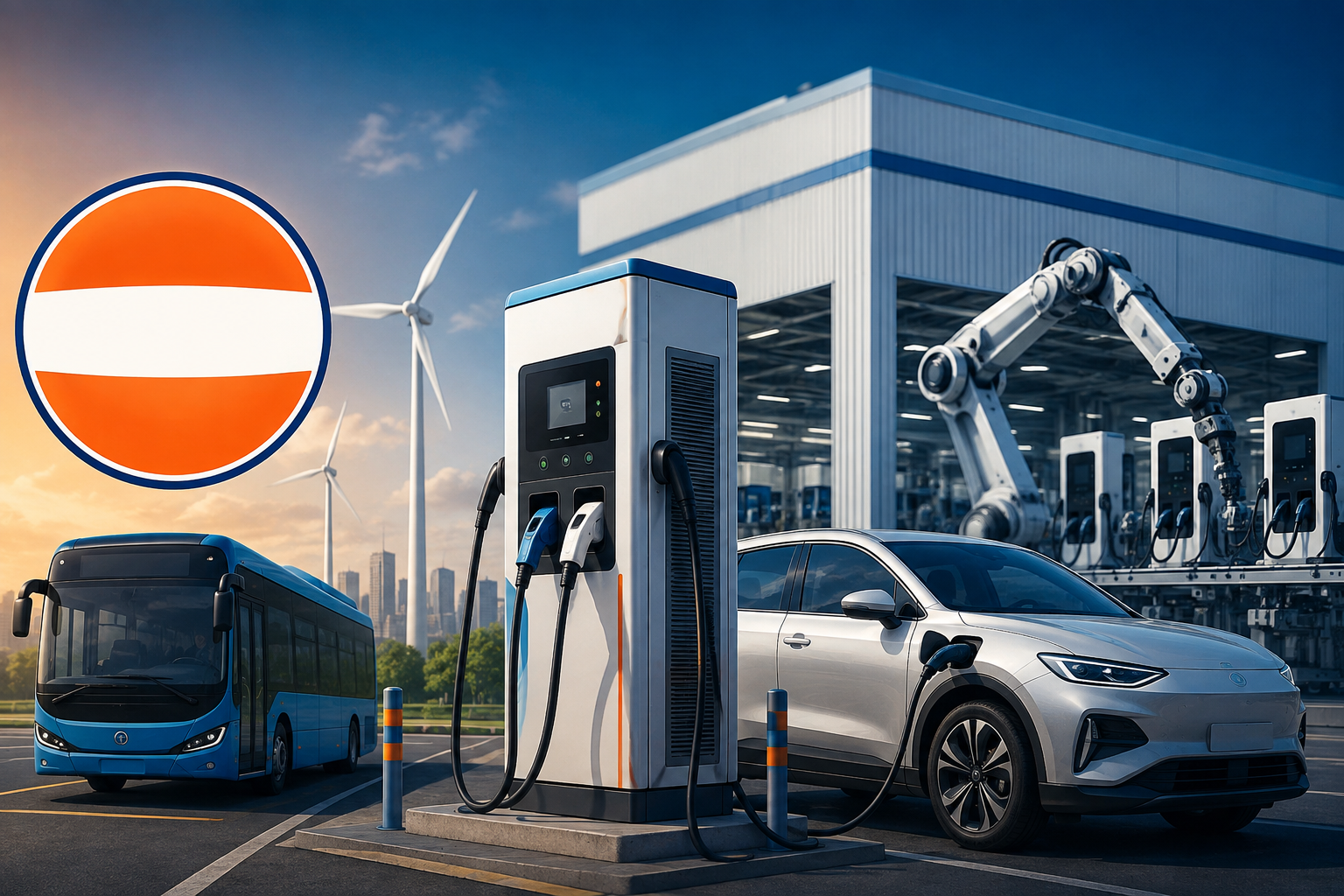
Gulf Oil Lubricants India is set to invest ₹50 crore to expand the manufacturing capacity of its electric vehicle charging business through Tirex Transmission. The move comes as demand for EV charging equipment grows across India, especially from electric bus makers and fleet operators.
Tirex has become an important part of Gulf Oil’s wider plan to build a presence in the electric mobility sector. The company started as a lubricant maker, but it now sees EV infrastructure as a new area for future growth.
The planned investment will help Tirex raise its production capacity for DC fast chargers. The company currently has a strong position in this market and has already supplied more than 3,000 chargers across India.
Tirex plans a major capacity rise
Tirex currently has the ability to make about 1,800 DC fast chargers. With the new investment, this capacity is expected to rise to around 3,000 chargers.
This means the company will add about 1,200 chargers to its annual capacity. The increase will allow Tirex to serve more customers as demand for fast charging grows.
DC fast chargers are important for electric buses, commercial vehicles and EV fleets because they can charge vehicles much faster than basic AC chargers. This makes them useful at bus depots, fleet hubs, highways and other high-use locations.
Gulf Oil believes this part of the EV market has strong long-term potential. The company has therefore chosen to put more money into Tirex rather than treat the business as a small side venture.
Gulf Oil has increased its stake in Tirex
Gulf Oil first acquired a 51% stake in Tirex Transmission in 2023. The initial deal involved an investment of about ₹103 crore.
The company later increased its ownership in Tirex. In FY26, Gulf Oil invested another ₹38 crore and raised its shareholding to 65.18%.
The higher stake shows the importance of Tirex within Gulf Oil’s future mobility plans. The parent company now has greater control over the EV charger business and can support its expansion with capital, business contacts and industry relationships.
Tirex has also moved from a small EV-focused business to a company with a much wider customer base. Its revenue rose from about ₹79 crore in FY25 to more than ₹100 crore in FY26.
Strong position in DC fast chargers
Tirex has built a strong position in India’s DC fast charger market. Gulf Oil has said that Tirex has around 40% of India’s DC fast-charger market.
The company has also supplied chargers to major electric bus customers. According to Gulf Oil, one out of every three electric buses in India is charged with a Tirex charger.
This gives Tirex an important base as electric bus use grows. Buses need large batteries and often travel long distances each day. They therefore need reliable and high-power charging systems.
The electric bus market can create a large opportunity for charger makers. As more public transport systems and private fleet operators shift from diesel buses to electric models, demand for charging equipment should rise as well.
Electric buses are a key growth area
Electric buses are at the centre of Tirex’s expansion plans. These vehicles need powerful chargers that can support regular commercial use.
India has seen a clear rise in electric bus sales. In FY2025-26, electric bus sales reached 5,356 units, which was 37% higher than the previous year.
The growth of electric buses matters because a single bus depot can require several high-power chargers. This creates a larger order size than a typical home charger.
Tirex is already active with bus OEMs and other fleet customers. Its experience in this area can help it win more orders as the market expands.
India’s EV charger market has room to grow
Gulf Oil expects India’s EV charger market to reach about ₹4,000 crore over the next four years.
The company sees a chance for Tirex to capture a meaningful part of this market. Its target is to generate ₹300–400 crore in sales over the next four years.
This target is much higher than Tirex’s current revenue. The planned factory expansion is therefore important because the company will need more production capacity if it wants to reach that level.
The investment also gives Tirex more room to accept larger orders. A company may have strong demand but still lose business if it cannot make and supply products fast enough. Higher capacity can reduce this problem.
Gulf Oil is building a wider EV business
The investment in Tirex is not Gulf Oil’s only move in the EV sector. The company has also invested in other parts of the electric mobility value chain.
Its EV strategy covers fast charging, AC home chargers and EV software. This gives Gulf Oil exposure to several parts of the charging ecosystem instead of relying on just one product.
Tirex focuses mainly on DC fast chargers. Gulf Oil has also invested in Indra Renewable Technologies, a UK-based company that works on AC home chargers. In addition, it has backed Techperspect Software, whose ElectreeFi brand provides EV charging management software.
Together, these investments give Gulf Oil a broader presence in electric mobility.
Why the ₹50 crore investment matters
The new ₹50 crore investment is important for two main reasons. First, it increases Tirex’s ability to make more chargers. Second, it shows that Gulf Oil expects EV charging to become a meaningful part of its business.
For Gulf Oil, the EV sector also offers a way to prepare for changes in the transport market. As more vehicles shift from internal combustion engines to electric power, demand for some traditional products may change over time.
By entering charging infrastructure, Gulf Oil is trying to create another growth business while using its existing relationships with vehicle makers, infrastructure companies and fleet customers.
Local production can support future growth
Tirex still depends on some imported components, including parts sourced from China. As the business grows, local production and supply chain development could become more important.
A stronger local supply chain could help the company reduce dependence on overseas suppliers and improve control over costs and delivery times.
The new capacity can also support product development. Tirex offers chargers across different power levels, with its DC fast charger range covering 30kW to 360kW.
Such a range allows the company to serve different customers, from smaller commercial fleets to large electric bus operations.
What comes next for Tirex
The next phase will be important for Tirex. Higher production capacity alone will not guarantee higher profits. The company will need to secure new orders, manage costs and maintain product quality as output rises.
Its recent financial growth gives Gulf Oil a strong reason to remain positive. Tirex reported over 300% revenue growth in FY25, when revenue reached about ₹79 crore. In FY26, its revenue crossed ₹100 crore.
The company also reported strong growth in FY26. Its Q3 revenue rose 83%, while the business delivered positive EBITDA.
These numbers suggest that Tirex is moving beyond its early growth stage and building a more established business.
A bigger role for EVs at Gulf Oil
The ₹50 crore investment marks another step in Gulf Oil’s shift toward mobility and EV infrastructure. Tirex already has a strong base in DC fast chargers, a large customer network and a sizeable installed base.
The planned capacity rise from 1,800 to 3,000 DC fast chargers can help the company meet future demand. At the same time, Gulf Oil’s increased ownership gives it more control over the direction of the business.
The bigger question will be whether Tirex can turn its strong market position into sustained revenue and profit growth. If electric buses, commercial EVs and charging networks continue to expand at a healthy pace, the company could become a much larger part of Gulf Oil’s overall growth story.
For now, the ₹50 crore investment shows that Gulf Oil is serious about EV infrastructure. Tirex is no longer just a small addition to its business. It is becoming one of the company’s key bets for the future.
ALSO READ: India 10-Year Bond Yield Rises to 6.8523%: What It Means