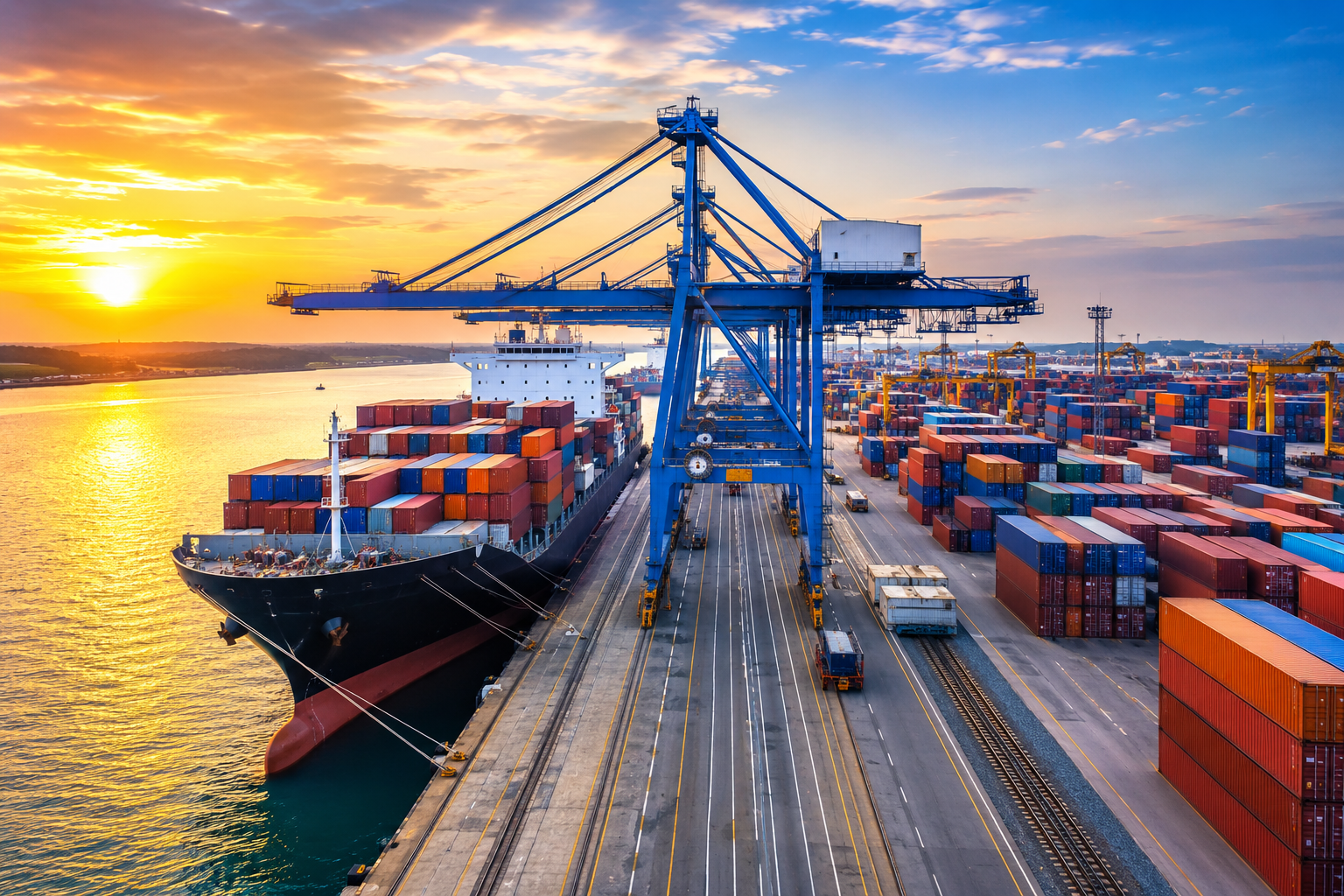
Gujarat Pipavav Port has received a major boost after the Gujarat government agreed in principle to roll over the concession for Pipavav Port. The move is important because the current concession agreement of Gujarat Pipavav Port Limited, or GPPL, is valid only until September 2028. The proposed extension gives the company greater confidence about the future of the port and can help it move ahead with a large expansion plan.
The development is also important for the wider private port sector in Gujarat. The state government is said to have agreed to roll over the concessions of four major private ports: Mundra, Pipavav, Hazira and Dahej. The move can give private port operators more certainty and support fresh investment in port infrastructure.
However, the approval should not yet be seen as the final completion of the renewal process. The Gujarat government has not made the exact duration and commercial terms of the extension public. These details will be important for GPPL and its investors.
Why the concession matters
A port needs a long operating period to recover the money spent on land, berths, cranes, storage areas, rail links and other facilities. GPPL has operated Pipavav Port in Saurashtra, Gujarat, since 1998. The company has exclusive rights to develop and operate its facilities at Pipavav under the concession agreement with the Gujarat Maritime Board and the Government of Gujarat.
The present agreement ends in September 2028. That date had become an important issue for the company because large new investments make more sense when the operator has a long period to use the upgraded facilities.
In October 2025, GPPL signed a non-binding Memorandum of Understanding with the Gujarat Maritime Board for future investment of Rs. 17,000 crore at Pipavav Port. The plan was subject to a long-term extension of the current concession.
The latest government decision can therefore remove a major uncertainty around this proposed investment.
Rs. 17,000 crore expansion plan
The proposed Rs. 17,000 crore investment is one of the biggest reasons why the concession extension matters so much.
GPPL plans to use the proposed investment to improve several parts of Pipavav Port. The plan covers higher capacity for containers, liquid cargo and RoRo operations. RoRo means roll-on, roll-off cargo, such as cars and other vehicles that can move directly on and off a ship.
The company also plans to expand storage and rail siding capacity. It wants to add specialised equipment, create a deeper waterfront and improve the connection between ocean, rail and road transport.
These changes can help Pipavav serve more cargo and offer better transport links to the northwest region of India. The port has a useful location on an international trade route that connects India with markets in the US, Europe, Africa and the Middle East on one side and the Far East on the other.
The investment is not an immediate Rs. 17,000 crore cash spend. It is a long-term plan linked to the concession extension. The final pace and structure of the investment will depend on the terms of the renewed concession and the company’s future plans.
Strong business performance
GPPL enters this period with a strong financial position.
According to CRISIL’s August 10, 2026 rating report, GPPL’s revenue rose 17% in fiscal 2026 to Rs. 1,158 crore from Rs. 992 crore in fiscal 2025. Profit after tax rose to Rs. 500 crore from Rs. 394 crore. The company remained debt free as of March 31, 2026.
The company also had about Rs. 680 crore of cash as of March 31, 2026. CRISIL said the company had strong financial risk metrics, with interest coverage at about 114 times in fiscal 2026.
This financial strength gives GPPL a useful base as it prepares for the next stage of growth.
The port handles four main types of cargo: containers, dry bulk, liquid bulk and RoRo. Its diverse cargo mix helps reduce dependence on one single business area.
RoRo has become an important growth area
Vehicle exports have become a strong part of GPPL’s business.
In fiscal 2026, the port handled 229,433 car export units. This was up from 164,977 units in the previous financial year, a rise of more than 39%. The growth came from strong vehicle exports by automobile makers.
GPPL has also signed an MoU with NYK India to improve its RoRo infrastructure. The planned facilities can handle up to 500,000 cars per year.
This area could become more important as India’s automobile export market grows. Better RoRo facilities can allow the port to handle higher vehicle volumes and strengthen its position in the vehicle export trade.
Liquid cargo capacity is also set to rise
GPPL is already spending on a new liquid berth.
The company has planned about Rs. 750–800 crore of expenditure to raise liquid cargo capacity from about 2 million tonnes to 5 million tonnes. CRISIL said this work is funded through internal accruals and existing cash, with no planned debt addition.
The new liquid berth is expected to raise total liquid cargo handling capacity to about 5.2 million tonnes once it becomes operational. Capital dredging has been completed and civil work is in progress, with commissioning expected by December 2026.
Liquid cargo volumes also showed healthy growth. In fiscal 2026, liquid cargo volume rose 8% to 1.59 million tonnes from 1.46 million tonnes. The increase was mainly due to higher LPG volume.
Dry bulk and container business
Dry bulk has also shown strong growth. GPPL’s dry bulk volume rose 31% from 2.21 million tonnes to 2.90 million tonnes in fiscal 2026. Strong fertiliser demand was a key reason for the rise.
Coal handling, however, remains suspended at the port due to operational reasons. The company is working on ways to identify safe and efficient coal handling measures.
Container volume was weaker in fiscal 2026, with a decline of about 4%. This shows why the proposed expansion of container facilities matters. GPPL has stated that it needs to upgrade its container handling infrastructure to improve its product offering to shipping lines.
What the extension means for investors
For investors, the biggest benefit is better long-term visibility.
Without a concession extension, GPPL would have faced a much shorter period to recover major new investments before September 2028. That would have made a large expansion harder to justify.
A long extension can change that picture. It can give the company more time to invest, raise capacity and earn returns from the new facilities. It can also make the port more attractive as a long-term infrastructure asset.
The market will now focus on two key details: the length of the extension and the royalty or other financial terms attached to it.
Earlier analysis had considered a possible 20-year extension, but that was an assumption rather than a confirmed government decision. The final duration has not yet been made public.
The next step is the final agreement
The latest development is clearly positive, but investors should wait for the formal concession agreement and its complete terms.
GPPL’s management had earlier said that the timing depended on the Gujarat Maritime Board and the Gujarat government. The company had also said that it would disclose the details once the process reached a close.
This means the latest government decision is best viewed as a major step toward a long-term renewal rather than the final legal completion of the process.
Once the final agreement is signed, the company should have much better clarity on its future investment plan.
A new phase for Pipavav Port
The concession issue has been one of the biggest questions around Gujarat Pipavav Port. The current agreement ends in September 2028, while the company has a proposed Rs. 17,000 crore investment plan that depends on a long-term extension.
The Gujarat government’s decision to roll over the Pipavav concession can therefore mark the start of a new phase for the port. GPPL already has a strong financial base, a debt-free balance sheet, rising RoRo volumes and planned growth in liquid cargo capacity.
The next few steps will be important. The final concession period, royalty structure and investment schedule will show how much value the extension can create.
If the final terms support a long concession and allow the planned expansion to move ahead, Pipavav Port could gain a stronger position in India’s private port sector. For GPPL, the decision provides something the company has needed for a long time: greater clarity about the future of its core asset.
ALSO READ: Zerodha, Angel One Get SEBI Nod for Corporate Bonds