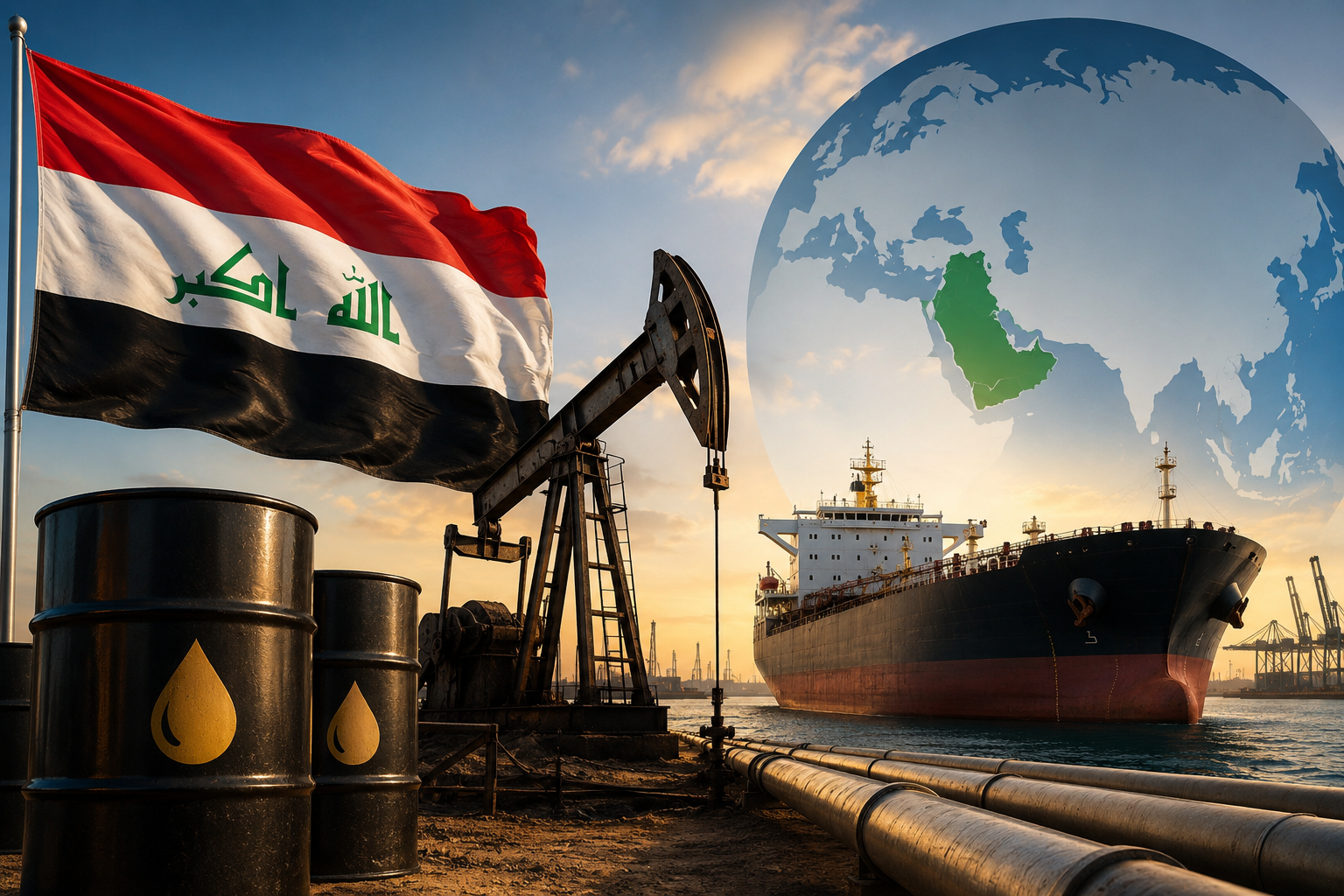
Iraq saw a major rise in its oil exports in August, with the country selling about 73 million barrels of crude during the month. The sales brought in around $4.5 billion in revenue, according to Iraq’s state oil marketer SOMO.
The August figures show a clear recovery after a sharp fall in oil exports in July. Iraq had faced serious problems with oil transport and access to key shipping routes. These problems had cut the amount of crude that could reach foreign buyers.
The rise in August is important for Iraq because oil is the main source of money for the country. A large share of the government budget depends on crude oil sales. Any major change in export volumes can therefore have a direct effect on public finances.
The latest figures show that Iraq found ways to send more crude to international buyers, even as the wider oil market faced major transport and security problems.
Daily Exports Rise Sharply
Iraq’s total August exports of about 73 million barrels equal an average of around 2.34 million barrels per day.
That was a major rise from July, when exports stood at about 1.35 million barrels per day. The August rate was therefore about 73% higher than the July level.
The change was especially important because July was a very weak month for Iraq’s oil trade. Lower export volumes meant less crude reached overseas markets, which also put pressure on state income.
August brought a much better result. However, the country was still far from its usual export level before the conflict and major shipping problems.
Before the recent disruption, Iraq exported more than 3.3 million barrels per day. Compared with that level, the August figure of about 2.34 million barrels per day still shows a large gap.
This means Iraq has recovered part of its lost oil trade, but its exports have not yet returned to normal.
Lower Prices Helped Iraq Find Buyers
One of the main reasons for the rise was the price offered by Iraq for its Basrah crude.
Iraq gave buyers discounts of about $25 to $30 per barrel. These were very large discounts, but they made Iraqi oil more attractive to companies that wanted cheaper crude.
For buyers, the lower price helped offset some of the extra costs and risks linked to oil transport. This gave Iraqi crude a better chance to reach the market despite difficult conditions.
For Iraq, however, there was a clear cost. Higher export volumes do not always mean higher profits. If crude sells at a much lower price, the country may earn less money per barrel.
This is an important part of the August story. Iraq managed to raise the amount of oil it sold, but it had to accept much lower prices to do so.
The Strait of Hormuz Was a Major Challenge
Oil transport faced another major problem because of the situation around the Strait of Hormuz.
The Strait is one of the most important oil shipping routes in the world. A large amount of crude from the Middle East passes through this narrow waterway before it reaches buyers in Asia and other markets.
Iraq faced limits on the movement of some oil tankers through the area. To keep exports alive, the country had to use different methods and routes.
Iran gave permission for some Iraqi tankers to pass through the Strait of Hormuz. This helped Iraq move more crude to foreign customers.
Iraq also used ship-to-ship transfers near Oman. In this method, oil moves from one vessel to another at sea. Such methods can help companies deal with difficult shipping conditions and keep supplies moving when normal routes face problems.
These steps helped Iraq raise its August export volume.
Why the August Figure Matters
The 73 million barrels sold in August are important for more than one reason.
First, they show that Iraq was able to recover from the very low export rate seen in July. A daily rate of 2.34 million barrels is much closer to normal than the 1.35 million barrels per day seen a month earlier.
Second, the $4.5 billion in revenue gives Iraq an important source of cash at a time when its oil trade has faced serious pressure.
Third, the figures show how strongly global oil trade can react to changes in shipping access and crude prices. Iraq has large oil reserves and strong production capacity, but it still needs safe and reliable routes to sell that oil abroad.
The country cannot earn full value from its crude if it cannot move enough barrels to international customers.
Iraq Still Faces a Large Gap
Despite the strong August recovery, the latest numbers should not be seen as a full return to normal.
Iraq’s August export rate of about 2.34 million barrels per day was still well below its pre-conflict level of more than 3.3 million barrels per day.
That gap is important. It means Iraq was still unable to sell the same amount of crude that it could before the major disruption.
The country also had to offer discounts of $25 to $30 per barrel. Such discounts may help protect export volumes, but they can reduce the value of each barrel sold.
This creates a difficult choice for Iraq. It can accept lower prices to keep oil moving, or it can seek better prices but risk lower sales if buyers face higher costs and greater transport risks.
For a country that depends heavily on oil income, neither option is easy.
What It Means for Iraq’s Economy
Oil plays a central role in Iraq’s economy. Government income depends heavily on crude sales, which means export problems can create pressure on public spending.
A rise from 1.35 million barrels per day in July to about 2.34 million barrels per day in August gives the country some relief.
The $4.5 billion in August revenue also provides important income for the state. But the lower price received for Iraqi crude means the financial benefit may not match what the higher volume alone would suggest.
Iraq will need stable export routes and better market prices if it wants a full recovery.
The country also needs to watch the wider security situation. Any fresh problem around major shipping routes could once again affect the flow of crude.
A Partial Recovery, Not a Full Return
Iraq’s August oil figures tell a story of recovery under difficult conditions.
The country exported about 73 million barrels and earned around $4.5 billion. Its average export rate rose to about 2.34 million barrels per day, compared with about 1.35 million barrels per day in July.
That rise of roughly 73% in one month is a major improvement.
Still, Iraq remains below its pre-conflict export rate of more than 3.3 million barrels per day. The country also had to offer deep discounts of $25 to $30 per barrel to attract buyers.
The August result therefore shows both strength and weakness. Iraq proved that it could restore a large part of its oil trade despite major transport problems. At the same time, the need for steep discounts and alternative shipping methods shows that the situation remains fragile.
For now, the 73 million barrels sold in August give Iraq a much-needed boost. The bigger question is whether the country can keep export volumes near this level, improve the price it receives, and return to its normal oil trade as shipping conditions become more stable.