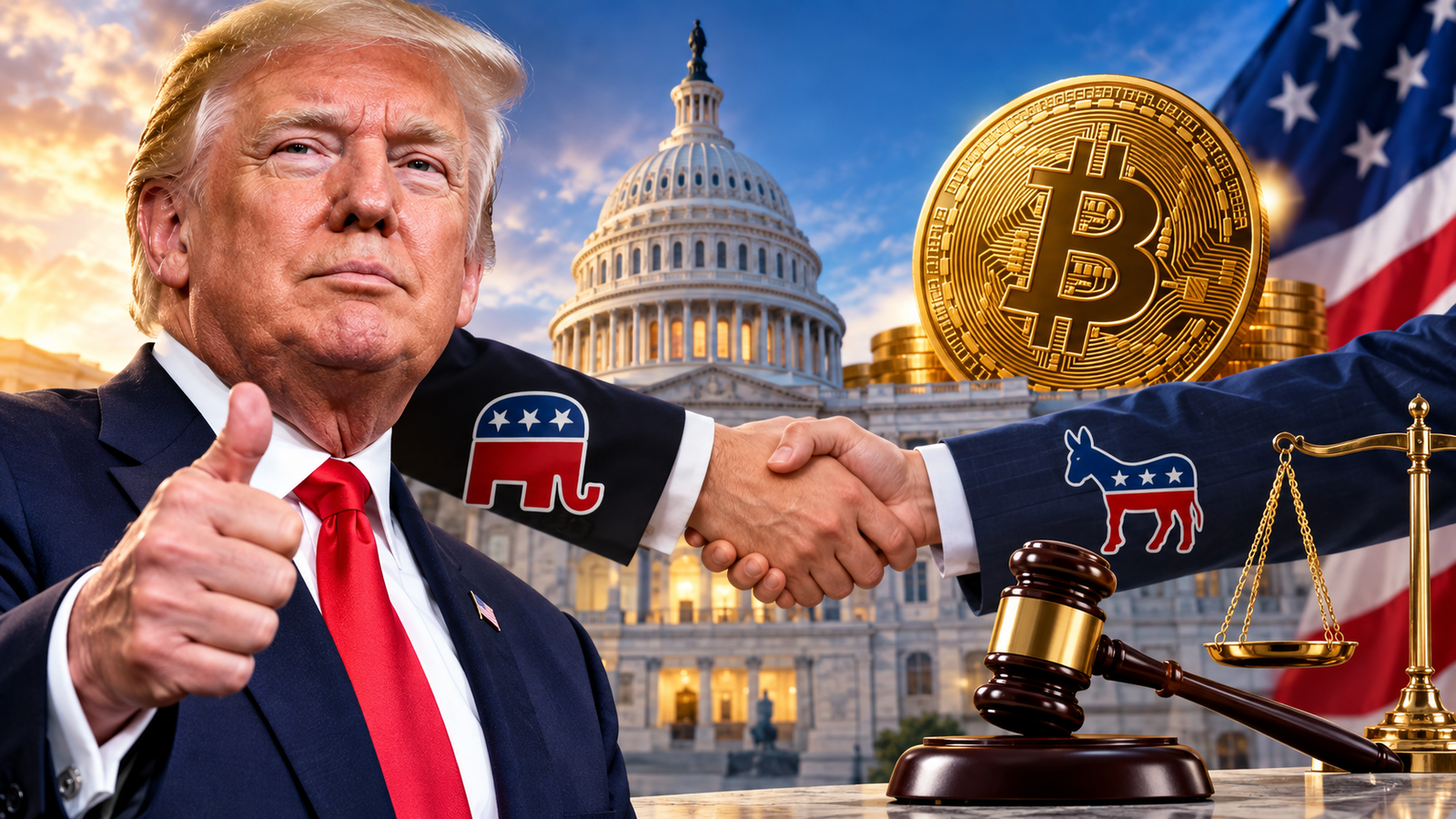
President Donald Trump has agreed to most of a bipartisan ethics proposal tied to a major US cryptocurrency bill. The move comes just one day before the Senate is set to hold a crucial vote on the broader legislation.
The bill, known as the CLARITY Act, seeks to create a clear legal framework for digital assets in the United States. It would set rules for crypto companies and define which parts of the market should fall under the authority of the Securities and Exchange Commission and the Commodity Futures Trading Commission.
The ethics issue has become one of the biggest barriers to the bill. Democrats have argued that the earlier version did not do enough to prevent possible conflicts of interest for Trump and other senior officials who have links to the crypto sector.
Trump has now accepted about 80% of a proposal from Republican Senator Thom Tillis and Democratic Senator Ruben Gallego, according to a senior Republican aide. The agreement includes a larger role for state attorneys general in enforcement.
The change could help the bill gain support from Democrats who had refused to back the measure without stronger ethics rules.
Why the Ethics Issue Matters
The dispute is closely tied to Trump’s personal crypto interests. Democrats have raised concerns about the president’s crypto wealth and business links during talks on the bill.
The first ethics provision in the bill was much narrower. It would stop federally elected officials and their spouses, as well as federal judges, from issuing digital assets.
Democrats and Senator Tillis said that this did not go far enough. Their concern was not only about the creation of new digital assets. They also wanted stronger rules for officials who already hold major crypto interests.
That demand became a major issue because Trump has supported the crypto sector while also having financial interests linked to the industry.
For Democrats, the question is simple: government officials should not be able to use public power in a way that could benefit their own crypto businesses or investments.
For Republicans who support the bill, the challenge has been to address that concern without creating rules that could later be used for political attacks against either party.
State Attorneys General Get a Bigger Role
One of the most important parts of the new deal is the role of state attorneys general.
Under the earlier version, the Justice Department would have been the main body responsible for enforcement of the ethics rules. Democrats wanted state attorneys general to have authority as well.
Trump has now agreed to that part of the proposal.
The change would allow state attorneys general to take action if a crypto exchange lists a digital asset that the final law bans. They would also have a role in enforcing the restrictions that apply to public officials.
This is important because it creates another level of oversight outside the federal government.
However, the idea had faced opposition inside the White House. Officials had raised concerns that state attorneys general from either party could use the power for political reasons.
Democratic state attorneys general could target Republican officials, while Republican state attorneys general could use the same authority against Democrats.
Despite those concerns, the White House agreed to the major part of the proposal as Republicans sought enough support to move the bill ahead.
Divestment and Blind Trust Rules
The new ethics deal also addresses a major concern about officials who already hold crypto interests.
The updated bill is set to require officials to either sell significant financial interests in an entity that issues cryptocurrencies or place those interests into a blind trust.
A blind trust is a financial arrangement where the person who owns the assets does not control the day-to-day decisions about those assets.
The purpose is to reduce the chance that an official could make a government decision while also knowing that the decision could affect their personal wealth.
This part of the deal could prove important for Democrats who have argued that a simple ban on new crypto issuance would not solve the wider conflict-of-interest problem.
The proposal therefore goes beyond the original restriction and looks at existing financial interests as well.
The Senate Vote Comes on September 15
The timing of Trump’s decision is critical.
The Senate is set to hold a procedural vote on the CLARITY Act on Tuesday, September 15. The vote is not the final passage of the bill. Instead, it is a key step that could allow the legislation to move forward.
The bill needs 60 votes to clear the Senate’s procedural hurdle. That means Republicans cannot rely only on their own members. Democratic support is necessary.
This has made the ethics talks especially important.
Before Trump’s latest decision, several Democrats had warned that they could not support the bill without stronger ethics rules. Senator Gallego had also said that a deal on ethics was necessary if lawmakers wanted to reach the 60-vote mark.
The new agreement could therefore remove one of the biggest reasons for Democratic opposition.
It does not, however, solve every problem around the bill.
Other Issues Still Remain
The CLARITY Act has faced concerns beyond ethics.
Democrats have raised questions about anti-money-laundering rules and whether the bill does enough to stop illegal activity through digital assets.
There are also disputes over stablecoin rewards and other parts of the crypto market.
Some Republicans have raised concerns as well. They worry that certain digital assets could compete with traditional bank deposits and affect the ability of banks to provide loans.
The banking sector has pushed lawmakers to make changes to parts of the bill, especially rules related to stablecoins. The crypto industry, on the other hand, says the United States needs clear rules so companies can operate without constant uncertainty.
The Senate Banking Committee advanced the CLARITY Act in May by a 15-9 vote. Yet the wider Senate debate has proved much harder because the bill needs support from lawmakers with very different views on crypto.
Why the Crypto Industry Wants the Bill
Crypto companies see the CLARITY Act as a major step toward legal certainty.
For years, the US crypto sector has faced questions about which digital assets count as securities and which fall under commodity rules. The industry has also argued that unclear regulation could push companies, jobs and investment outside the United States.
The bill would give the SEC and CFTC clearer roles over different parts of the digital asset market.
Crypto groups have spent large sums on lobbying efforts ahead of the vote. Reuters reported that crypto interests had spent at least $190 million on political efforts tied to the broader fight.
The industry sees the current moment as important because the November midterm elections could change the balance of power in Congress.
A failure to pass the bill this year could make the next attempt much harder.
Why Democrats Still Have Concerns
The new ethics deal may help, but Democrats still have reasons to remain cautious.
The final text matters more than public statements from lawmakers. Democrats want rules that apply for the long term and do not create a short window of restrictions.
Earlier versions of the ethics provision included a sunset date. That rule would have ended the restrictions at noon on January 20, 2029.
That drew criticism from Democrats, who wanted a lasting standard that would apply to future presidents and other officials as well.
The latest agreement appears to address several of their demands, but lawmakers will still need to examine the exact language before they decide whether to support the bill.
A Major Test for Trump’s Crypto Policy
Trump’s decision marks an important shift in the crypto debate.
The president has strongly supported the digital asset industry and has made crypto a major part of his economic and political agenda. At the same time, his own crypto interests have made ethics a central issue in negotiations over the bill.
By accepting most of the Tillis-Gallego proposal, Trump has shown a willingness to accept stronger limits in order to help the larger legislation move ahead.
Republican Senators Cynthia Lummis, Tim Scott and John Boozman said the agreement gives state attorneys general a meaningful role in enforcement. White House crypto adviser Patrick Witt also urged lawmakers from both parties to move the bill forward after more than a year of talks.
What Happens Next
The immediate test comes on September 15.
If the Senate reaches the required 60 votes, the CLARITY Act can move deeper into the legislative process. That would not mean the bill has become law. More debate, votes and possible changes would still follow.
If lawmakers fail to reach the threshold, the future of the bill becomes far less certain.
For now, Trump’s agreement gives the legislation a fresh chance.
The ethics dispute had threatened to stop the bill before it could reach the main Senate vote. The new compromise could give Democrats enough reason to stay at the table while also keeping Republican support for a major crypto reform.
The result of Tuesday’s vote will show whether the compromise was enough.
For the crypto industry, the stakes are high. For Trump, the vote is also a test of whether his crypto policy can survive concerns about personal financial interests. And for Congress, the debate is a test of whether Democrats and Republicans can agree on basic rules for one of the fastest-growing parts of the financial system.
After more than a year of talks, the CLARITY Act is now closer to a decisive moment.
ALSO READ: Treasury Yields Near 5% as Oil Shock Raises Inflation Risk