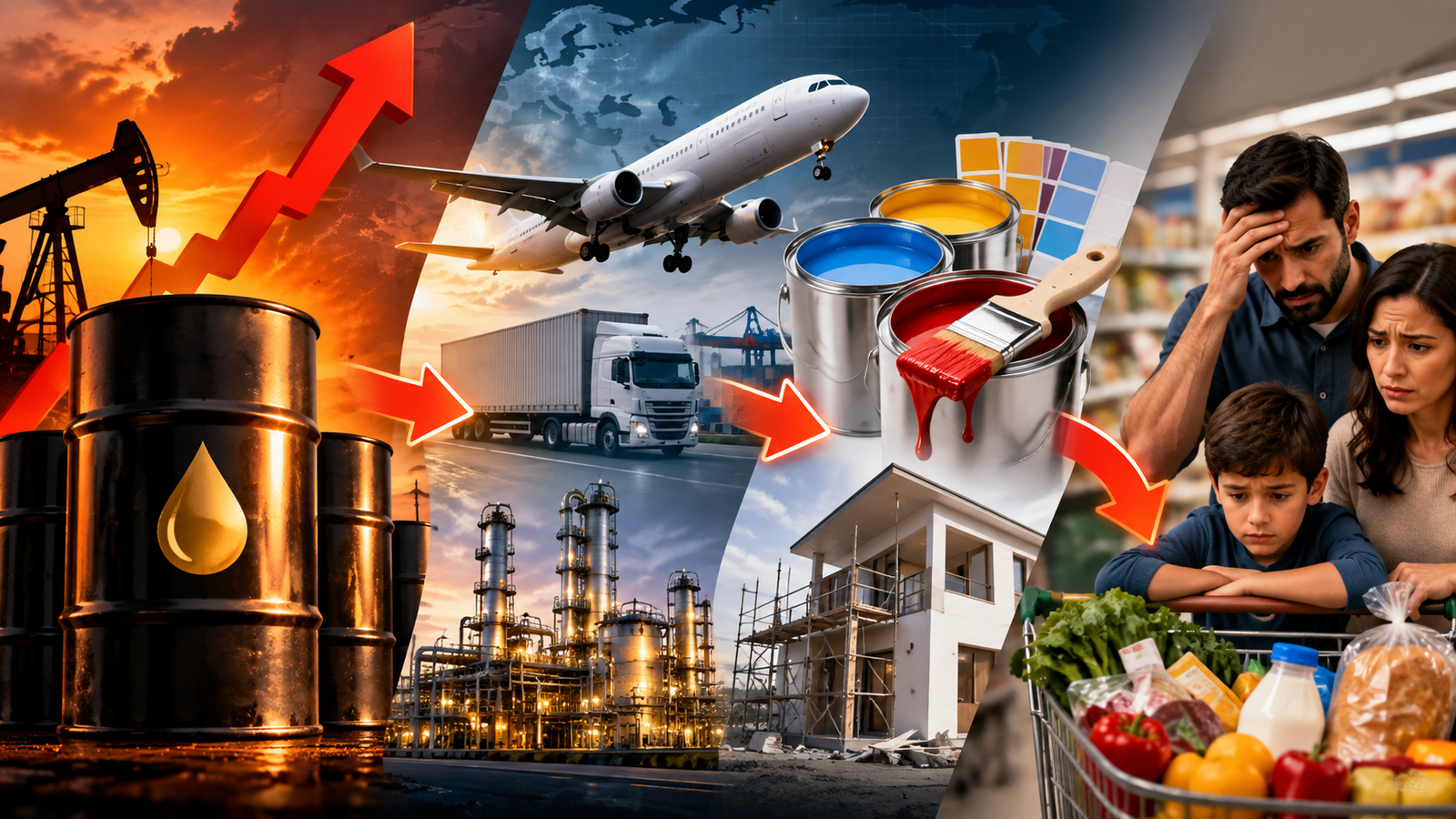
When oil prices rise sharply, the first concern is usually fuel. Airlines face higher jet fuel costs, drivers pay more at petrol pumps, and transport companies face higher diesel bills. But the effect does not stop there.
A sustained oil shock can move through several parts of the economy. It can first hurt airlines, then raise the cost of chemicals, paints, packaging and transport. After that, higher prices can reduce the amount of money households have left for non-essential purchases.
This creates a chain that can look simple at first but become much larger over time.
The broad path is clear: higher crude prices lead to higher fuel and petrochemical costs, which raise company costs, push up prices, reduce real household income and finally weaken consumer demand.
Airlines Face the First Hit
Airlines are among the first businesses to feel the effect of higher crude prices. Jet fuel is a major cost for carriers, so a sharp rise in oil can quickly raise the cost of each flight.
Recent data show how large this move can be. Crude moved into the $95–115 per barrel range after it briefly crossed $120–125 per barrel. At the same time, global jet fuel prices rose much faster and reached an average of $188 per barrel in April.
Airlines have only a few ways to deal with such a shock. They can raise ticket prices, cut flights or accept lower profits. Strong airlines may use all three options, based on the route and the level of demand.
This can create an unusual situation. Ticket prices may rise while airline profits still fall. The reason is simple. A higher fare does not always cover the full rise in fuel and other costs.
Smaller and weaker airlines face even more pressure. Carriers with less financial strength or weak fuel protection can struggle when oil stays high for a long period.
Recent market events show this risk. Ryanair has cut some winter flights and warned that fares could rise sharply if oil stays high into 2027. JetBlue has also raised its fuel cost assumptions and cut its capacity growth outlook.
Higher Airfares Affect More Than Airlines
A rise in airfares does not hurt only the airline sector. It can also affect the wider travel economy.
When flights become more expensive, some people delay holidays. Some companies reduce business travel. Fewer flights can also affect hotels, restaurants, airports and other travel-related businesses.
There is another side to this. If airlines cut capacity, the number of available seats falls. This can give the airlines that remain more control over prices. Airfares can rise even more.
So the first second-order effect is already clear. An oil shock can move from the airline balance sheet to the wider travel sector and then into household spending.
The Petrochemical Link Is Less Visible
The next part of the story is less obvious but very important.
Oil is not only used to make petrol, diesel and jet fuel. It also forms part of the raw material chain for many chemicals and industrial products.
One important route is crude oil to naphtha to petrochemicals to solvents, resins and polymers.
These materials are used in many everyday products. Paints and coatings are a good example.
When crude rises, the cost of some petrochemical inputs can also rise. That can put pressure on paint companies through higher resin, solvent, packaging and transport costs.
Indian market analysis has already pointed to solvents and resins as key pressure areas for paint companies when crude prices rise.
Paint Companies Face a Two-Sided Problem
Paint companies have a difficult choice when raw material costs rise.
They can raise prices and try to protect their margins. But customers may not accept the full increase. Dealers, contractors and homeowners can resist higher prices, especially when the wider economy is already under pressure.
If a paint company raises prices quickly and demand stays stable, the company can protect its gross margin.
But if customers reduce purchases after a price increase, the company can lose volume.
There is an even worse outcome. If the company cannot raise prices fast enough, higher resin, solvent and transport costs can reduce its margins before any price rise reaches the customer.
This makes paints different from a simple commodity business. The real question is not just how much oil costs. It is how much of that higher cost the company can pass on without losing demand.
The Construction Link Makes It Bigger
Paints also have a strong connection with construction, housing and renovation.
A new house needs paint. An office may need fresh paint. A hotel may need a new coat before a new season. A homeowner may want to repaint a room.
But many of these purchases can wait.
If household costs rise, a family can delay a home renovation for a few months. A property owner can postpone an upgrade. A business can delay a non-essential refurbishment.
This means paint companies can face pressure from both sides.
On one side, their raw material and transport costs rise. On the other, customers may delay purchases.
That combination can be much more damaging than a simple increase in input costs.
Oil Finally Reaches the Consumer
The most important part of the chain comes when higher oil prices start to affect household budgets.
Consumers do not see crude oil prices directly. They see the result at petrol pumps, on airline booking pages and in the prices of goods they buy every day.
Higher fuel costs can raise transport costs. Higher transport costs can raise food and delivery costs. Petrochemical costs can raise the cost of plastics, packaging, chemicals and household products.
The household therefore faces a broad rise in expenses.
At the same time, salaries do not always rise at the same speed. This means real disposable income falls.
In simple terms, people may earn the same amount of money but have less left after they pay for essential items.
Consumers Start to Change Their Choices
When money becomes tight, households usually protect essential spending first.
Food, utilities, healthcare and basic transport tend to receive priority. Other purchases can wait.
This is where an oil shock can hurt companies that have little direct connection with crude.
A family may delay a holiday. It may eat out less often. It may postpone the purchase of a car, television, furniture or new electronics. It may also delay a home renovation.
The same pattern can affect businesses. Companies may reduce travel, delay office upgrades or cut non-essential expenses.
As more households and companies make these choices, consumer demand becomes weaker.
The Margin Problem Can Become a Demand Problem
The biggest risk is the change from cost pressure to demand pressure.
At first, a company may only face higher costs. It may respond with a price increase.
But if many companies do the same thing, inflation rises across the economy. Consumers then have less real income.
That weaker demand can reduce sales volumes. Lower volumes can hurt fixed-cost absorption and put more pressure on profits.
The chain then becomes larger: oil prices rise, company costs rise, product prices rise, real income falls, demand weakens and company margins come under further pressure.
This is why the second-order impact of oil matters more than the first headline effect.
Who Is Most Vulnerable?
The most exposed companies are not simply those that use the most oil. The bigger risk lies with companies that have both high cost exposure and weak pricing power.
Airlines face direct jet fuel exposure. Chemical companies face feedstock pressure. Tyre makers can face higher costs for synthetic rubber and carbon black. Paint companies face higher resin, solvent and transport costs.
Consumer discretionary businesses face another type of risk. They may not have a large direct oil bill, but their customers have less money left to spend.
The strongest companies have better protection. Businesses with strong brands, low energy use, low petrochemical exposure and good pricing power may pass higher costs to customers with less damage to volume.
The Real Question for Investors
The key question is not simply, “Which companies are exposed to oil?”
A better question is, “Who absorbs the oil shock, and who can pass it on?”
If oil rises, a company raises prices and volume stays stable, it has strong pricing power.
If oil rises, prices rise but sales volume falls, the company has a demand problem.
If oil rises and the company cannot raise prices, it has a margin problem.
The most dangerous case comes when both happen at once: margins fall and volumes fall.
That is where an oil shock can become a much wider economic problem.
From Oil to the Whole Economy
The full effect of high oil prices is therefore much wider than higher fuel bills.
The shock can start with airlines and jet fuel. It can then move into freight, chemicals, resins, solvents and paints. Higher costs can push product prices higher. That can reduce household purchasing power. Consumers then cut or delay discretionary purchases.
The final impact can reach industries that have very little direct contact with crude oil.
This is the real second-order story. Oil does not need to remain a fuel story. If prices stay high for long enough, the shock can turn into an inflation story, a margin story and finally a consumer demand story.
ALSO READ: Grey-Market Premium Is Zero: What It Really Means