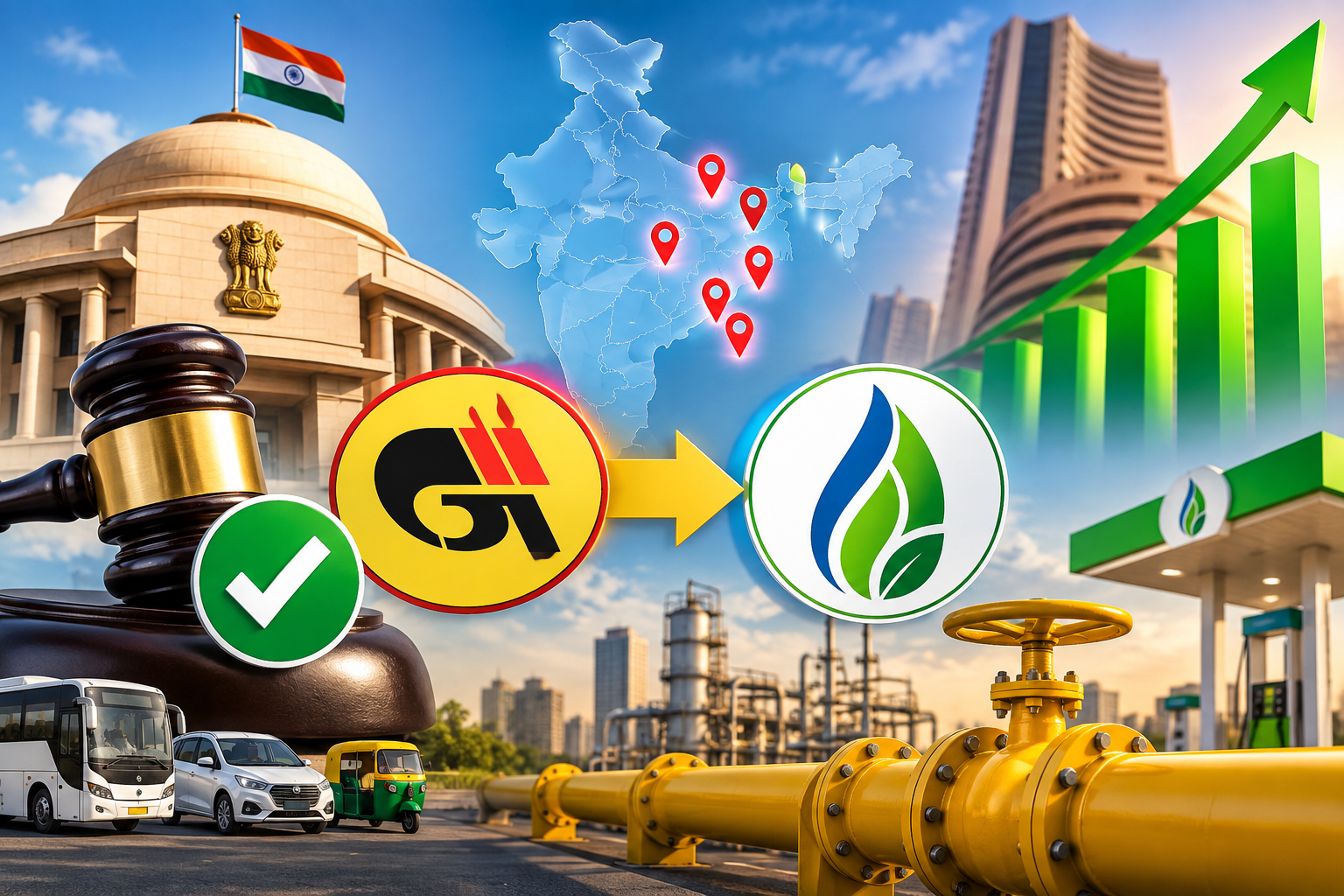
The Petroleum and Natural Gas Regulatory Board (PNGRB) has approved the transfer of six City Gas Distribution (CGD) geographical areas from GAIL (India) Ltd to its wholly owned subsidiary, GAIL Gas Ltd. The approval is an important regulatory step as GAIL India prepares to place a larger CGD business under GAIL Gas ahead of a proposed public issue.
The proposed GAIL Gas IPO has a reported size of ₹3,000 crore. The company has also been linked with a potential listing by the end of FY27. At this stage, the ₹3,000 crore figure should be treated as the reported proposed IPO size and not as the valuation of GAIL Gas.
The regulatory approval itself does not mean that the IPO has received final approval, that the issue size is final, or that investors will receive shares at any particular valuation. Those details will depend on later regulatory filings, the proposed offer structure and the final terms of the issue.
Six CGD areas will move to GAIL Gas
The six geographical areas covered by the transfer are Varanasi, Patna, Ranchi, East Singhbhum (Jamshedpur), Cuttack and Khordha (Bhubaneswar).
The transfer would place these CGD operations under GAIL Gas rather than GAIL India. This is relevant because GAIL Gas already operates CGD projects across 16 geographical areas. The addition of six more areas would therefore increase the scale of the business that could sit within the subsidiary before a potential IPO.
| Particular | Reported detail |
|---|---|
| Regulatory authority | PNGRB |
| Parent company | GAIL (India) Ltd |
| Subsidiary | GAIL Gas Ltd |
| Areas proposed for transfer | 6 |
| Existing GAIL Gas CGD presence | 16 geographical areas |
| Reported IPO size | ₹3,000 crore |
| Reported potential listing period | End of FY27 |
| Ownership before IPO | GAIL Gas is a wholly owned subsidiary of GAIL India |
The six areas include several major urban and industrial markets. Varanasi, Patna, Ranchi, Jamshedpur, Cuttack and Bhubaneswar are part of regions where demand for natural gas can arise from households, transport users, commercial customers and industrial consumers. However, the future financial contribution from each area cannot be determined only from its location or population. Actual results will depend on factors such as gas demand, network reach, customer additions, tariffs, gas prices, capital expenditure and operating costs.
Why the transfer matters before the IPO
The main significance of the transaction lies in the structure of GAIL Gas. GAIL India is a large integrated natural gas company with activities across transmission, gas marketing and other parts of the energy value chain. Its CGD operations can form only one part of the wider business.
A separate GAIL Gas entity could allow the CGD business to be presented to public-market investors as a more focused business. The transfer of the six areas would make the subsidiary larger before its proposed IPO.
This does not by itself establish that the transfer will increase shareholder value. The effect on value will depend on the terms of the transfer, the financial performance of the assets, the amount of capital required for their development and the valuation that public-market investors assign to GAIL Gas.
The structure can, however, make it easier for investors to assess the CGD business on a standalone basis. This could provide greater visibility into revenue, margins, capital expenditure and cash generation at the subsidiary level.
GAIL Gas already has a sizeable business
GAIL Gas reported turnover of about ₹12,681 crore in FY26, compared with ₹12,229 crore in FY25. This represents an increase in reported turnover of about ₹452 crore, or roughly 3.7%.
| Financial measure | FY25 | FY26 | Change |
|---|---|---|---|
| GAIL Gas turnover | ₹12,229 crore | ₹12,681 crore | ₹452 crore |
| Approximate year-on-year change | — | — | 3.7% |
Turnover alone, however, does not provide a complete picture of the business. For an IPO assessment, investors would also need to examine profit, operating cash flow, debt, capital expenditure, return on capital, gas volumes, customer growth and the cost of network expansion.
A rise in turnover can result from higher sales volumes, higher prices or a combination of both. It does not necessarily translate into a similar rise in profit or cash generation.
This distinction is important when assessing the proposed ₹3,000 crore IPO.
What the proposed IPO could mean for GAIL India
GAIL India currently owns GAIL Gas. A public issue could involve the sale of a minority stake in GAIL Gas by GAIL India, although the final structure and percentage of dilution need to be confirmed through formal filings.
If GAIL India sells part of its holding, it could receive proceeds from the transaction. At the same time, GAIL India would continue to own the remaining stake if it retains majority control.
The IPO could therefore serve two purposes. It could provide capital or liquidity through the public issue and create a separate market valuation for GAIL Gas.
The exact financial benefit to GAIL India cannot be calculated from the ₹3,000 crore figure alone. The analysis would require details of the number of new shares, shares sold by existing shareholders, the percentage stake offered and the final issue price.
| Issue-related factor | Current position |
|---|---|
| Proposed IPO size | ₹3,000 crore |
| GAIL Gas ownership | Wholly owned by GAIL India before IPO |
| Potential stake sale | Minority dilution has been reported |
| Final dilution percentage | Not established by the information above |
| Final valuation | Not established |
| Listing | Reported target by end of FY27 |
| Final IPO approval | Not established by the PNGRB transfer approval |
This distinction is legally and financially important. An IPO size is not the same as an equity valuation. For example, an issue of ₹3,000 crore could represent very different ownership percentages depending on the final capital structure.
The six areas can increase business scale
The proposed transfer would add six CGD geographical areas to the business of GAIL Gas. Since the company already has operations across 16 geographical areas, the addition could materially expand the geographical footprint of the subsidiary.
The potential benefit is not limited to the number of areas. CGD businesses can gain from greater scale because a larger network may provide a broader customer base and a wider operating platform.
However, the economic value of each geographical area can differ significantly. A CGD licence does not automatically translate into a fixed level of revenue or profit. The business must develop pipelines, compression facilities, customer connections and other infrastructure before it can capture demand.
Capital expenditure is therefore an important factor. A larger geographical footprint may require more investment before it produces its full commercial potential.
For this reason, the transfer should be viewed as a change in business structure and asset base rather than as an immediate increase in profit.
The regulatory role of PNGRB
PNGRB has an important role in the CGD sector because CGD geographical areas operate within a regulated framework. The approval for the transfer therefore matters from a regulatory perspective.
The transfer of the six areas from GAIL India to GAIL Gas gives the proposed corporate restructuring an important regulatory clearance. It does not, however, remove all conditions that may apply to the eventual IPO or to the operation and development of the CGD assets.
The IPO process would involve separate regulatory and corporate steps. GAIL Gas and GAIL India would have to disclose relevant financial, ownership and transaction details in the appropriate filings.
Investors would then have a better basis to assess the business.
What investors may examine in the IPO
A potential investor would need to look beyond the headline ₹3,000 crore issue size. The quality of the underlying business would depend on several financial and operating measures.
Gas sales volume would be one important measure because it indicates the level of demand across the network. Customer additions would also matter, particularly in domestic PNG and compressed natural gas segments.
Margins would provide information about the difference between revenue and operating costs. Cash flow would show whether the business can fund its operations and expansion without excessive reliance on external capital.
Capital expenditure would also deserve attention. CGD networks require significant investment in pipelines and related infrastructure. A company with a large expansion plan may report strong future growth potential but also require substantial capital.
Debt and interest costs would provide another part of the picture.
| Area of analysis | Why it matters |
|---|---|
| Gas volume | Shows underlying demand |
| Customer base | Indicates network penetration |
| Revenue | Measures scale of business |
| Operating margin | Shows operating economics |
| Profit | Indicates earnings after costs |
| Cash flow | Shows cash generation |
| Capital expenditure | Indicates investment needs |
| Debt | Shows financial leverage |
| Network coverage | Indicates infrastructure scale |
| New CGD areas | Shows potential expansion |
These measures would be particularly relevant once GAIL Gas publishes information for the six transferred areas.
The transfer could improve business visibility
One possible consequence of the restructuring is greater transparency around GAIL’s CGD business.
At present, investors who assess GAIL India also have to consider its other major activities. A separately listed GAIL Gas could provide a market-based valuation for the CGD business.
Such a valuation could help investors distinguish the value of the CGD operations from the value of GAIL India’s other businesses. It could also give the management of GAIL Gas a separate public-market platform.
At the same time, a separate listing does not guarantee a higher valuation. Market valuation can change based on earnings, growth expectations, capital requirements, industry conditions and broader market factors.
Therefore, the proposed IPO should not be interpreted as proof of a particular valuation outcome.
₹3,000 crore needs careful interpretation
The ₹3,000 crore figure is likely to attract significant attention because it provides an initial indication of the potential size of the public issue. But the number should be read in its proper context.
There is a material difference between the amount raised through an IPO and the total value of a company.
If the entire ₹3,000 crore represents shares sold by GAIL India, the proceeds would primarily go to the selling shareholder rather than GAIL Gas. If the issue includes fresh shares, some or all of the fresh-issue proceeds could go to GAIL Gas, subject to the final structure.
The actual use of funds would therefore be an important part of the IPO documents.
The distinction between a fresh issue and an offer for sale can affect how investors view the transaction. A fresh issue can provide new capital to the company, while an offer for sale generally allows an existing shareholder to sell part of its holding.
The final IPO documents would provide the necessary details.
Potential strategic significance for GAIL
For GAIL India, the proposed restructuring can be viewed as part of a broader effort to separate a focused CGD business from its parent company.
GAIL Gas would have a more concentrated business profile, while GAIL India could continue to hold a controlling interest after any proposed minority dilution.
This structure may allow the parent company to retain exposure to the CGD business while also creating an opportunity to monetise part of its holding.
However, the actual benefit to GAIL shareholders would depend on several factors. These include the valuation achieved at the IPO, the percentage of ownership retained by GAIL India, the future performance of GAIL Gas and the use of any proceeds received by GAIL India.
It would therefore be premature to assign a specific financial benefit to GAIL India based only on the current information.
What the development does not establish
The PNGRB approval should not be interpreted as confirmation of the final IPO terms.
It does not establish the final valuation of GAIL Gas. It also does not establish the final issue price, the final percentage of shares offered to public investors, or the exact amount that GAIL India may receive from the transaction.
Similarly, the transfer of six CGD areas does not by itself establish a specific increase in earnings.
The eventual financial effect would depend on the accounting treatment of the transfer, the operating performance of the transferred areas and the terms agreed for the transaction.
These details will become clearer through corporate disclosures and IPO-related filings.
Key numbers at a glance
| Parameter | Detail |
|---|---|
| Reported IPO size | ₹3,000 crore |
| GAIL Gas turnover, FY26 | ₹12,681 crore |
| GAIL Gas turnover, FY25 | ₹12,229 crore |
| Turnover increase | ₹452 crore |
| Approximate turnover growth | 3.7% |
| Existing CGD geographical areas | 16 |
| Additional areas approved for transfer | 6 |
| Total areas after transfer, subject to completion | 22 |
| Reported listing target | End of FY27 |
The figure of 22 areas represents 16 existing areas plus the six areas proposed for transfer, assuming the transfer is completed as described. It should not be treated as a statement that all 22 areas will have identical financial characteristics.
Near-term developments to watch
The next important stage would be the formal IPO process. Market participants would look for details about the capital structure, proposed dilution, issue composition and valuation.
The financial disclosure for the transferred CGD areas would also be important. Such information could help investors understand the contribution of these assets to revenue and profit.
The terms of the transaction between GAIL India and GAIL Gas would also deserve attention. If the assets are transferred for a specified consideration, the accounting and financing treatment could affect the financial position of both entities.
Further, the pace of network expansion and customer acquisition across the six areas could influence the future performance of GAIL Gas.
Overall assessment
The PNGRB approval represents a significant structural step for GAIL Gas because it permits the transfer of six CGD geographical areas from GAIL India to its wholly owned subsidiary. The move could create a larger and more focused CGD business ahead of the reported ₹3,000 crore IPO.
GAIL Gas already has a reported turnover of ₹12,681 crore for FY26, compared with ₹12,229 crore in FY25, and operates across 16 geographical areas. The proposed addition of six areas could increase its geographical footprint to 22 areas after completion of the transfer.
The proposed IPO could also create a separate public-market valuation for GAIL Gas and potentially allow GAIL India to dilute part of its holding while retaining control. The financial effect, however, cannot be assessed fully until the company discloses the final IPO structure, stake dilution, valuation, issue composition and terms of the asset transfer.
For investors, the key point is that the PNGRB approval is a regulatory and structural milestone, rather than confirmation of the final economic outcome of the IPO. The next set of disclosures should provide greater clarity on the value of the six CGD areas, the financial profile of GAIL Gas and the proposed ₹3,000 crore public issue.
ALSO READ: India 10-Year Bond Yield Moves Up to 7.0714% Today