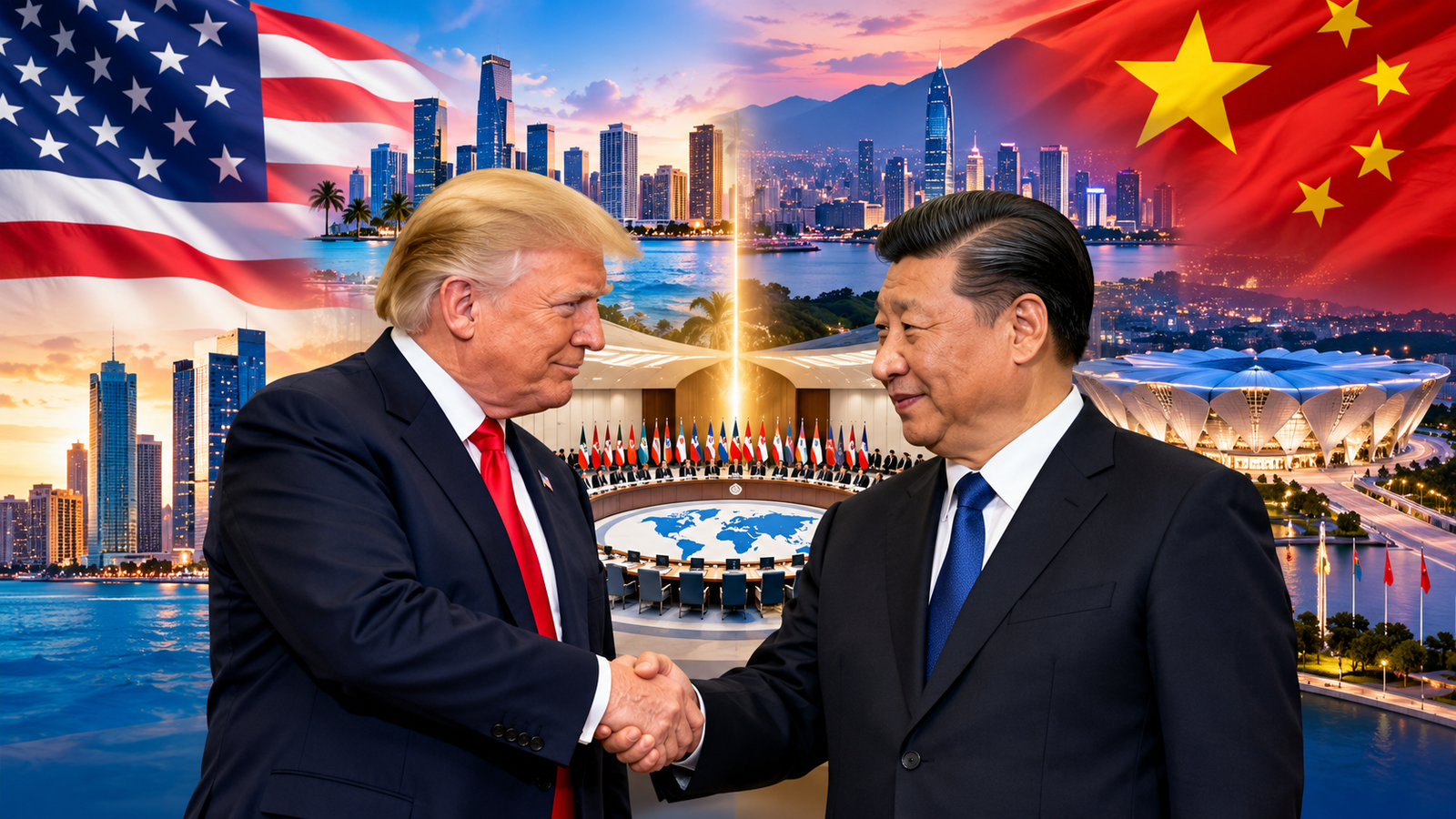
US President Donald Trump and Chinese President Xi Jinping have agreed to support each other as the United States and China host two major international meetings in 2026.
The agreement came during Xi’s meeting with Trump in Washington on September 24, according to a Reuters report based on a Xinhua report. The two sides agreed to support each other in hosting the 2026 Asia-Pacific Economic Cooperation, or APEC, Economic Leaders’ Meeting and the 2026 G20 Summit.
The agreement is important because both APEC and the G20 bring together major economies. The two forums also cover issues that directly affect trade, investment, supply chains, economic policy and global cooperation.
The agreement does not, by itself, mean that the United States and China have resolved their wider disputes. It also does not establish a new trade treaty or a broad political settlement. The available reports describe it as mutual support for the two summits.
That distinction matters. The United States and China continue to have major differences on trade, technology, Taiwan, critical minerals and other strategic issues. Reuters reported that the September 24 talks also covered the Middle East, Ukraine and the Korean Peninsula.
APEC Will Take Place in China
China will host the 2026 APEC Economic Leaders’ Meeting in Shenzhen on November 18 and 19.
The official APEC website lists the Shenzhen meeting for November 18–19, 2026. APEC is a regional economic forum that brings together economies from across the Asia-Pacific region.
The APEC meeting therefore gives China an important international platform later this year.
For Beijing, the meeting can provide a setting for talks with a wide group of economies at a time when trade and supply-chain issues remain major global concerns. For Washington, participation can provide a direct channel for talks with China and other Asia-Pacific economies.
The US-China agreement for mutual support should therefore be viewed mainly as a diplomatic arrangement around the two events.
It is not evidence that every issue between Washington and Beijing has been settled.
The G20 Will Take Place in the United States
The second major event is the 2026 G20 Summit, which the United States is hosting.
The White House had already stated in May 2026 that the United States and China would support each other as the respective hosts of the G20 and APEC summits later in the year.
This means the September 24 announcement is better understood as a reaffirmation of an earlier commitment rather than a completely new arrangement.
The May White House fact sheet said Trump and Xi had agreed that the two countries should build a constructive relationship based on strategic stability, fairness and reciprocity. It also stated that the two countries would support each other as hosts of the G20 and APEC summits.
The September meeting therefore adds fresh political attention to an arrangement that had already been announced several months earlier.
What the Agreement Actually Means
The most direct meaning is simple: Washington and Beijing have agreed to support each other while each country hosts one major international economic meeting.
This can help keep official contact open.
The arrangement also creates two additional points on the diplomatic calendar after the September Trump-Xi meeting. Leaders and senior officials from the two countries will have more opportunities to meet, discuss disputes and address issues of common interest.
That does not guarantee further agreements.
Diplomatic support for a summit is different from a binding treaty. It is also different from a commitment to settle a particular dispute.
For that reason, the agreement should not be described as a full US-China reconciliation.
A more careful description is that the two governments have reaffirmed a willingness to cooperate around two major multilateral events.
The Broader US-China Relationship
The summit took place against a much wider background.
The United States and China remain major economic partners, but they also compete across trade, technology, strategic goods and national security.
One important issue is critical minerals.
Reuters reported before the Trump-Xi meeting that the United States was expected to remain dependent on China for rare earth processing well into the 2030s, even as the United States expands its own mining and processing capacity. Rare earth materials have uses across automobiles, electronics, advanced technology and defence-related products.
This gives the issue economic and strategic importance.
The two countries also continue to face disputes over trade. On September 23, US Treasury Secretary Scott Bessent said the United States and China had agreed to extend their trade truce by two months. Reuters reported that the extension would provide more time for work on a possible larger trade agreement.
The timing is relevant.
The APEC meeting is in November, while the G20 meeting comes later in the year. Trade discussions could therefore remain important as both governments prepare for these international meetings.
However, any future trade agreement would depend on separate negotiations and formal decisions. The summit-support arrangement does not itself create such an agreement.
Trade Remains a Central Issue
Trade is one of the most important parts of the US-China relationship.
US farmers have also sought stronger Chinese purchases of American agricultural products. Reuters reported that US agricultural goods such as soybeans, sorghum, grains and meat were expected to be important topics around the Trump-Xi talks.
The White House said in May that China would purchase at least $17 billion per year of US agricultural products in 2026, 2027 and 2028, with the 2026 amount subject to proration. The White House also referred to other commitments related to US agricultural goods, beef and poultry.
These figures form part of the broader economic framework announced by Washington.
They should not, however, be treated as proof that all trade disputes have ended.
Trade relations between major economies can change through tariffs, exemptions, purchases, export rules and later negotiations.
Technology and Critical Minerals
Technology is another major area of US-China competition.
The September meeting included artificial intelligence among the subjects under discussion, according to Reuters.
At the same time, critical minerals remain a major issue.
The White House said in May that China would address US concerns about supply shortages related to rare earths and other critical minerals. The same document referred to materials such as yttrium, scandium, neodymium and indium.
The importance of these materials goes beyond ordinary trade.
Many advanced industries depend on reliable access to specialised minerals and processing capacity. Any restriction or delay can affect manufacturers and supply chains.
This is one reason why the economic relationship between the United States and China cannot be viewed only through the value of goods traded between the two countries.
Supply security has become an important part of the relationship.
Taiwan Remains a Separate Issue
Taiwan remains one of the most sensitive subjects between Washington and Beijing.
Reuters reported before Xi’s September visit that Chinese officials were expected to raise the issue of US arms sales to Taiwan. China considers Taiwan part of its territory, while the United States maintains a longstanding relationship with Taiwan and provides it with defence-related support under US policy and law.
The agreement on APEC and G20 cooperation does not change those separate issues.
It would therefore be legally and factually unsafe to describe the summit agreement as proof of a settlement over Taiwan.
The same applies to other strategic questions.
The two leaders can cooperate on one subject while remaining far apart on another.
That is common in international diplomacy, especially between major powers with overlapping economic interests and serious strategic differences.
The Role of the Two Summits
The two meetings have different structures and purposes.
| Forum | 2026 Host | Date | Main Role |
|---|---|---|---|
| APEC Economic Leaders’ Meeting | China | November 18–19, 2026 | Asia-Pacific economic cooperation |
| G20 Summit | United States | Later in 2026 | Major global economic and policy issues |
APEC is focused on the Asia-Pacific economic region. Its membership includes economies from across that region, and its work covers areas such as trade, digital issues, economic growth and regional cooperation. The official APEC site confirms the 2026 leaders’ meeting in Shenzhen on November 18–19.
The G20 has a wider global scope.
The forum brings together major advanced and emerging economies. The US State Department has described the G20 as a forum for cooperation on the international financial system and major economic policy issues.
This gives the two meetings different diplomatic value.
APEC provides a strong regional setting for China.
The G20 provides a broader global setting for the United States.
The mutual-support arrangement allows both governments to preserve a degree of cooperation within these separate forums.
Why the Timing Matters
The timing is also significant.
The Trump-Xi meeting took place on September 24. APEC comes less than two months later in November. The G20 follows later in the year.
This creates a relatively short period in which the two governments may have to manage several sensitive matters.
The immediate trade truce is one such matter. Reuters reported on September 23 that the United States and China had agreed to extend the truce by two months.
The extension gives negotiators more time.
It also means that trade questions can remain part of the diplomatic agenda as officials prepare for later international meetings.
The two governments may also use these meetings to discuss issues that cannot be resolved through a single bilateral summit.
What Investors May Watch
From a market perspective, the agreement may matter because US-China relations affect global trade and supply chains.
However, it would be too strong to state that the agreement will automatically lead to higher or lower asset prices.
Markets can respond to many factors at the same time, including interest rates, energy prices, corporate results, tariffs, currency movements and geopolitical events.
The more direct market relevance comes from the possibility of greater policy clarity.
If the United States and China keep their trade truce in place and make further progress on specific economic issues, companies may have more information about future trade conditions.
If negotiations face new disputes, that clarity could weaken.
The summit agreement itself does not settle that question.
A Broader Signal of Dialogue
The strongest analytical point is that Washington and Beijing continue to keep a high-level channel open.
The White House had already said in May that the two countries would support each other as hosts of APEC and the G20.
The September meeting therefore reinforces that approach.
Reuters described the September meeting as one focused on trade, artificial intelligence and the wider strategic relationship between the United States and China.
This suggests a relationship in which cooperation and competition can exist at the same time.
That is different from a full strategic partnership.
It is also different from a complete breakdown in relations.
The available evidence supports a more limited conclusion: the two governments continue to use direct diplomacy while major disagreements remain.
What Should Not Be Assumed
Several conclusions would go beyond the available evidence.
The agreement should not be described as a new US-China peace deal.
It should not be treated as a formal settlement of the trade dispute.
It should not be described as a resolution of the Taiwan issue.
It should not be taken as proof that the United States and China now share the same strategic goals.
It also should not be treated as a guarantee that future meetings will produce new agreements.
Those matters require separate evidence.
The safest reading is narrower.
Trump and Xi have agreed to support each other as their countries host the 2026 APEC and G20 meetings. The two governments had already announced this basic arrangement in May, and the September meeting has again placed it in the diplomatic record.
What Comes Next
The next major test will be whether the broader US-China relationship remains stable through the final months of 2026.
APEC in Shenzhen on November 18–19 will provide the first major multilateral setting after the September meeting.
The G20 will then give the United States its own opportunity to host major economies and place economic and international issues before a wider group of leaders.
Between these events, trade negotiations may remain important.
Critical minerals may remain another major issue.
Technology, artificial intelligence and Taiwan are also likely to remain sensitive subjects in the broader relationship.
The two governments therefore have both reasons to cooperate and reasons to disagree.
Final Assessment
The Trump-Xi agreement on mutual support for the 2026 APEC and G20 summits is best understood as a limited but meaningful diplomatic step.
It confirms that Washington and Beijing have an interest in keeping their high-level relationship functional while both sides continue to manage serious disputes.
The agreement is not, by itself, a comprehensive political or economic settlement.
Its importance comes from the fact that it keeps two major international forums open as places for contact between the United States, China and other major economies.
The May 2026 White House statement already established the basic commitment to mutual support. The September 24 meeting has now put that commitment back at the centre of attention.
The coming months will show whether this limited cooperation can support wider progress on trade and other issues.
For now, the confirmed fact is narrower: Trump and Xi have agreed to support each other as China hosts APEC and the United States hosts the G20 in 2026.
That agreement should be viewed as one part of a much larger and still unsettled US-China relationship.