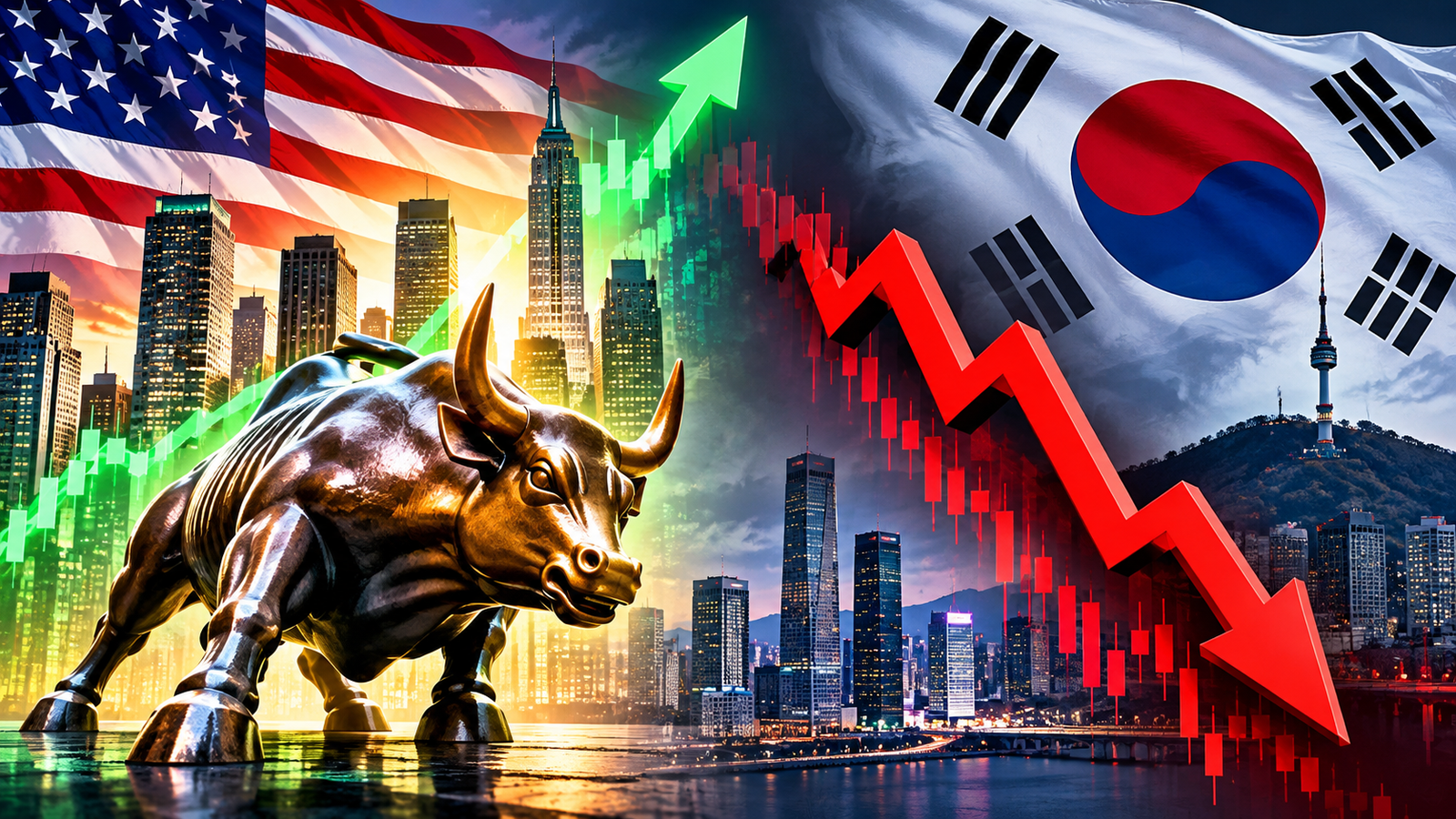
South Korean stocks opened lower on Monday, September 28, even as major U.S. stock indexes ended higher on Friday. The move came as investors returned to the market after the Chuseok holiday and looked at fresh changes in oil prices, U.S. interest rates and the global tech sector.
The benchmark Korea Composite Stock Price Index, or KOSPI, fell 40.16 points, or 0.47%, to 7,040.76 at 9:15 a.m. local time. The fall came after the index had closed at 7,080.92 on September 23.
The weaker start stood out because Wall Street had a strong session before the weekend. The Dow Jones Industrial Average rose 0.93%. The S&P 500 gained 0.51%, while the tech-heavy Nasdaq Composite rose 0.48%.
This means South Korean shares did not follow the same path as U.S. stocks at the start of the new week. The main reason was not a lack of strength in global technology shares. Instead, several local and global factors had a stronger effect on Korean stocks.
Wall Street Had a Strong Friday
U.S. markets ended Friday on a positive note, with technology and industrial companies among the main sources of strength. The Nasdaq rose 0.48%, which was important for South Korea because the Korean market has a large exposure to chip and technology companies.
U.S. semiconductor shares also had a strong session. The Philadelphia Semiconductor Index rose 1.41% on September 25. Shares of major chip firms such as Sandisk, Seagate and Western Digital also closed higher.
That strength would normally give Korean chip stocks a positive signal. However, the KOSPI had to deal with several other factors when local trade resumed.
South Korea had no stock market session on Thursday and Friday because of the Chuseok holiday. Chuseok is one of the country’s major holidays and is often compared with Thanksgiving in the United States.
This holiday break meant Korean investors had to react to several changes in global markets at once. U.S. shares had moved lower during part of the break before recovering on Friday. Oil prices also changed sharply, while U.S. bond yields remained a major concern.
Samsung and SK Hynix Lead the Weakness
The biggest reason for the weak KOSPI start was the fall in major chip stocks.
Samsung Electronics, the largest company by market value in South Korea, fell 1.14%. SK Hynix, another major memory chip maker, fell 2.63%. SK Square, the parent company of SK Hynix, lost 3.36%.
These companies have a large effect on the KOSPI because of their size. When major semiconductor shares fall, the index can lose ground even when other parts of the market remain firm.
The weakness in these stocks also shows why the U.S. tech rally does not always lead to an equal rise in Korean shares. Investors may react to local price levels, profit-taking, foreign fund flows and expectations for future company results.
Samsung Electronics and SK Hynix had already posted strong gains before the holiday. On September 23, Samsung Electronics rose 3.25% to 285,500 won. SK Hynix gained 1.20% and closed at 1,860,000 won.
The KOSPI also rose 1.21% that day to close at 7,080.92.
After such a strong move, some investors may choose to take profits. This can put pressure on share prices even when the wider global technology market remains strong.
Oil Prices Add a New Factor
Oil prices also became an important part of the market story.
Brent crude settled at about US$104 a barrel after reports that Iran had proposed a plan to end the conflict. The news raised hopes for a diplomatic solution and helped push oil prices lower.
Lower oil prices can be positive for many economies because cheaper energy can reduce costs for companies and consumers. But the effect on stock markets is not always simple.
Oil prices can affect inflation, interest rates, company profits and investor demand for different sectors. For South Korea, which depends heavily on imported energy, a sustained fall in oil prices can reduce pressure on import costs.
At the same time, investors were also watching U.S. Treasury yields. High bond yields can make stocks less attractive because investors can earn more from safer fixed-income assets.
Foreign Investors Remain Important
Foreign investor activity is another key factor for the KOSPI.
Before the Chuseok break, the KOSPI had a strong week. The index rose 2.71% over three trading days and returned above the 7,000 level.
However, foreign investors were net sellers of 419.1 billion won in the stock market during that period. Their activity was also different across major chip companies.
Foreign investors bought 2.5906 trillion won worth of Samsung Electronics shares, while they sold 2.2795 trillion won worth of SK Hynix shares.
This difference shows that investors do not treat all semiconductor companies in the same way. Samsung has several major businesses, including memory chips, foundry services and smartphones. SK Hynix has a much stronger focus on memory products.
The market is paying close attention to demand for advanced memory used in artificial intelligence systems. Prices for HBM4 and DRAM have risen, and expectations for chip company results remain high.
Micron Results Could Matter
One of the biggest events for the semiconductor sector this week is the earnings report from Micron Technology on September 30.
Micron is the world’s third-largest memory semiconductor company. Its results can give investors a clearer view of demand for memory chips and AI hardware.
Market forecasts before the holiday placed Samsung Electronics’ third-quarter operating profit at about 105.6 trillion won. The forecast for SK Hynix was about 74.1 trillion won.
However, these forecasts had fallen slightly over the previous month. That means investors may want to see strong results and strong future guidance before they push semiconductor shares higher again.
The Micron report could therefore have a direct effect on Korean chip stocks. A strong outlook could support the view that AI-related demand remains firm. A weaker outlook could raise fresh concerns about chip prices and future profits.
More U.S. Data Is Ahead
The KOSPI also faces several important U.S. economic reports this week.
Investors will watch U.S. inflation and labor data because these figures can affect expectations for Federal Reserve policy. Changes in U.S. interest-rate expectations can also affect Treasury yields and global stock markets.
The September U.S. Consumer Confidence Index and JOLTS report are due on September 29. The September ADP private employment report and August PCE inflation index are due on September 30. The U.S. Employment Report is due on October 2.
South Korea will also release important data. September export and import figures are due on October 1, while September consumer price data are due on October 2.
These reports can shape views on economic growth, inflation and interest rates.
The KOSPI Faces a Key Test
The weak Monday open does not mean South Korea has lost all of its recent market strength. The KOSPI had a strong run before the Chuseok holiday and had moved above 7,000.
The current move shows that global market strength is only one part of the picture. Local share prices, foreign investor flows, chip company results, oil prices and bond yields can all affect the direction of Korean stocks.
The Korean won was at 1,357.1 won against the U.S. dollar on Monday, down 0.1 won from the previous session. Currency moves can also affect foreign investors and companies with large overseas sales.
For now, the 7,000 level remains an important point for the KOSPI. The market will also focus on Samsung Electronics, SK Hynix and the wider semiconductor sector.
The next few sessions could give investors a clearer picture of whether the recent strength in Korean stocks can continue or whether the market needs time to absorb the gains seen before the holiday. Much will depend on U.S. economic data, Treasury yields, oil prices and Micron’s results.
The gap between Wall Street and Seoul on Monday is therefore less about a simple failure of Korean technology stocks to follow the U.S. market. It reflects the many factors that shape South Korean shares at the same time.
ALSO READ: Japan Stocks Rise as Nikkei 225 Extends Powerful Rally