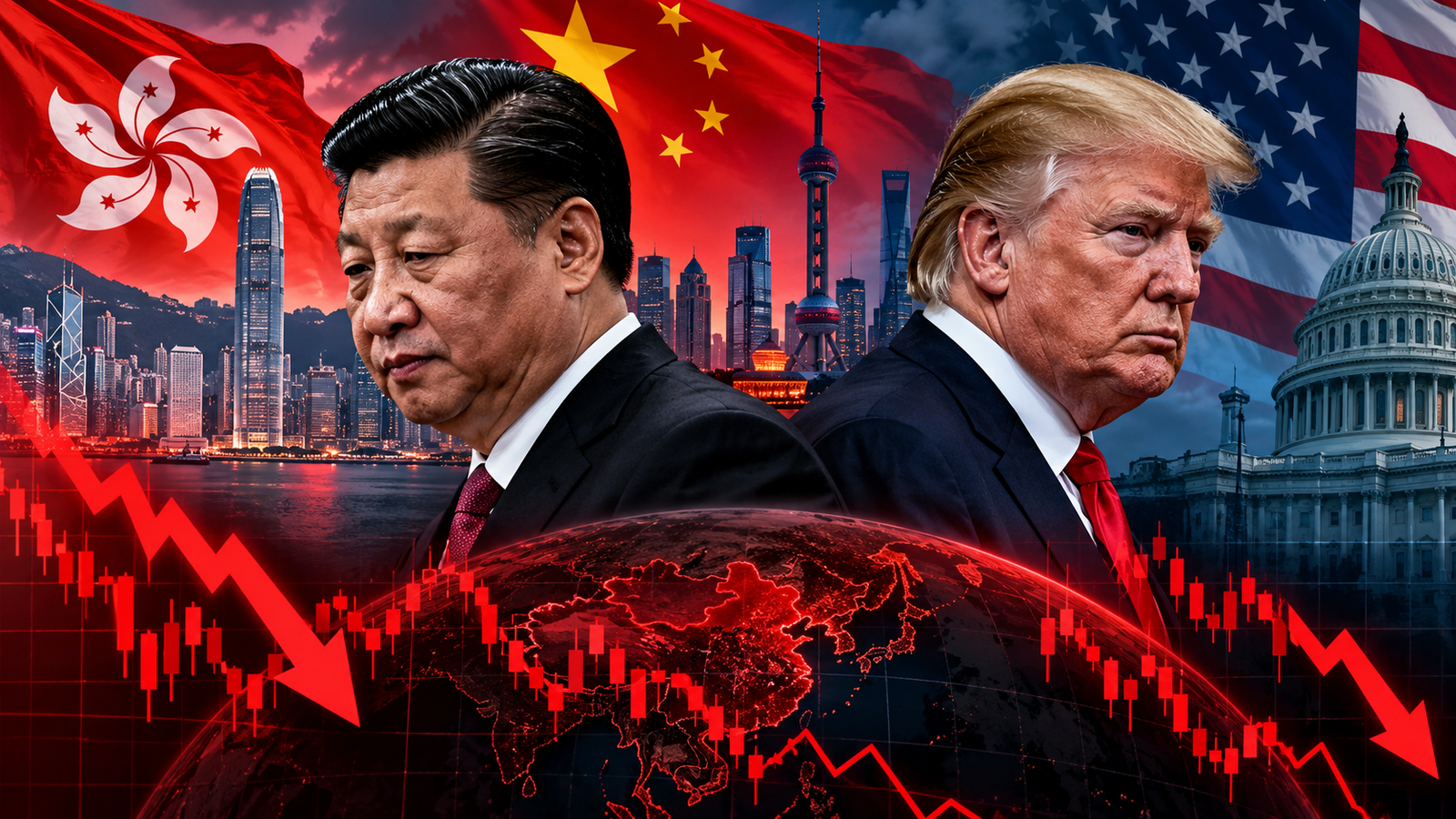
Hong Kong and mainland China stocks have faced fresh pressure as investors assess the latest US-China trade developments. The main concern is not only the direction of tariffs, but also whether the United States and China can reach a wider and more stable trade agreement.
The Hang Seng Index lost 72 points, or 0.29 percent, on September 24 and closed at 24,761. The Hang Seng Tech Index fell almost 18 points, or 0.41 percent, to 4,361. The China Enterprises Index also fell, by 0.09 percent, to 8,266.
The pressure was stronger on mainland markets. The Shanghai Composite fell 48 points, or 1.22 percent, to 3,888. The CSI300 index dropped 1.7 percent. Both recorded their biggest one-day fall in a month. The Shenzhen Component Index fell 2.34 percent, while the ChiNext Index dropped 2.68 percent.
These figures show that the weakness was not limited to one part of the Chinese stock market. Several major parts of the market came under pressure at the same time.
Hang Seng Falls Further
The pressure continued in Hong Kong on September 25. The Hang Seng Index fell 251.04 points, or 1 percent, to 24,510.09. The Hang Seng Tech Index lost 1.1 percent, while the Mainland Properties Index fell 1.3 percent.
Technology and property stocks were among the weaker areas. Lenovo was one of the stronger names, with a gain of 3.2 percent. Weichai Power, however, fell 4.8 percent.
The wider market also faced pressure from global factors. Higher US oil prices and higher US Treasury yields had already hurt investor mood in other markets. That weakness then added to the pressure on Hong Kong shares.
For investors, this means that the decline cannot be linked to China-US relations alone. Global market conditions also have an effect on share prices in Hong Kong and mainland China.
Shanghai Composite Takes a Bigger Hit
The Shanghai Composite faced a sharper fall than the Hang Seng during the September 24 session. It ended the day at 3,888, after a drop of 1.22 percent.
The CSI300 had an even larger fall of 1.7 percent. The Shenzhen Component Index lost 2.34 percent, while the ChiNext Index fell 2.68 percent.
The broad decline showed that investors had concerns across several parts of the Chinese market. Gold, metals and AI hardware shares were among the weaker areas during the session.
One reason for the cautious mood was uncertainty about the result of the Trump-Xi summit. Before the meeting, many investors had hoped for a wider trade agreement. Instead, the two countries agreed to extend their existing trade truce by only two months.
Trump-Xi Summit Brings a Limited Trade Step
US President Donald Trump and Chinese President Xi Jinping met in Washington on September 24. Trade and artificial intelligence were among the main subjects.
The most important economic result was a two-month extension of the trade truce. The extension gives both sides more time to discuss major trade issues, but it does not create a full and lasting settlement.
The key issues still include tariffs, Chinese purchases of US goods, rare-earth supplies and technology restrictions. These matters remain part of future talks.
The short extension also fell below what some market participants had hoped to see. UBS analysts said the two-month period was shorter than the one-year extension that markets had expected, although it still helps keep trade relations more stable for now.
This helps explain why the stock market did not respond with a strong rise after the summit. Investors received some relief, but not the major trade breakthrough that many had hoped for.
Why Trade Matters So Much
The US and China are two of the world’s largest economies. Their trade relationship affects companies, factories, technology firms, banks and commodity markets across the world.
When tariffs rise, companies can face higher costs. When technology rules become stricter, companies can lose access to important products or markets. Rare-earth supplies also matter because these materials are used in several important industries.
For Chinese companies, access to the US market remains important. For US companies, China remains a major market and a major part of global supply chains.
This makes every major statement from Washington and Beijing important for investors. A small change in trade policy can affect company profits and share prices.
Technology Remains a Major Concern
Technology is another major source of uncertainty. AI has become an important part of the US-China economic relationship.
Before the Trump-Xi meeting, there was hope that both countries could make progress on AI cooperation and safety. However, no major AI agreement was announced at the summit.
US restrictions on chip exports to China also remain a major issue. Semiconductor companies depend on access to advanced chips and technology, so any change in US rules can have a direct effect on the sector.
Sanjeev Rana, head of North Asia semiconductor research at CLSA, said he did not expect the United States to relax its chip export controls on China.
That view adds another layer of uncertainty for Chinese technology stocks.
Investors Remain Careful
The market response shows that investors remain careful about the next phase of US-China relations.
A trade truce can reduce the risk of a sudden rise in tariffs, but it does not remove the deeper problems between the two countries. The two governments still have differences over trade, technology, rare earths, Taiwan and other strategic matters.
At the same time, some investors see room for a more stable relationship. Charles Wang, chairman of Shenzhen Dragon Pacific Capital Management, said US-China relations could move from direct confrontation toward greater understanding, compromise and coexistence.
That view reflects the fact that both economies have strong reasons to avoid a major trade shock.
What Comes Next for Chinese Markets
The next stage will depend on what happens during the additional two-month trade truce.
Investors will watch for clear steps on tariffs, Chinese purchases of US goods, rare-earth supplies and technology rules. They will also look for signs that future talks can produce a wider agreement.
For now, the market response shows a clear gap between political talks and investor expectations. The Trump-Xi summit created another period of trade stability, but it did not solve the larger disputes between Washington and Beijing.
The Hang Seng and Shanghai Composite therefore remain sensitive to every new trade statement. A positive development could support market confidence, while a fresh dispute could bring more pressure.
A Period of Caution
Hong Kong and mainland Chinese stocks have entered a period where investors must weigh both hope and risk.
The Hang Seng closed at 24,510.09 on September 25, after a 1 percent fall. The Shanghai Composite stood at 3,888.37 after a 1.2 percent decline.
The two-month trade truce offers some short-term stability, but the larger US-China economic dispute remains unresolved. Technology rules, tariffs and supply issues will continue to shape market sentiment.
For Chinese stocks, the next few weeks may therefore remain sensitive to fresh trade news. Investors will look beyond friendly talks and pay close attention to actual policy steps. The direction of those talks could have a major effect on Hong Kong and mainland markets as the two countries move toward their next round of discussions.