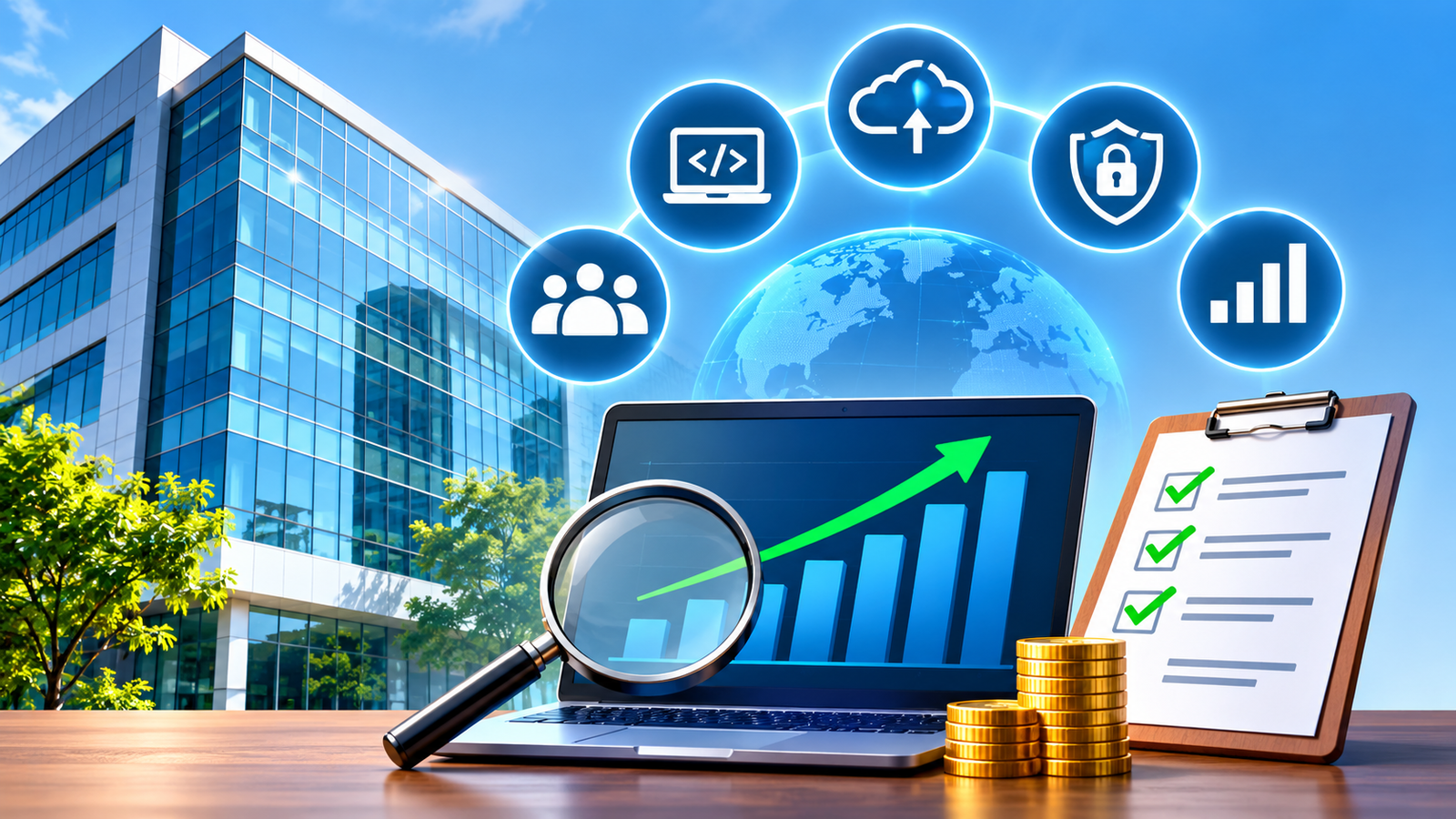
An IT services company is a business that provides technology-related services to other companies. These services may include software development, IT support, cloud services, cybersecurity, data management and technology consulting. Such companies help businesses use technology to improve their work, reduce costs and serve their customers better.
Unlike manufacturing companies, IT services companies do not depend on factories, machines or large amounts of raw materials. Their biggest strength is their employees, technical skills, client relationships and ability to provide quality services. Therefore, the analysis of an IT services company is quite different from that of a manufacturing or consumer goods company.
To understand an IT services company, we must look at how it earns revenue, how much profit it makes, how well it uses its employees, how many clients it serves and how much cash it generates. We must also study its management, competitors, future business opportunities and stock valuation.
A proper analysis helps us understand whether the company has a strong business model, good financial health and the ability to grow over the long term.
1. Understand the Business Model
The first step is to understand what the company does and how it earns money. Every IT services company may offer different types of services. Some companies focus on software development, while others provide cloud services, cybersecurity, IT consulting or business process services.
IT consulting companies help clients choose the right technology for their business. Application development companies create software and mobile applications. Application maintenance companies take care of existing software and fix technical problems. Cloud service providers help businesses move their data and operations to cloud platforms. Cybersecurity companies protect business systems from hackers, data theft and other online threats.
Some companies also work in data analytics, artificial intelligence and engineering services. These areas have become important as businesses across the world spend more money on technology.
While you analyse the company, check which services contribute the most to its revenue. Also, understand whether it depends on traditional IT services or has a strong presence in newer areas such as cloud computing, artificial intelligence and cybersecurity.
A company with a wide range of services may have better opportunities to serve different clients. However, a company with a clear focus on a specialised service may also have a strong competitive advantage.
2. Analyse Revenue Growth
Revenue is the total income a company earns from its business activities before it deducts expenses. Revenue growth shows whether the company can attract new clients, win more projects and increase its business with existing customers.
For example, suppose an IT company reports revenue of ₹5,000 crore in FY24 and ₹5,750 crore in FY25. Its revenue has increased by ₹750 crore, which means annual revenue growth of 15%.
However, one year of growth is not enough to judge the company’s performance. You should examine its revenue growth over the last three to five years. This will help you understand whether the business has a stable growth record or depends on a few good quarters.
It is also important to understand the reason behind revenue growth. Higher revenue may come from new clients, larger projects, better service prices, acquisitions or currency changes. A company that grows through its own business strength may have better long-term prospects than one that depends mainly on acquisitions.
You should also study revenue by geography, service type and client category. This will show which parts of the business contribute the most to its total income.
3. Analyse Profitability
Revenue alone cannot tell us whether a company is successful. A business may report strong sales but still earn very little profit because of high employee costs, weak pricing or poor cost control.
Therefore, profitability is one of the most important parts of IT company analysis.
EBITDA margin shows how much operating profit a company earns before interest, tax, depreciation and amortisation, as a percentage of revenue. EBIT margin measures operating profit after depreciation and amortisation. Net profit margin shows how much final profit remains after all expenses and taxes.
For example, if a company earns revenue of ₹1,000 crore and its EBITDA is ₹250 crore, its EBITDA margin is 25%.
You should compare these margins over the last five years. If margins improve over time, it may show better cost control, higher employee productivity or stronger service prices.
You should also compare the company’s margins with those of its competitors. A company with higher margins may have better technology skills, stronger client relationships or more efficient operations.
Other useful measures include return on equity (ROE) and return on capital employed (ROCE). These ratios help us understand how well the company uses its capital to generate profits.
4. Analyse Employee Productivity and Utilisation
Employees are the most important part of an IT services company because they provide the services that clients pay for. Therefore, employee productivity has a direct effect on revenue and profits.
One important measure is revenue per employee. It tells us how much revenue the company earns from each employee.
Suppose a company earns annual revenue of ₹10,000 crore and has an average workforce of 50,000 employees. Its revenue per employee is ₹20 lakh.
A higher figure may suggest better productivity, higher-value services or stronger pricing. However, this measure should always be compared with similar companies because different service models require different numbers of employees.
Another important measure is employee utilisation. It shows how much of the available employee time is used for work that clients pay for. A higher utilisation rate may help the company earn more revenue from its existing workforce.
Attrition rate is also important. It shows the percentage of employees who leave the company during a particular period. High attrition may increase hiring and training costs. It can also affect project quality and client relationships.
You should also study employee expenses as a percentage of revenue. Since salaries form a major part of the total cost, a rise in employee expenses without a similar rise in revenue may reduce profit margins.
5. Analyse Client Concentration
Clients are the main source of revenue for an IT services company. Therefore, it is important to understand how many clients the company serves and how much it depends on its largest customers.
Some IT companies earn a large part of their revenue from a small number of major clients. This can create risk because the loss of even one large customer may affect total revenue and profits.
For example, suppose the top five clients contribute 35% of the company’s total revenue. This means the business has a considerable level of dependence on those customers.
A company with a diverse client base may have lower customer concentration risk. It is also useful to check how many active clients the company has, whether it can retain existing customers and whether it can add new clients each year.
Long-term relationships with major clients can be a strength. However, the company should not depend too much on a few customers for its future growth.
6. Study Geographic and Industry Exposure
Most large IT services companies earn a major part of their revenue from international markets. The United States and Europe are important markets for many Indian IT companies.
You should examine how much revenue comes from North America, Europe, India and other regions. This helps you understand the company’s dependence on particular countries.
For example, a company that earns most of its revenue from the United States may face problems if American businesses reduce their technology budgets.
Apart from geography, it is also important to study the industries that contribute to revenue. Major industries include banking and financial services, healthcare, retail, manufacturing, telecommunications, energy and utilities.
Each industry has different technology needs and spending patterns. For example, banks may spend more on digital payments, data security and software systems. Healthcare companies may require better data management and digital health systems.
A company with clients across several industries may have a more balanced business model. However, a strong position in one growing industry can also create valuable opportunities.
7. Analyse Deal Wins and Order Book
Deal wins are an important part of IT services company analysis because they provide an idea about future business opportunities.
When an IT company signs a contract with a client, it may provide services for several years. The total value of such a contract is often called Total Contract Value (TCV).
For example, if a company signs a five-year contract worth $500 million, the total contract value is $500 million. However, the entire amount does not become revenue at once. The company earns revenue as it delivers services over the contract period.
You should study the value of new deals, the number of large contracts and the company’s ability to win new customers. It is also useful to examine the order book and deal pipeline.
Another useful measure is the book-to-bill ratio. It is calculated by dividing new bookings by revenue. If the ratio is above 1, new bookings are higher than revenue for that period. If it is below 1, revenue is higher than new bookings.
A healthy level of deal wins can support future growth. However, not every contract turns into revenue at once, and some projects may face delays or cancellations. Therefore, deal wins should be studied along with actual revenue growth.
8. Analyse Cash Flow and Balance Sheet
A company may report good profits in its financial statements, but that does not always mean it receives the same amount of cash.
Cash flow analysis helps us understand whether the company can convert its profits into actual money.
Operating cash flow shows the cash generated from normal business activities. Free cash flow is calculated by deducting capital expenditure from operating cash flow.
IT services companies generally require less investment in factories and heavy machinery. As a result, many of them can generate strong free cash flow.
You should compare operating cash flow with net profit over the last three to five years. If cash flow remains close to or above net profit over time, it is usually a positive sign.
Another important measure is Days Sales Outstanding (DSO). It shows how many days the company takes, on average, to collect money from its clients. A high DSO may indicate delays in payments and poor cash collection.
You should also examine the company’s cash balance, debt and working capital. Many established IT services companies have low debt and strong cash reserves. This gives them financial flexibility during difficult business conditions.
9. Evaluate Management Quality
Good management is important for the long-term success of any company. In IT services, management must understand technology, client needs, employee requirements and changes in the global business environment.
You should study the experience of senior leaders and their ability to make good business decisions. It is also useful to check whether management meets its financial targets and keeps its promises.
Corporate governance is another important area. Check promoter shareholding, institutional ownership, related-party transactions and any major legal or regulatory issues.
You should also study how the company uses its profits. Some companies pay regular dividends, while others use their cash for acquisitions, business expansion or share buybacks.
Good management should focus on long-term business growth rather than only short-term financial results. It should also prepare the company for changes in technology, especially artificial intelligence, cloud computing and automation.
10. Compare the Company with Its Competitors
An IT services company should never be analysed in isolation. Its performance must be compared with other companies that offer similar services.
In India, major listed IT services companies include TCS, Infosys, HCLTech, Wipro and Tech Mahindra.
TCS has a large presence across IT services, consulting and digital transformation. Infosys focuses on technology consulting and digital services. HCLTech has a strong presence in engineering, infrastructure and software services. Wipro provides IT consulting and business transformation services. Tech Mahindra has a strong presence in telecommunications and enterprise technology.
You should compare these companies based on revenue growth, EBITDA margin, EBIT margin, ROE, ROCE and revenue per employee.
It is also useful to compare their employee attrition, deal wins, cash flow and debt levels.
This comparison helps you understand whether the company performs better or worse than its competitors. It also helps you identify companies with stronger business models and better financial performance.
11. Analyse Stock Valuation
After you understand the company’s business and financial health, the next step is to check whether its shares are available at a fair price.
A good company is not always a good investment. Even a strong business can become an expensive investment if its share price is too high.
The Price-to-Earnings (P/E) ratio is one of the most common measures used to value IT companies. It compares the share price with earnings per share.
EV/EBITDA compares the company’s total enterprise value with its EBITDA. This measure is useful because it considers both debt and equity value.
EV/Sales compares enterprise value with revenue. The PEG ratio compares the P/E ratio with expected earnings growth. Free cash flow yield measures the free cash flow generated in relation to market capitalisation.
You should compare these ratios with industry peers and the company’s own historical valuation.
Also, consider future earnings growth, profit margins, cash flow and business quality before making an investment decision.
A company with strong growth and high profitability may deserve a higher valuation than a company with weak business performance. However, the price must still make sense compared with its future earnings potential.
12. Final Framework for IT Services Company Analysis
A complete analysis should cover the business model, revenue growth, profitability, employee productivity, client concentration, geographic exposure, deal wins, cash flow, management quality and stock valuation.
You can use the following suggested weights to organise your research.
| Area of analysis | Suggested weight |
|---|---|
| Business Model and Industry | 10% |
| Revenue Growth | 15% |
| Profitability | 15% |
| Employee Productivity | 10% |
| Client and Geographic Diversification | 10% |
| Deal Wins and Future Growth | 10% |
| Cash Flow and Balance Sheet | 10% |
| Management Quality | 10% |
| Stock Valuation | 10% |
| Total | 100% |
These weights are only a suggested framework. They are not fixed industry standards. You can change them based on the company’s size, business model and financial position.
Conclusion
The analysis of an IT services company requires more than a simple review of revenue and net profit. Since employees, technology skills and client relationships form the base of this business, you must understand how well the company uses its workforce, retains customers and wins new contracts.
A strong IT services company should have steady revenue growth, healthy profit margins, good employee productivity, a diverse client base and strong cash flow. It should also have experienced management, a clear business strategy and the ability to adapt to new technologies.
Finally, compare its financial performance with competitors and study its valuation before making an investment decision. This approach will help you understand the true quality of the business and whether its shares offer a reasonable opportunity for long-term investment.