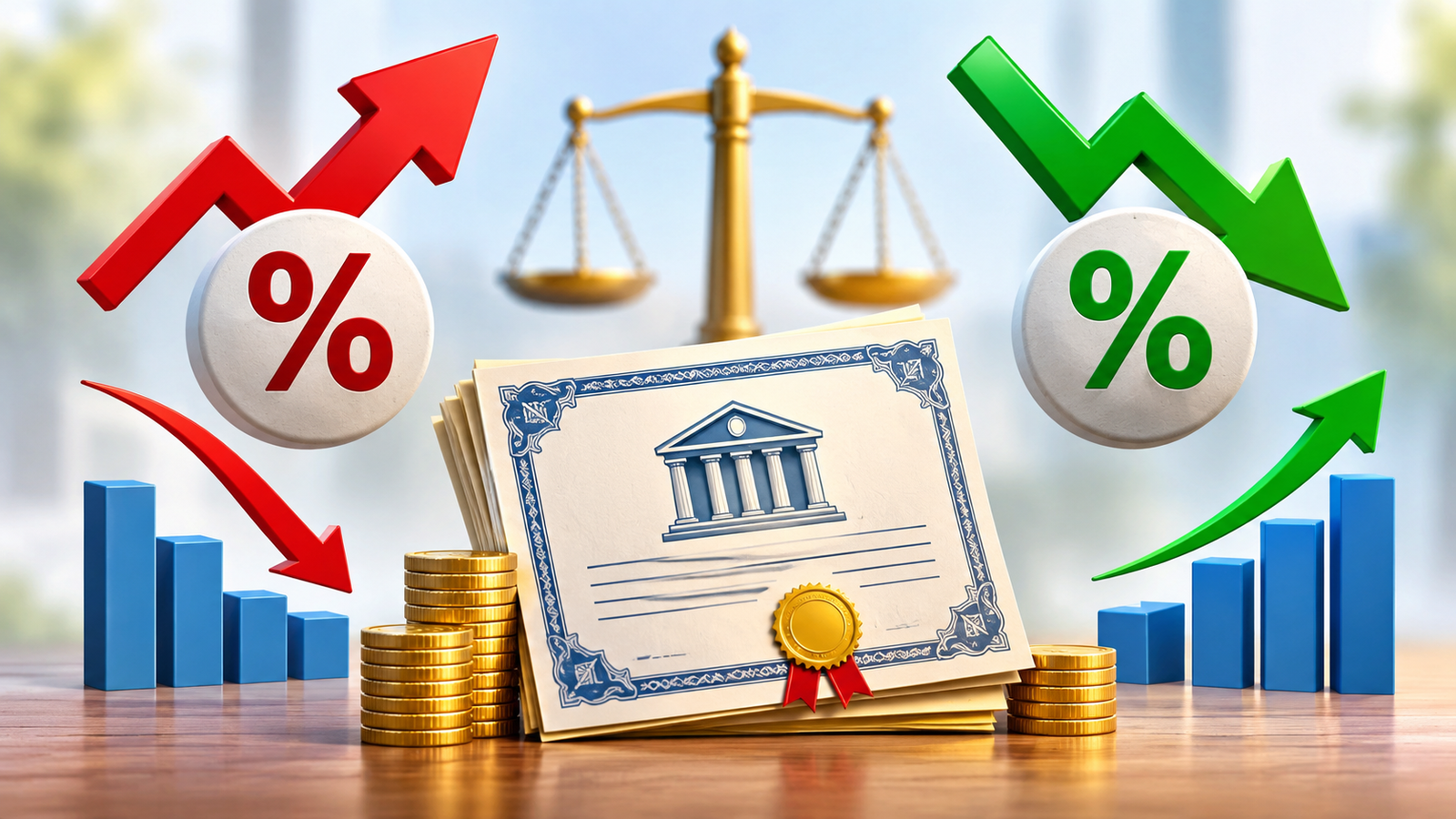
Bonds and interest rates have a very close relationship. When interest rates rise, bond prices usually fall. When interest rates fall, bond prices usually rise. This is one of the most important rules of the bond market.
To understand this idea, we first need to know what a bond is. A bond is a type of loan. When an investor buys a bond, they lend money to a company or a government. In return, the company or government agrees to pay interest at fixed times. It also promises to return the original amount at the end of the bond’s term.
For example, suppose a person buys a bond worth ₹1,000. The bond has an annual interest rate of 8%. This means the investor will receive ₹80 every year as interest. At the end of the bond’s term, the investor will also get back the original ₹1,000, as long as the issuer meets its payment promise.
The main point to remember is that most bonds have a fixed interest payment. This means the amount of interest does not change even when market interest rates rise or fall. Because of this, the market price of an old bond can change when new bonds offer different interest rates.
What Happens When Interest Rates Rise?
When market interest rates rise, the prices of old bonds usually fall. This happens because new bonds offer higher interest payments than old bonds.
Let us understand this with a simple example. Suppose you own a bond worth ₹1,000. Its annual interest rate is 8%. You receive ₹80 every year from this bond.
Now, imagine that market interest rates rise to 10%. New bonds are now available with a 10% interest rate. A new investor can buy a bond worth ₹1,000 and receive ₹100 every year.
In this situation, your old bond pays only ₹80 per year, while the new bond pays ₹100. Most investors would prefer the new bond because it offers more interest on the same amount of money.
As a result, fewer people may want to buy your old bond at its original price of ₹1,000. If you want to sell it, you may have to reduce its price to attract buyers.
This means the market value of your old bond falls.
For example, your ₹1,000 bond may now sell for less than ₹1,000. The exact price will depend on several factors, such as the time left until the bond ends and the interest rate in the market.
Therefore, when interest rates rise, the prices of existing bonds usually fall.
What Happens When Interest Rates Fall?
The opposite happens when market interest rates fall. In this case, the prices of old bonds usually rise.
Suppose you own the same bond worth ₹1,000, with an annual interest rate of 8%. It pays you ₹80 every year.
Now imagine that market interest rates fall from 8% to 6%. New bonds worth ₹1,000 now offer only ₹60 per year as interest.
Your old bond still pays ₹80 every year. This makes it more attractive than the new bonds because it offers a higher annual payment.
More investors may want to buy your bond. They may even agree to pay more than its original value of ₹1,000 because of its higher interest payment.
As a result, the market price of your old bond rises.
For example, its price may increase above ₹1,000. The exact amount depends on the market rate, the time left until the bond ends and other factors.
This shows that when interest rates fall, the prices of existing bonds usually rise.
Why Do Bond Prices and Interest Rates Have an Opposite Relationship?
Bond prices and interest rates have an opposite relationship because most bonds offer fixed interest payments.
When you buy a bond, you know how much interest you will receive each year. This amount usually stays the same throughout the bond’s term.
However, market interest rates do not always stay the same. They can rise or fall due to changes in the economy, inflation, central bank decisions and other factors.
When new bonds offer higher interest, old bonds with lower payments become less attractive. Their prices must fall to make them a better deal for new buyers.
On the other hand, when new bonds offer lower interest, old bonds with higher payments become more attractive. Their prices can rise because more people want to buy them.
This is the main reason behind the opposite movement of bond prices and interest rates.
Example of Bond Prices and Interest Rates
Let us take a simple example to understand this relationship more clearly.
Suppose you have a bond with a face value of ₹1,000 and an annual coupon rate of 8%. This means you receive ₹80 every year as interest.
Now, there are two possible situations.
First situation: Interest rates rise
Suppose market interest rates rise to 10%. New bonds now offer a higher return than your old bond. Your bond still pays ₹80 per year, but a new bond worth ₹1,000 pays ₹100 per year.
Because of this difference, investors may not want to pay the full ₹1,000 for your old bond. You may have to sell it for less than ₹1,000.
Second situation: Interest rates fall
Suppose market interest rates fall to 6%. New bonds now pay only ₹60 per year on a value of ₹1,000. Your old bond still pays ₹80 per year.
This makes your bond more attractive to investors. More people may want to buy it, so its market price can rise above ₹1,000.
The example makes one thing clear: the interest payment of the old bond stays the same, but its market price changes when interest rates change.
What Is Bond Yield?
Bond yield is the return an investor earns from a bond based on its current market price.
It helps investors understand how much return they can get from a bond at the price they pay for it.
For example, suppose a bond pays ₹80 every year as interest. If its market price is ₹1,000, its current yield is 8%.
Now suppose the market price falls to ₹800. The bond still pays ₹80 every year. However, a new buyer who pays ₹800 receives ₹80 per year.
The current yield is now 10%.
This means that when the price of a bond falls, its current yield rises.
On the other hand, if the bond price rises to ₹1,200, the annual interest payment remains ₹80. The current yield becomes about 6.67%.
This means that when the price of a bond rises, its current yield falls.
Therefore, bond prices and bond yields also have an opposite relationship.
How Bond Prices Affect Bond Yields
Bond prices and bond yields move in opposite directions. This is another important rule of the bond market.
When bond prices rise, the return from the fixed annual interest payment becomes smaller compared with the amount paid by the buyer. As a result, the yield falls.
When bond prices fall, the same fixed interest payment becomes larger compared with the lower purchase price. As a result, the yield rises.
For example, a bond that pays ₹80 every year gives an 8% current yield at a price of ₹1,000. If its price falls to ₹800, the current yield rises to 10%. If its price rises to ₹1,200, the current yield falls to about 6.67%.
The annual interest payment does not change in these examples. Only the market price changes.
This is why investors must look at both the bond price and its yield before they decide to buy or sell a bond.
Why Are Long-Term Bonds More Sensitive to Interest Rates?
Long-term bonds are usually more sensitive to changes in interest rates than short-term bonds.
A short-term bond has a shorter period before the issuer returns the original amount. A long-term bond has a much longer period before the investor gets the original money back.
Because long-term bonds have a longer term, their market prices usually react more strongly when interest rates change.
For example, suppose interest rates rise. A long-term bond with a fixed interest payment may become less attractive for many years. Buyers may ask for a larger price cut before they agree to buy it.
A short-term bond has less time left before its original value is due for payment. Therefore, its price may not change as much as the price of a similar long-term bond.
This difference is related to a concept called duration.
What Is Duration?
Duration is a measure of how sensitive a bond’s price is to changes in interest rates.
In simple words, duration tells us how much the price of a bond may change when market interest rates rise or fall.
A bond with a higher duration usually has greater price sensitivity. This means its price may rise or fall more when interest rates change.
A bond with a lower duration usually has less price sensitivity. Its market price may change by a smaller amount when interest rates move.
For example, a long-term bond often has a higher duration than a short-term bond. This is why long-term bonds usually face greater price changes when interest rates rise or fall.
Duration is useful because it helps investors understand the level of interest-rate risk in their bond investments.
What Causes Interest Rates to Change?
Interest rates can change for many reasons. One major reason is inflation. Inflation means a general rise in the prices of goods and services.
When inflation becomes high, central banks may raise interest rates to control the rise in prices. Higher rates can make loans more expensive. This may reduce spending and help control inflation.
When inflation is low or the economy needs support, central banks may reduce interest rates. Lower rates can make loans cheaper and encourage people and businesses to spend and invest more.
Economic growth can also affect interest rates. When the economy grows very fast, interest rates may rise to control excess demand and inflation. When the economy is weak, central banks may lower rates to support economic activity.
Government policies and market expectations can also affect interest rates.
These changes in market rates can have a direct effect on the prices of existing bonds.
How Interest Rate Changes Affect Investors
Changes in interest rates can create both opportunities and risks for bond investors.
When interest rates rise, people who already own old bonds may face a fall in the market value of their investments. If they sell their bonds before the end of the term, they may receive less than the amount they paid.
However, higher interest rates also give new investors a chance to buy bonds with better interest payments.
When interest rates fall, people who own old bonds with higher fixed interest payments may benefit. The market value of their bonds may rise because their payments are more attractive than those of new bonds.
However, new investors may find it harder to get the same high interest payments because newly issued bonds may offer lower rates.
Therefore, interest rate changes affect both existing bondholders and people who plan to buy new bonds.
Conclusion
Bond prices and interest rates have an opposite relationship. When interest rates rise, the prices of existing bonds usually fall. When interest rates fall, the prices of existing bonds usually rise.
This happens because most bonds have fixed interest payments. When new bonds offer higher interest, old bonds become less attractive. Their prices fall. When new bonds offer lower interest, old bonds with higher payments become more attractive. Their prices rise.
Bond yields also move in the opposite direction to bond prices. A fall in bond prices leads to a rise in current yield, while a rise in bond prices leads to a fall in current yield.
Long-term bonds are usually more sensitive to interest rate changes than short-term bonds. This is due to their higher duration.
Understanding this relationship helps investors make better decisions. It also helps them understand how central bank policies, inflation and changes in the economy affect the bond market.
The most important rule to remember is simple: when interest rates go up, bond prices usually go down. When interest rates go down, bond prices usually go up.
ALSO READ: How to Build a Diversified Stock Portfolio