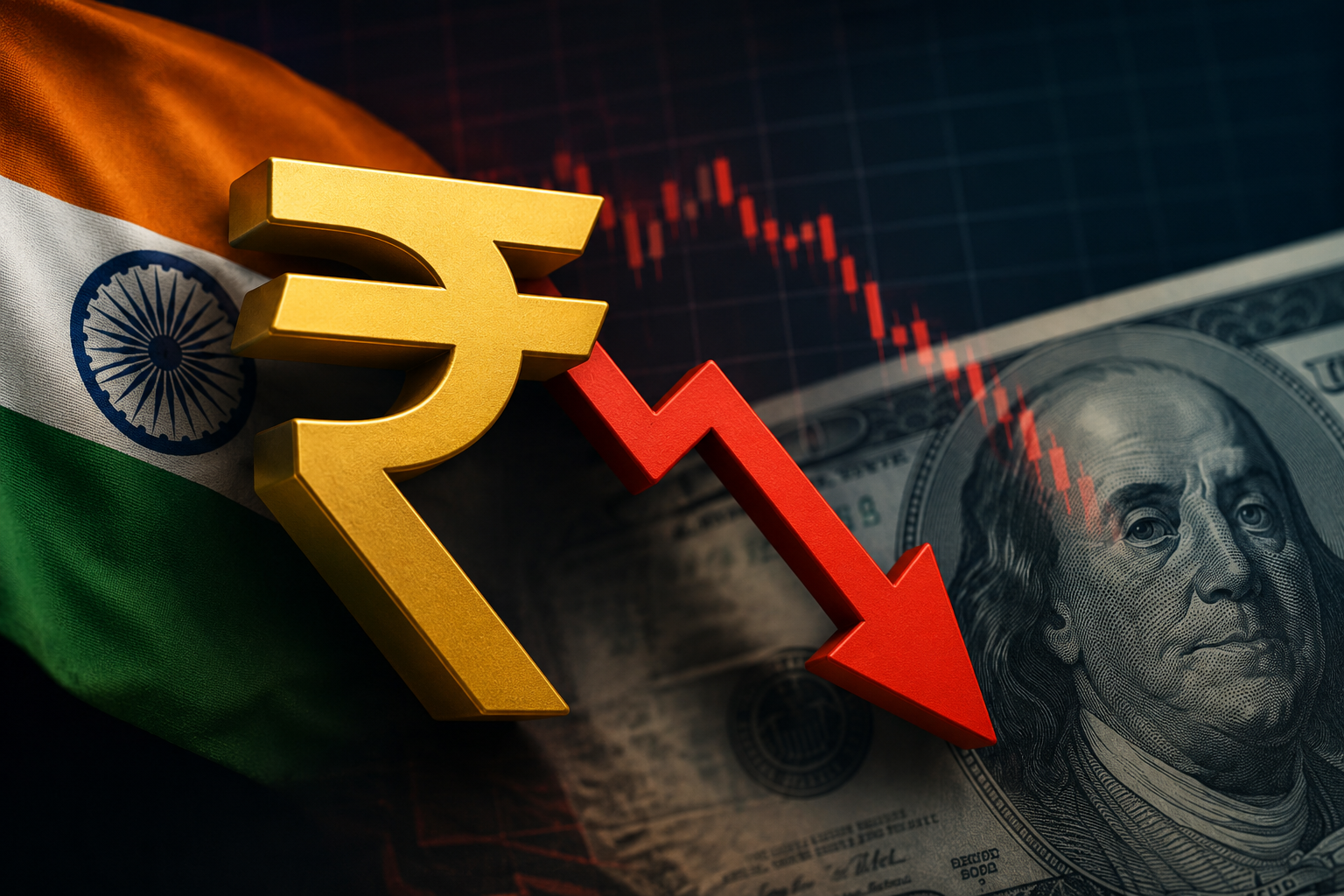
Indian stock markets witnessed a sharp selloff on May 8, 2026, after rising crude oil prices and escalating geopolitical tensions rattled investor confidence. The benchmark Sensex lost more than 400 points during the session, while the Nifty slipped close to the 24,200 mark. Investors rushed toward safer assets as fears over inflation, currency pressure, and foreign capital outflows intensified.
The sudden spike in global oil prices created panic across emerging markets, but India faced greater pressure because of its heavy dependence on imported crude. Traders reacted quickly as Brent crude crossed the psychologically important $100 per barrel level. Market participants now fear that sustained oil inflation could slow economic growth, weaken corporate earnings, and complicate monetary policy decisions.
Crude Oil Prices Trigger Market Panic
The stock market decline started after reports linked renewed tensions between the United States and Iran to potential disruptions in global energy supplies. Traders anticipated supply shortages, which pushed crude oil prices sharply higher in international markets.
India imports nearly 85 percent of its crude oil requirements. Any major increase in oil prices directly affects transportation, manufacturing, logistics, aviation, and consumer goods industries. Investors immediately started reducing exposure to sectors that rely heavily on fuel consumption and imported raw materials.
Oil marketing companies, airline stocks, paint manufacturers, and several chemical businesses witnessed heavy selling pressure throughout the trading session. Investors worried that companies may struggle to protect profit margins if fuel costs continue to rise.
The market also reacted to fears surrounding inflation. Higher crude oil prices usually increase retail fuel prices, transportation costs, and input expenses across industries. Rising inflation can reduce consumer spending power and weaken economic activity over time.
Sensex and Nifty Extend Losses
The BSE Sensex continued its downward movement for the second consecutive session. Banking, financial, automobile, and energy stocks dragged the index lower as traders booked profits aggressively.
The NSE Nifty also faced broad-based selling pressure. Analysts observed weakness across large-cap and mid-cap counters as investors avoided riskier positions amid global uncertainty.
Market breadth remained negative during most of the session. More stocks declined than advanced, which reflected widespread caution among institutional and retail investors.
Banking stocks suffered significant losses because higher oil prices often create inflationary pressure and increase concerns around interest rates. Investors fear that prolonged inflation could force the Reserve Bank of India to maintain tighter monetary conditions for longer periods.
Financial institutions usually perform better in stable economic conditions. Rising geopolitical uncertainty, however, often reduces investor appetite for financial stocks because economic growth expectations become less predictable.
Foreign Investors Continue Selling Indian Equities
Foreign Institutional Investors continued their selling activity in Indian markets, which added further pressure on benchmark indices. FIIs have already reduced exposure to several emerging markets due to global uncertainty and rising commodity prices.
Global investors often move funds toward safer assets like US Treasury bonds and gold during periods of geopolitical instability. This shift affects emerging markets like India more severely because foreign capital plays a major role in market liquidity and sentiment.
Persistent FII selling also weakens the Indian rupee. Currency depreciation increases the cost of imports, especially crude oil, which creates another layer of economic pressure.
Market participants closely monitored FII activity during the session because foreign investor flows often influence short-term market direction. Continuous outflows may keep volatility elevated over the coming weeks.
Rupee Weakness Raises Additional Concerns
The Indian rupee weakened against the US dollar as investors reacted to rising crude prices and foreign capital outflows. Currency traders expect continued pressure on the rupee if oil prices remain elevated.
A weaker rupee increases the overall import bill for India. Companies that depend heavily on imported materials may face rising operational costs, which could eventually affect profitability and earnings guidance.
Currency depreciation also impacts inflation because imported goods become more expensive. Economists now expect policymakers to monitor inflation trends more closely over the next few months.
Investors remain cautious because currency instability can reduce international investor confidence in emerging economies. Stable currency conditions usually encourage foreign investment, while rapid depreciation creates uncertainty.
Defensive Sectors Offer Limited Support
Despite the broader market weakness, a few defensive sectors managed to show resilience. Healthcare and diagnostic companies attracted buying interest after reporting strong quarterly earnings.
Investors often move toward defensive sectors during uncertain market conditions because these businesses usually maintain stable demand regardless of economic cycles.
Fast-moving consumer goods companies also limited some losses, although rising input costs continue to worry investors. Businesses that depend on packaging materials, transportation, and fuel may experience margin pressure if crude oil prices remain high for an extended period.
Technology stocks showed mixed performance during the session. Some investors viewed export-oriented IT companies as relatively safer because a weaker rupee can improve overseas revenue realization.
Analysts Watch Key Support Levels
Technical analysts now focus on important support zones for the Nifty and Sensex. Many traders believe the market could remain volatile until oil prices stabilize and geopolitical tensions ease.
The 24,100 to 24,300 range on the Nifty has emerged as a critical support area. A decisive break below that range could trigger additional selling pressure in the near term.
Analysts also expect global developments to influence Indian equities over the coming sessions. Any escalation in geopolitical conflict or further spike in oil prices may deepen market losses.
At the same time, positive diplomatic developments or signs of easing tensions could improve investor sentiment quickly.
Investors Shift Toward Safer Assets
The sharp decline in equities encouraged many investors to move funds toward safer investment options. Gold prices gained strength as traders sought protection against uncertainty and inflation risks.
Government bonds also attracted interest because investors often prefer fixed-income instruments during periods of heightened volatility.
Retail investors remained cautious throughout the day. Many traders reduced leveraged positions and avoided aggressive buying despite lower stock valuations.
Wealth managers advised long-term investors to focus on quality companies with strong balance sheets and stable earnings visibility instead of reacting emotionally to short-term market fluctuations.
Outlook for Indian Markets
Indian markets may continue to experience volatility over the next few weeks as global uncertainties dominate investor sentiment. Oil prices, foreign investor flows, inflation data, and geopolitical developments will likely determine market direction in the near term.
The Indian economy still maintains strong long-term growth fundamentals, supported by domestic consumption, infrastructure spending, and manufacturing expansion. However, external shocks like rising crude prices can temporarily disrupt market momentum.
Investors now await further signals from global energy markets and central banks. Stable oil prices and improving geopolitical conditions could help restore confidence across financial markets.
Until then, traders and investors may continue to adopt a cautious approach while monitoring developments closely.
Also Read – Can You Really Turn $100 into $10,000 with Forex?