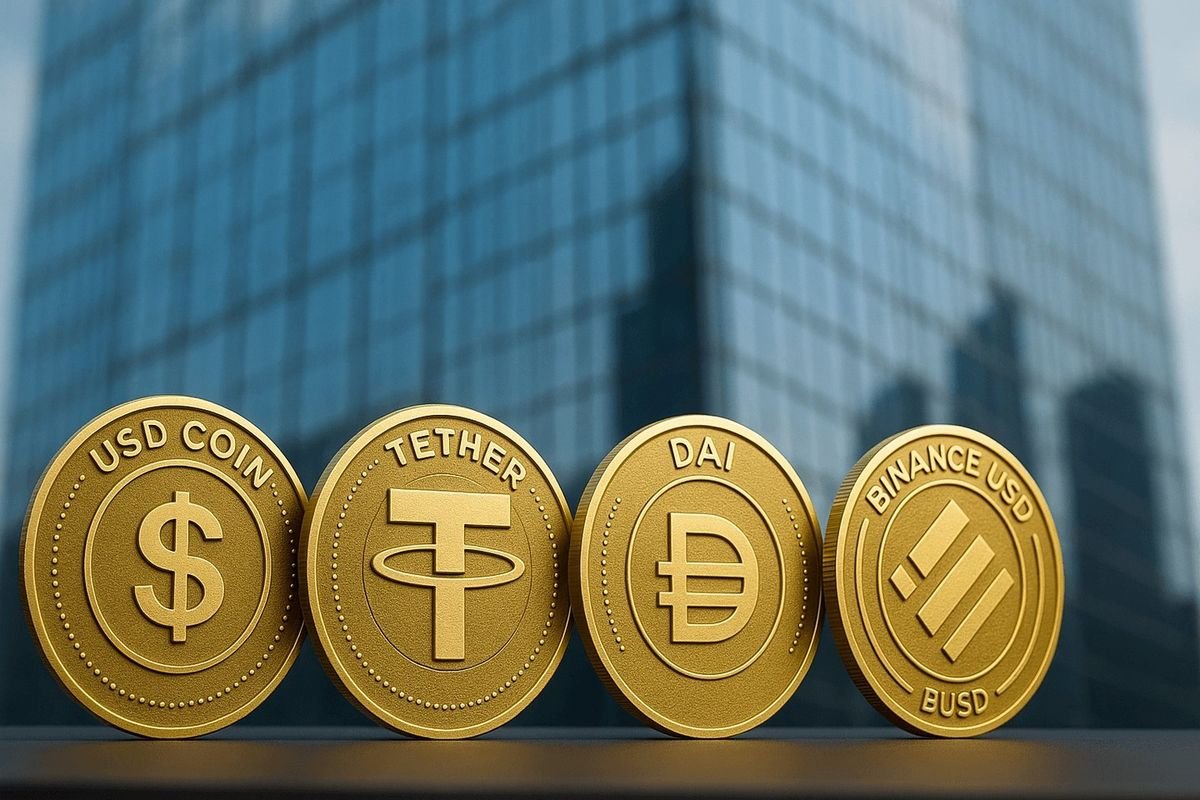
Stablecoins have become one of the main parts of DeFi. They aim to keep a value close to one US dollar, yet they can also produce returns through lending, liquidity pools, savings products, and other DeFi systems.
In 2026, the stablecoin yield market has a much wider range of choices than before. A simple Aave deposit may offer a low single-digit return, while some Pendle markets can show double-digit rates. The key point is that a higher APY usually comes with higher risk.
Current data from Spark puts Aave V3 USDC supply APY at about 3.21%, Sky Savings Rate at about 3.75%, Ethena sUSDe at about 4.55%, and Morpho USDC on a Spark vault on Base at about 4.08%. These figures can change as market conditions and protocol rules change.
Aave: A Core DeFi Choice
Aave remains one of the most important names in DeFi lending. Its basic model is easy to understand. A user supplies a stablecoin such as USDC to a lending market. Borrowers then pay interest for access to that capital.
The return comes mainly from borrower demand. When more people want to borrow stablecoins, supply rates can rise. When demand falls, rates can drop.
A mid-2026 review placed Aave V3 USDC supply APY in the 3% to 7% range. A separate review gave a narrower current range of about 3.8% to 5.2% for USDC and 4.0% to 5.4% for USDT. Aave V3 also had about $12 billion in total value locked in that review.
Aave is worth watching for users who want a relatively simple DeFi lending option. The main risks still include smart contract issues, stablecoin depeg risk, oracle risk, and changes in supply rates.
Aave also moved into a new phase in 2026. Aave V4 launched on Ethereum mainnet on March 30, 2026, with a Hub-and-Spoke liquidity model.
Sky and Spark: A Savings-Style Option
Sky offers another approach to stablecoin yield. Its USDS and sUSDS products are tied to the Sky ecosystem, where users can access a protocol-based savings rate.
The Sky Savings Rate was about 3.75% in recent 2026 data. The rate can change because governance and protocol revenue affect the system.
This makes Sky different from a basic Aave lending deposit. With Aave, the return is closely tied to borrower demand and market use. With Sky, the savings rate comes from the wider Sky system.
For someone who wants a simple stablecoin savings model, Sky deserves close attention. It does not mean the product has no risk. Users still face smart contract, stablecoin, governance, and wider protocol risks.
Morpho: More Flexible Lending
Morpho has become one of the more interesting names in DeFi lending. Its system allows users to access different lending markets and curated vaults.
A mid-2026 review placed Morpho Blue USDC supply APY at about 4.1% to 6.8%, while another broader source gave Morpho a 4% to 12% range for some USDC opportunities. Morpho had about $11.8 billion in total value locked in the same review.
The wider range matters. A user should not assume that every Morpho vault offers the highest rate. Each market has its own collateral, liquidity, risk settings, and curator.
Morpho can suit users who want more choice than a standard lending pool. It also requires more care because a specific market may have a different risk profile from another.
Curve: A Major Stablecoin Liquidity Platform
Curve has long held a major place in stablecoin DeFi. Its design focuses on trades between assets that have similar values, such as stablecoins.
Users can supply liquidity to Curve pools and earn fees. Some pools can also have extra rewards. This can create returns above plain lending rates.
The trade-off is more complexity. A stablecoin pool is not automatically safe just because all assets aim for a one-dollar value. One asset can lose its peg, pool balances can change, and reward rates can fall.
Curve therefore suits users who understand liquidity pools and the risks of each asset in a pool. Its yield can look attractive, but the headline number should never be the only factor.
Pendle: A Market for Future Yield
Pendle stands out because it lets users trade future yield. Its Principal Token, or PT, model can provide a way to lock a return until a set maturity date.
This can appeal to users who prefer a clearer target rate instead of a variable rate. In 2026, PT markets have shown some very high figures. Recent market data showed examples above 20%, including about 21.46% for one sUSD3 PT market and about 17.83% for a reUSDe market.
Those rates should not be viewed as low-risk stablecoin returns. The underlying asset, maturity date, liquidity, and structure all matter.
Pendle can therefore be useful for more experienced DeFi users who understand fixed-term positions and the risks behind the yield.
Ethena: Higher Yield With More Risk
Ethena belongs in a separate category. Its stablecoin system does not rely on the same model as basic overcollateralized lending.
Its sUSDe product can offer attractive returns, with recent data showing about 4.55% in one comparison. Ethena assets have also become active across major DeFi markets. In June 2026, Ethena reported more than $461 million of USDe supplied on the Aave Ethereum core market and about $241 million of sUSDe supply.
The return can change with market conditions, so users should not treat Ethena as a bank savings account.
Its risks include synthetic-dollar risk, funding-rate conditions, liquidity risk, smart contract risk, and broader system risk. That makes Ethena more suitable for users who understand how its yield model works.
What Makes a Good Stablecoin Yield Platform?
The highest APY is not always the best choice. A 15% return may look better than a 5% return, but the 15% option may have far more risk.
The first question should be where the yield comes from. Borrower interest, trading fees, protocol rewards, funding rates, and credit exposure all create different risk profiles.
The second question is whether the yield can last. Some high rates depend on temporary incentives. When those incentives end, the return can fall quickly.
Stablecoin quality also matters. USDC, USDT, USDS, USDe, and other dollar-linked assets do not carry the same risks.
Liquidity is another key factor. A user may see an attractive rate but still face trouble when a fast exit is needed.
The 2026 DeFi Stablecoin Outlook
The main trend in 2026 is a move away from simple yield farming toward more specific forms of yield. Aave and Morpho focus on lending. Sky focuses on protocol-based savings. Curve focuses on stablecoin liquidity. Pendle creates markets for future yield. Ethena offers a different synthetic-dollar model.
Current market data also shows that ordinary stablecoin lending rates are mostly in the low-to-mid single digits. Aave, Morpho, SparkLend, Compound, Fluid, and Euler all sit within broadly similar ranges, although exact rates differ by asset and market.
This makes very high APYs worth extra attention. A double-digit return may be real, but it usually means the user accepts additional credit, liquidity, market, protocol, or structural risk.
Final Thoughts
For a more conservative DeFi approach, Aave and Sky/Spark are two of the strongest platforms to watch. Morpho offers more flexibility for users who want to study individual markets. Curve remains important for stablecoin liquidity, while Pendle stands out for fixed-term yield markets. Ethena remains one of the more specialized choices for users who accept higher risk.
The best platform is therefore not the one with the biggest number on the screen. It is the one whose yield source, risks, liquidity, and structure match the user’s goals. In 2026, careful research matters more than chasing the highest APY.
ALSO READ: DeFi Protocol Comparisons: Aave, Uniswap, Curve and More Now