Pyramid Technoplast Limited has issued revised audio and video links for its Q1 FY27 earnings call. The call took place on August 12, 2026, after a change from the earlier August 11 date. The company said the earlier web link was not accessible due to a technical error. It has now shared direct links on its website so investors can hear and view the full call.
The earnings call was for the unaudited financial results for the quarter ended June 30, 2026. The company filed the revised notice with the National Stock Exchange of India Ltd. and BSE Limited on August 12, 2026, as per Regulation 30 of the SEBI Listing Obligations and Disclosure Requirements Regulations, 2015.
The call was hosted by Go India Advisors. Pyramid Technoplast Managing Director and Chairman Bijaykumar Agarwal took part in the call along with Whole Time Director and CFO Jaiprakash Agarwal. Investors can use the revised audio and video links to hear the management view on Q1 FY27 results and the business outlook for the rest of the year.
Q1 FY27 results show strong growth
The revised call comes at a useful time because Pyramid Technoplast has posted a strong first quarter. Revenue from operations rose 35.8% year on year to ₹2,224.90 lakh in Q1 FY27 from ₹1,638.11 lakh in Q1 FY26. Total income rose 35.7% to ₹2,235.12 lakh from ₹1,646.62 lakh.
Profit before tax rose 32.1% to ₹139.58 lakh from ₹105.68 lakh. Net profit after tax also rose 32.1% to ₹104.45 lakh from ₹79.08 lakh. Basic earnings per share rose to ₹2.85 from ₹2.16, a rise of 32%. These figures show that the company had solid growth across the first quarter of FY27.
The rise in revenue came from better realisations and strong volume growth in Mild Steel, or MS, drums and Intermediate Bulk Containers, or IBCs. IBCs are an important part of the company’s future plans because they can offer better margins than some other products.
Profit margin also shows improvement
Pyramid Technoplast also saw a better EBITDA margin in Q1 FY27. EBITDA rose to ₹202 million from ₹133 million a year earlier, while the EBITDA margin rose to 9.1% from 8.14%. This is important because revenue growth alone does not always lead to better profit. In this case, the company also saw an improvement in its operating margin.
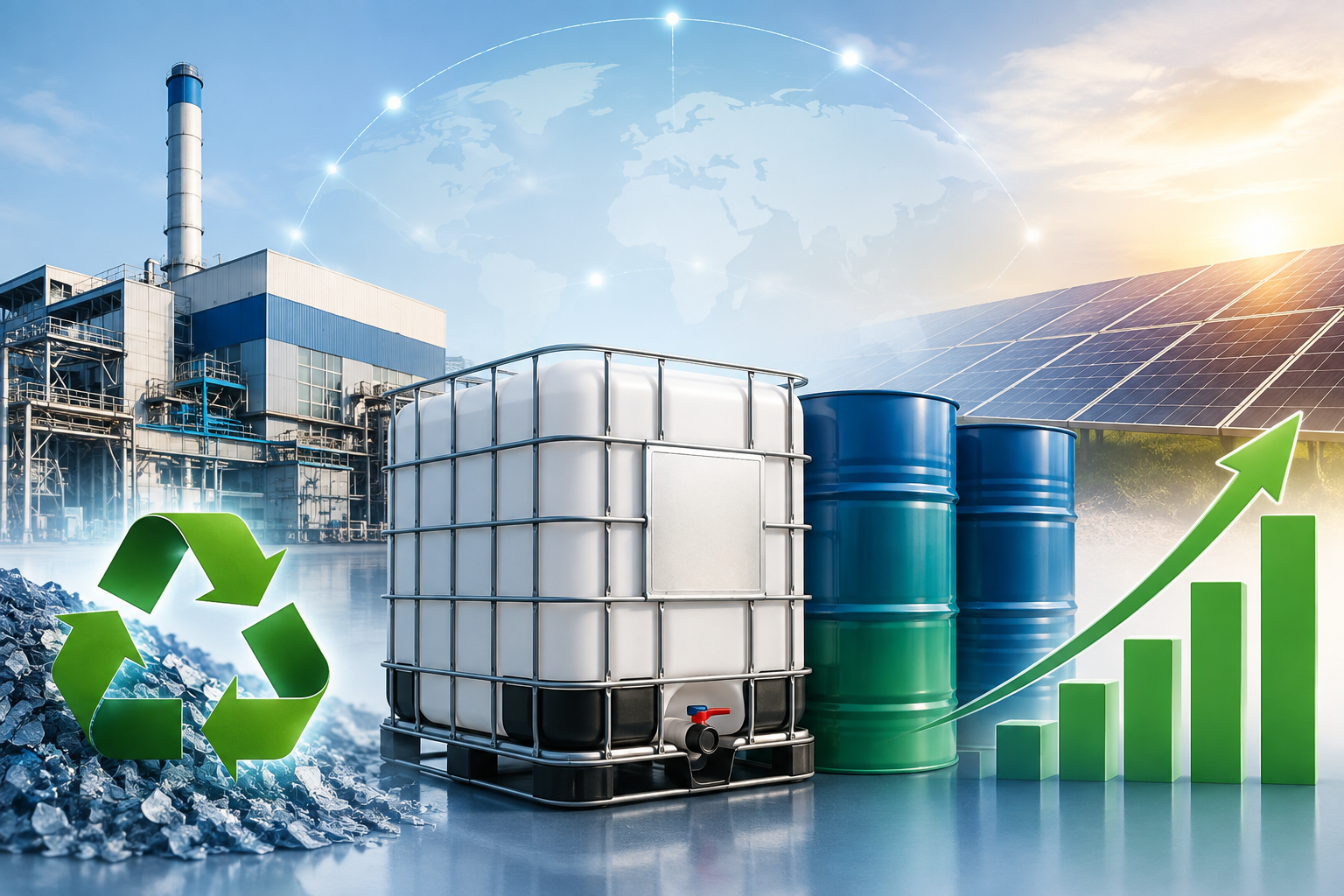
The company has made two major investments that now support its cost structure. One is a recycling plant and the other is a solar power plant. Both projects have started to give financial benefits, which can help the company move closer to its FY27 margin goal.
Recycling plant adds a new source of savings
Pyramid Technoplast commissioned its recycling plant on October 3, 2025, with an investment of ₹8–10 crore. The plant processed 155 MT of material in Q1 FY27 and generated EBITDA profit of ₹25 lakh during the quarter.
Management expects the recycling plant to add about ₹2 crore to EBITDA in FY27. The plant is also expected to meet around 10–12% of the company’s raw material needs. This can help reduce the company’s dependence on outside raw material sources and give it better control over costs.
This part of the business is worth close attention because raw material costs can have a major effect on packaging companies. A higher share of recycled material may help Pyramid Technoplast protect its margins if input costs rise.
Solar plant cuts power costs
The second major project is the solar power plant, which was commissioned on October 30, 2025. The company has invested more than ₹60 crore in the project.
The solar plant gave savings of ₹2 crore in Q1 FY27. Pyramid Technoplast expects total savings of about ₹15 crore from the plant in FY27. Such savings can support EBITDA and profit without a direct need for higher product prices.
The two projects together show that the company is not relying only on higher sales for profit growth. Cost control has also become a key part of its strategy.
Capacity use remains a key factor
Pyramid Technoplast has nine manufacturing units with total production capacity of 83,745 MTPA. Current capacity use stands at 62%. Management has linked the lower use to short-term volume pressure from geopolitical tensions. It has also said that per-tonne profitability remains unaffected.
The 62% figure is important for investors because it shows that the company still has spare capacity. If demand improves, Pyramid Technoplast can raise output without the same level of fresh capital spend that a fully used business would need.
At the same time, the low capacity use creates a near-term risk. If market demand stays weak for longer, the company may find it harder to meet its FY27 revenue target.
FY27 target stays at 15% revenue growth
Management has retained a revenue growth target of about 15% for FY27. The company expects a higher share of revenue from high-margin IBC products. It also plans to use more automation in metal drum production.
The company has also set an EBITDA margin target of 11–12% for FY27. The Q1 FY27 margin stood at 9.1%, so the business has more ground to cover before it reaches the full-year target. The recycling and solar projects could help close part of this gap.
Kutch facility adds another growth lever
Pyramid Technoplast also plans a new facility in Kutch, Gujarat. The project has an estimated investment of ₹20–25 crore and a planned capacity of 10,000 IBC units per month. The company expects the facility to be ready by March 2027.
The Kutch site should give Pyramid Technoplast a stronger presence in Western India. It may also lower freight costs and allow faster delivery to customers in the region. The new unit fits well with the company’s plan to raise the share of IBC products in its revenue mix.
Subsidy benefits may improve project returns
Another positive factor is the potential government subsidy support for two existing facilities. Pyramid Technoplast has an approved subsidy of about ₹24.90 crore over 10 years for its Wada facility. Sanction is expected by March 2027.
For Unit 7 at Bharuch, the subsidy benefit is about ₹10.50 crore, although the formal sanction application has yet to be filed. The total potential subsidy support is about ₹35.40 crore, subject to the required approval and disbursement process.
These benefits can reduce the effective cost of the company’s investments. They may also improve return on capital employed, internal rate of return and project payback.
Higher finance cost needs attention
Not all parts of the Q1 picture were positive. Finance costs rose to ₹35.14 lakh from ₹12.60 lakh a year earlier. This is a sharp rise and deserves close attention as the company plans more capital expenditure.
The company plans FY27 capex of ₹20–25 crore, mainly for the Kutch project, and expects to fund it through internal accruals. This approach can reduce the need for fresh debt, but investors will still need to watch cash flow and finance costs as the business expands.
What investors should watch next
The revised earnings call links are useful because the main value now lies in the management commentary. Investors should focus on whether the company can raise capacity use from 62%, reach its 15% FY27 revenue target and lift EBITDA margin toward 11–12%.
The progress of the Kutch facility is another key point. Its planned capacity of 10,000 IBC units per month could support future growth, but its value will depend on demand and actual capacity use.
The subsidy approvals, solar savings and recycling plant also deserve attention. If these benefits continue as expected, they could support margins and improve returns on capital.
Overall, Pyramid Technoplast enters FY27 with strong Q1 numbers, new cost-saving assets, spare capacity and a clear expansion plan. The main challenge is to turn that capacity and investment into sustained sales and higher margins. The revised call links now give investors direct access to management’s view on how the company plans to achieve that goal.
ALSO READ: VA Tech Wabag FY26 Results: Profit Rises 26%


