Warren Buffett has built his reputation on a simple idea: buy a good business at a fair price and hold it for many years. He does not usually chase the latest trend or buy a stock just because everyone else likes it.
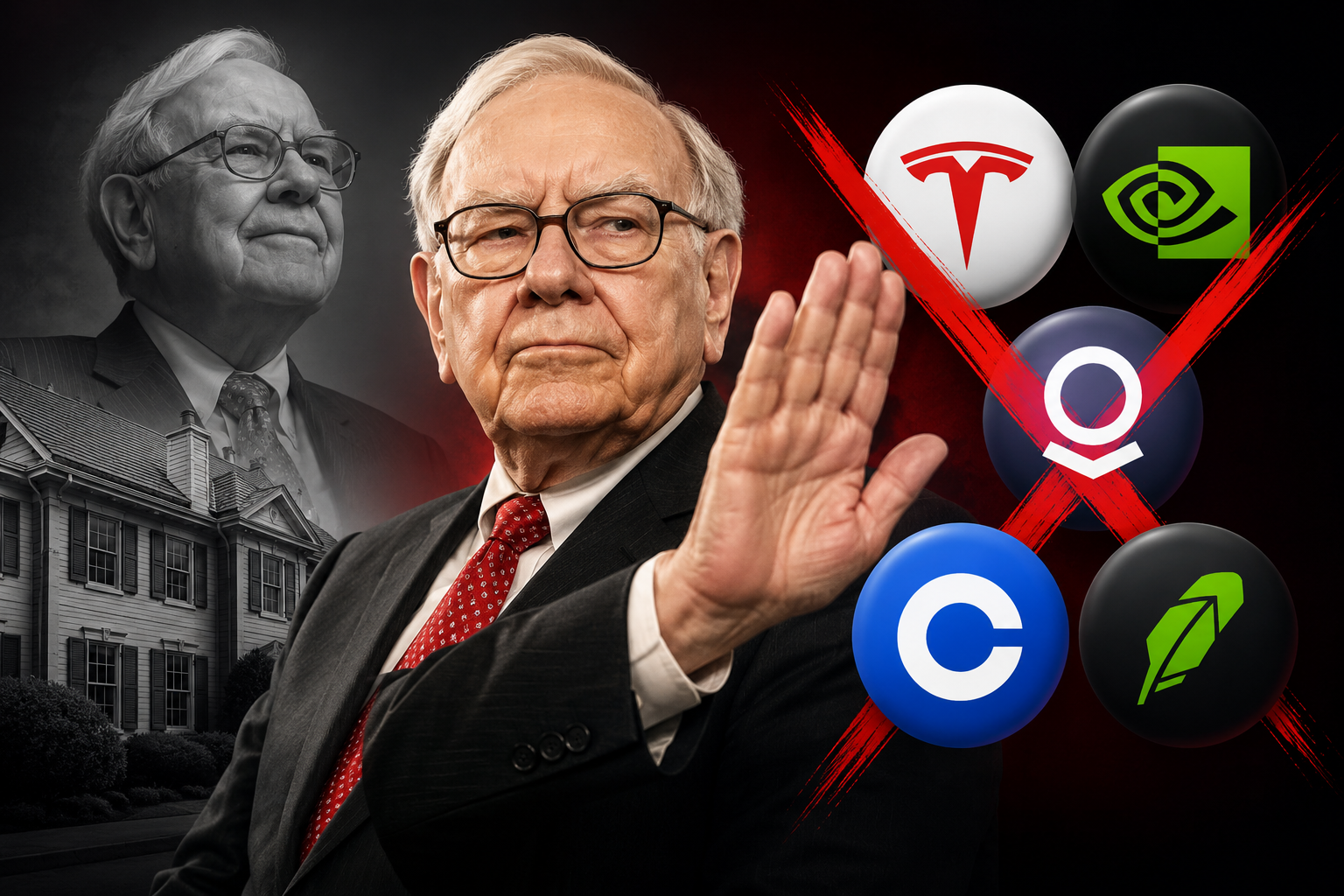
That is why some of the most popular stocks in the market today may not fit his style. Tesla, NVIDIA, Palantir, Coinbase, and Robinhood are all well-known names. Each company has a strong story behind it. Yet each also has features that could make Buffett cautious.
There is one important point to make first. Buffett has not said that he would “never” buy all five of these stocks. So this is not a list of stocks that Buffett has personally rejected. Instead, it looks at these companies through the rules and ideas that have shaped his investment decisions for decades.
That difference matters because Buffett has surprised investors before.
The Buffett Test Is More Simple Than It Looks
Buffett usually looks for a business that he can understand. He wants a company with a strong advantage over its rivals, good management, solid cash flow, and a fair price.
He also wants to feel confident about the future of the business.
This is where many popular growth stocks can become difficult. If a company needs very high future growth to justify its current price, an investor has to make many guesses. A small mistake in those guesses can change the value of the stock by a large amount.
Buffett prefers a business where the future is easier to estimate.
But there is a common mistake about his style. Buffett does not avoid technology simply because it is technology.
Berkshire Hathaway has owned Apple for years. More recently, Buffett said he was the person who started Berkshire’s investment in Alphabet, the parent company of Google. Berkshire first disclosed its Alphabet position in the third quarter of 2025 and later increased it. Buffett also said Greg Abel, Berkshire’s new CEO, is now the final decision maker.
So the real Buffett question is not, “Is this a technology company?”
The better question is, “Can I understand this business, estimate its future value, and buy it at a sensible price?”
Tesla Faces a Difficult Buffett Test
Tesla may be the clearest example of a popular stock that does not fit the classic Buffett style.
Tesla has a major position in electric cars. It also has businesses and future plans related to batteries, energy, software, and self-driving technology. These areas could create enormous value in the future.
The problem is that the future is hard to predict.
Buffett likes businesses with what he calls an economic moat. A moat is a lasting advantage that helps a company protect its profits from rivals.
Tesla has a powerful brand and a large global customer base. But the electric car market has intense competition. Many large car companies are also trying to gain a bigger share of this market.
That makes the strength of Tesla’s long-term moat harder to judge.
A 2025 analysis also argued that Tesla does not fit the type of company Buffett usually seeks. The analysis pointed to Tesla’s industry and its focus on artificial intelligence as reasons Buffett may stay away.
This does not mean Tesla is a bad company. It means Tesla may require more predictions about the future than Buffett normally likes to make.
NVIDIA Has a Different Problem
NVIDIA is a much more interesting case.
The company has a powerful position in computer chips and artificial intelligence. Its products have become central to the growth of AI systems. NVIDIA also has a large software and hardware ecosystem, which can make it harder for rivals to compete.
At first glance, that sounds like the type of business Buffett could like.
But there is still a major question: what will NVIDIA’s profits look like ten years from now?
The artificial intelligence market is moving very fast. Demand for AI chips could remain strong, but new rivals could appear. Large technology companies can also create their own chips. Changes in AI software could also affect future demand.
NVIDIA may keep its lead for many years. But a Buffett-style analysis would require a high level of confidence about that future.
That is the key issue.
A great company can still be a poor investment if its future profits are too hard to estimate or if its stock price already assumes many years of excellent results.
Palantir Depends on Strong Future Growth
Palantir is another popular stock that could make a Buffett-style investor pause.
The company sells software that helps organizations work with large amounts of data. It also has a major connection to artificial intelligence. Palantir serves both government and commercial customers.
Its business has attracted a lot of attention because AI could create a much larger market for its products.
The challenge is valuation.
Much of Palantir’s appeal comes from the belief that its revenue and profits can grow at a very high rate for many years. Buffett does not need a company to grow at a huge rate. He needs to have a reasonable idea of what the company may be worth in the future.
If a large part of a stock’s value depends on very high future growth, the risk becomes greater.
Suppose an investor expects very strong growth for ten years. If that growth slows after five years, the value of the stock could look very different.
A cautious investor may prefer a company where the future does not depend on such a large number of optimistic forecasts.
Coinbase Is Far From Buffett’s Usual Style
Coinbase may be an even bigger mismatch with Buffett’s traditional approach.
Coinbase is closely tied to the cryptocurrency market. When crypto activity is strong, the company can benefit from higher customer activity and greater market interest. When the crypto market becomes weak, its business can face pressure.
That makes its future results harder to predict.
Compare that with a company such as Coca-Cola. People buy Coca-Cola products in good economic times and bad economic times. The business has a long history, a familiar brand, and demand that is easier to understand.
Buffett has also been very clear about cryptocurrency itself. He has said that he does not own Bitcoin and does not plan to own it. His main objection is that Bitcoin does not produce earnings or dividends like a productive business.
Coinbase is a real company, so it is not the same as Bitcoin. But its close link to crypto activity could still make it less attractive to an investor who prefers simple and predictable businesses.
Robinhood Brings Another Risk
Robinhood changed the way many retail investors access stocks, options, and other financial products.
Its platform has attracted a large user base, and its brand has become well known among younger investors.
But Robinhood’s results can depend heavily on customer activity and market conditions.
When retail investors are very active, Robinhood can benefit. When interest in financial markets falls, customer activity can slow.
This creates a different type of uncertainty.
Buffett often prefers companies where demand stays fairly stable through different economic periods. A company whose results depend more heavily on market activity may be less comfortable for his style.
Again, that does not make Robinhood a bad business. It simply makes the company different from the type of predictable business Buffett has favored for much of his career.
Buffett Does Not Buy a Story
This is perhaps the biggest lesson from these five stocks.
Tesla has its electric car and AI story. NVIDIA has its AI chip story. Palantir has its data and AI story. Coinbase has its crypto story. Robinhood has its retail investor story.
These stories can be powerful.
But Buffett does not usually buy a stock because the story sounds exciting.
He wants to understand how the company makes money. He wants to know what protects the company from rivals. He wants to estimate how much cash the business can produce over many years. Then he wants to compare that value with the price of the stock.
That approach can make Buffett look slow when the market is excited about a new trend.
But it can also protect him from paying too much.
The Real Buffett Filter
The idea that Buffett does not buy technology stocks is no longer correct.
Apple became one of Berkshire Hathaway’s most important investments. Buffett also said he personally started the Alphabet investment.
The real Buffett filter is much more useful.
Can he understand the business? Does it have a lasting advantage? Can it produce strong cash flow? Does management have a good record? Can its future value be estimated without extreme assumptions? And is the stock price low enough to leave room for mistakes?
These questions matter more than whether a stock is popular.
Tesla, NVIDIA, Palantir, Coinbase, and Robinhood may all have strong futures. But each asks an investor to make important predictions about markets, technology, competition, or customer behavior.
That can make them less comfortable for a classic Buffett-style investor.
The Final Word
Warren Buffett’s biggest advantage has never been his ability to predict every new technology.
His real advantage has been patience and discipline.
He can watch a famous company become more popular and still say no if he cannot understand its future well enough. He can also ignore a hot stock if the price leaves too little room for mistakes.
That is why these five companies are so interesting.
They show the difference between a great business story and a business that fits a particular investment method.
Tesla, NVIDIA, Palantir, Coinbase, and Robinhood may all have strong potential. But under a classic Buffett framework, each one creates questions that can make a valuation harder.
So the reason Buffett could stay away is not necessarily that these companies lack potential.
It may be much simpler than that.
He would rather put his money into a business where the future is easier to understand, the competitive advantage is clear, the cash flow is more predictable, and the price gives him enough room for error.
That is the Buffett method in its simplest form: understand the business, value it carefully, and never let excitement make the decision for you.
ALSO READ: The Best Investment Nobody Talks About That Change Your Life