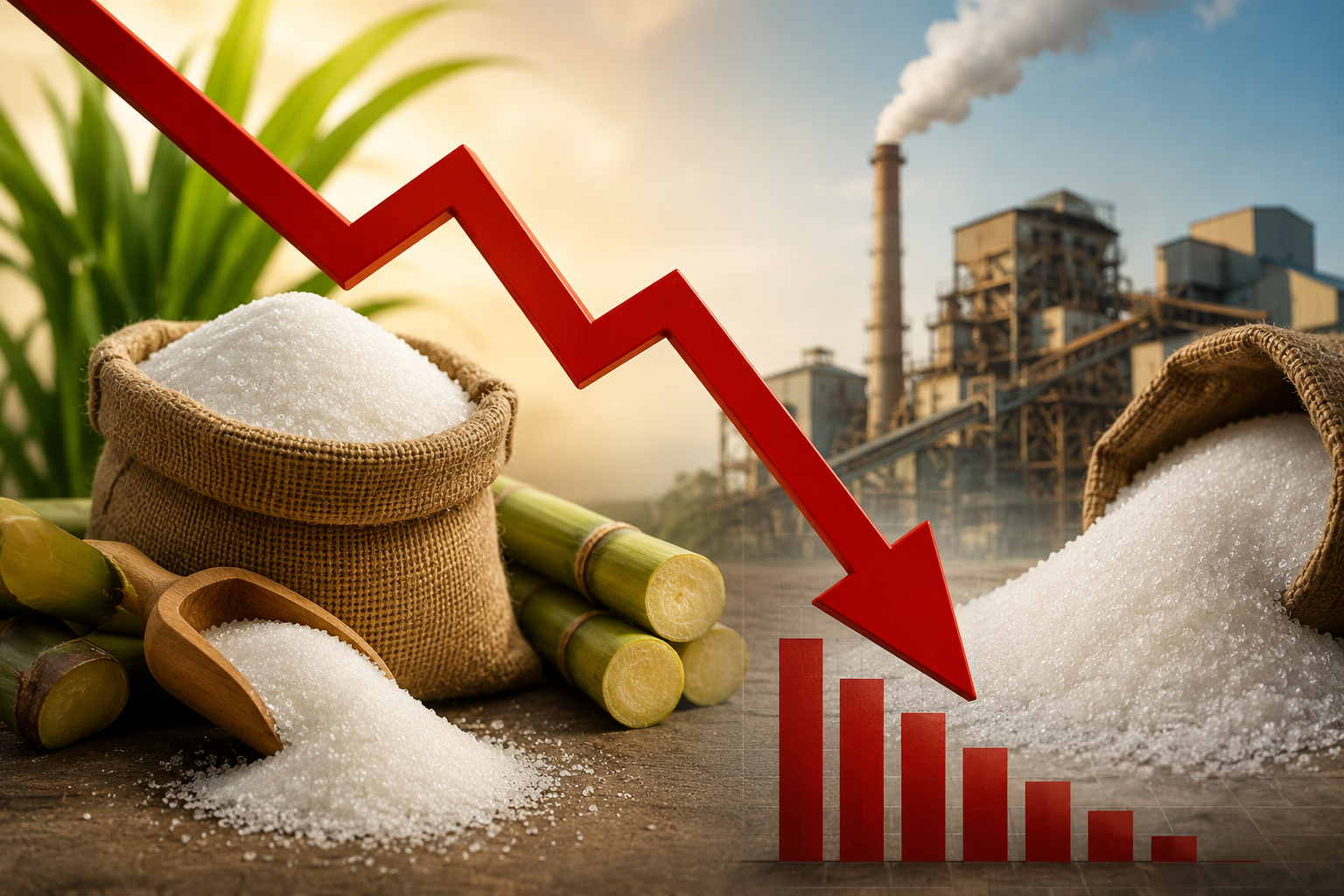
India’s sugar market has seen a sharp change in prices over the past few days. Ex-mill sugar prices have fallen by about 20% over the past 10 days, according to government officials and industry sources cited in recent reports.
The fall has come after several government measures aimed at improving domestic supply, limiting excess stock and reducing pressure on prices. The development is important for sugar mills, traders, refiners and consumers because ex-mill prices are an early part of the supply chain that eventually affects the price paid by consumers.
However, it would not be correct to assume that a 20% fall in ex-mill prices means consumers will also see a 20% fall in retail prices. The two prices operate at different stages of the market. Retail prices can also reflect transport, storage, trade margins, taxes and local supply conditions.
The latest figures therefore point to a clear correction at the mill level, while the full effect on consumers remains uncertain.
What the latest numbers show
Recent reports put the ex-mill sugar price in Kolhapur at about ₹48 per kg. In Uttar Pradesh, the reported price was about ₹53 per kg. These prices came after a sharp rise earlier in August.
The government has also reported a wider rise in sugar prices before the recent correction. The average retail price rose from ₹48.18 per kg on July 20, 2026, to ₹55.70 per kg on August 20, 2026. This was a rise of about 15.6% in one month.
A later report put the average retail price at about ₹65 per kg on August 26. This shows why the difference between ex-mill and retail prices is important.
Key figures
| Measure | Reported figure |
|---|---|
| Ex-mill price decline | About 20% in 10 days |
| Kolhapur ex-mill price | About ₹48/kg |
| Uttar Pradesh ex-mill price | About ₹53/kg |
| Earlier Kolhapur level cited by officials | ₹58–60/kg |
| Retail price on July 20, 2026 | ₹48.18/kg |
| Retail price on August 20, 2026 | ₹55.70/kg |
| Retail price reported on August 26 | About ₹65/kg |
| Duty-free raw sugar import quota | 10 lakh MT |
| Extra refined sugar that may enter the market | About 3–3.5 lakh tonnes |
These figures relate to different dates and stages of the supply chain. They should therefore not be treated as direct one-to-one comparisons.
Why did sugar prices rise first?
The recent rise in sugar prices appears to have had several causes. Government statements have referred to lower-than-expected domestic production, higher demand before the festive season, weather-related crop damage, tighter global sugar supply and certain market practices such as speculation and hoarding.
It is important to use careful language here. A reference to speculation or hoarding does not, by itself, establish unlawful conduct by any particular person or company. Any such conclusion would require evidence about stocks, transactions, market conduct and the actions of the parties concerned.
The government has also rejected the view that ethanol production alone explains the recent price rise.
According to government data, the share of sugar diverted for ethanol fell from about 12% in 2022–23 to about 9% in 2025–26. The government has also stated that nearly three-fourths of ethanol production now comes from grains, especially maize.
This suggests that the price movement cannot safely be explained by one factor alone. Supply, demand, crop conditions, global prices and market expectations can all affect sugar prices.
Government steps to control prices
The Centre has taken several steps to improve domestic supply and limit excess stock.
One major measure is a duty-free import quota of 10 lakh metric tonnes of raw sugar. The measure is intended to add supply to the domestic market and reduce pressure on prices.
The government has also placed limits on sugar stocks held by dealers. A stock limit of 400 tonnes applies to sugar dealers across the country from August 1 to November 30, 2026.
From September 1, bulk consumers will not be allowed to hold more than 15 days of consumption.
The government has also ordered physical checks of sugar stocks at mills. Joint teams of central and state officials are carrying out checks to verify stock levels and examine concerns about possible hoarding or artificial scarcity.
These measures show that the policy response is not based only on imports. It also includes stock controls and physical verification.
Additional refined sugar supply
Another important part of the policy concerns refined sugar already held by Indian refiners.
About 3–3.5 lakh tonnes of refined sugar may become available for the domestic market after a government decision allowed processors to sell some sugar that had been intended for export.
Reports indicate that at least 3 lakh tonnes could enter the domestic market relatively quickly.
This measure may have a faster effect than raw sugar imports. Imported raw sugar first has to reach India and then undergo processing before it can reach buyers. Existing refined sugar can move into the domestic market more quickly.
The possibility of extra supply can also affect market expectations. Traders may become less willing to pay high prices if they expect more sugar to become available.
The exact volume that will reach the market and the speed of its sale remain matters to watch.
What does the 20% fall mean?
The 20% decline in ex-mill prices suggests that the sharp price pressure seen earlier in August has eased.
Government measures may have played a role in this change. The prospect of additional supply can also alter the expectations of mills, traders and refiners.
However, it would be too strong to say that government action alone caused the entire 20% decline.
Prices can change because of several factors at the same time. The recent fall may reflect policy measures, additional supply prospects, changes in trader expectations and a correction after the earlier price rise.
The timing is important, but timing alone does not establish a precise cause.
A legally safer description is that the price fall followed government action and changes in market conditions. It is less appropriate to state as a proven fact that one specific policy measure caused the entire decline.
Why retail prices may not fall immediately
The reported retail price of sugar remains much higher than some ex-mill prices.
For example, the reported Kolhapur ex-mill price is about ₹48 per kg, while the reported average retail price on August 26 was about ₹65 per kg.
This difference does not necessarily mean that retailers are keeping an excessive margin.
There are several stages between a sugar mill and a consumer. Sugar may pass through wholesalers, distributors and retailers. Each stage can involve transport, storage, handling and other costs.
Local conditions can also differ. A retail price in one state or city may not reflect the price in another part of the country.
For this reason, a fall at the mill level does not automatically produce an equal fall in shops.
If lower ex-mill prices continue for a longer period, however, there could be greater pressure for wholesale and retail prices to move lower.
The production outlook
The price issue must also be viewed against India’s sugar production outlook.
The government has estimated current-season sugar production at about 306 lakh tonnes. The earlier estimate was about 343 lakh tonnes.
The lower estimate has been linked to crop problems, including Red Rot and Top Borer disease, as well as waterlogging caused by excess rain.
At the same time, the government has stated that India has adequate sugar stocks to meet domestic demand.
These two statements can exist together. Lower production does not automatically mean an immediate shortage. A country can have lower output while still have enough existing stock to meet current demand.
The more important question is whether available supply will remain sufficient as demand rises and stocks decline.
The October crushing season
The next sugarcane crushing season could have an important effect on the market.
The government has advised states and sugar mills to begin crushing from October 15, 2026.
According to the government’s estimate, October production could rise from the usual 3–4 lakh metric tonnes to more than 10 lakh metric tonnes.
If mills follow the proposed schedule and production reaches the expected level, domestic availability could improve during the festive period.
That could reduce pressure on prices.
There is still some uncertainty, however. The final outcome will depend on crop availability, mill operations, weather conditions and the speed at which sugar reaches the market.
What it means for sugar mills
The recent price decline has mixed consequences for sugar mills.
Higher sugar prices can improve revenue for mills if production costs remain stable. A sharp price decline can reduce that benefit.
Mills may also face financial pressure if they have high production costs or large quantities of sugar that need to be sold.
At the same time, lower prices can reduce the risk of further government intervention if the domestic market becomes more stable.
The effect will differ from mill to mill. Mills with lower costs and stronger finances may be in a better position than those with higher costs or greater financial pressure.
The import policy is another factor.
Recent market reports suggest that mills and refiners may import only about half of the 10 lakh metric tonne duty-free quota because lower domestic prices have reduced the commercial attraction of imports.
This is an important market signal. A government policy may allow imports, but businesses will still decide whether those imports make economic sense.
What it means for consumers
For consumers, the key question is whether lower ex-mill prices will eventually lead to lower retail prices.
There is no certainty yet.
The reported retail price of about ₹65 per kg remains well above the reported Kolhapur ex-mill price of ₹48 per kg.
If lower mill prices remain in place, wholesalers and retailers may face greater pressure to reduce prices. Additional sugar supply could also support lower prices.
But the timing and size of any retail decline cannot be predicted with certainty.
Consumers may therefore receive some benefit if the lower mill prices continue and more sugar reaches the market.
The legal and regulatory angle
The recent developments also need careful treatment from a legal perspective.
Government statements have referred to speculation and hoarding by some sections of the industry. Such statements should not be treated as proof of wrongdoing by every sugar mill, trader, refiner or dealer.
A price increase alone does not establish unlawful hoarding, price manipulation or any other offence.
Similarly, government stock checks do not mean that every business under review has violated any law or regulation.
The same caution applies to the recent price decline.
It is reasonable to say that the fall came after a series of government measures and changes in supply expectations. It would be less appropriate to claim, without supporting evidence, that a particular company or group caused the earlier rise.
Any finding of liability would depend on evidence and the applicable law.
What the market may watch next
The next few weeks could provide a clearer picture of where sugar prices are headed.
The first issue is the actual arrival of additional refined sugar. About 3–3.5 lakh tonnes may become available for domestic sale, but the effect will depend on the quantity that actually reaches buyers and the speed of its sale.
The second issue is the raw sugar import programme. The government has allowed duty-free imports of 10 lakh MT, but commercial demand for those imports may be lower because domestic prices have already fallen.
The third issue is the October crushing season. If mills begin crushing from October 15 and production rises as expected, domestic supply could improve.
The fourth issue is retail pricing. A sustained fall in ex-mill prices would provide a stronger basis for expecting some reduction in consumer prices.
A sharp correction, but not yet a full consumer benefit
The 20% fall in ex-mill sugar prices is a significant market development.
It indicates that the strong price pressure seen earlier in August has eased. The change has come at a time when the government has introduced several measures to improve supply, control stocks and increase market availability.
The reported ex-mill price in Kolhapur is now about ₹48 per kg, while Uttar Pradesh is at about ₹53 per kg. The reported retail price, however, remains around ₹65 per kg.
This gap is important. It shows that lower mill prices have not yet produced an equal benefit for consumers.
The government’s 10 lakh MT duty-free import quota, the possible release of 3–3.5 lakh tonnes of refined sugar and the planned October 15 crushing start could provide further supply support.
At the same time, estimated sugar production of about 306 lakh tonnes remains below the earlier estimate of about 343 lakh tonnes.
The market therefore faces two different forces. Additional supply may reduce price pressure, while lower production could limit the extent of that relief.
Conclusion
India’s sugar market has moved from a period of sharp price pressure to a notable correction at the ex-mill level.
The reported 20% fall over 10 days is substantial. It has come after government action that includes a 10 lakh MT duty-free raw sugar import quota, stock limits, physical stock checks and measures that could bring about 3–3.5 lakh tonnes of refined sugar into the domestic market.
The next sugarcane crushing season is also expected to begin from October 15, 2026, with the government estimating October production at more than 10 lakh metric tonnes compared with the usual 3–4 lakh metric tonnes.
For consumers, however, the story is not yet complete. The reported retail price of about ₹65 per kg remains much higher than some ex-mill prices.
The safest conclusion is that price pressure at the mill level has eased, but it is too early to say that consumers will receive the same 20% reduction.
The coming weeks will be important. The actual flow of imported and released sugar, the start of the crushing season, domestic production and retail price movements will determine whether the recent correction becomes a longer-term trend.
Any claim about unlawful hoarding, manipulation or other misconduct should also remain subject to evidence and due process. Price movements alone cannot establish wrongdoing by any particular party.