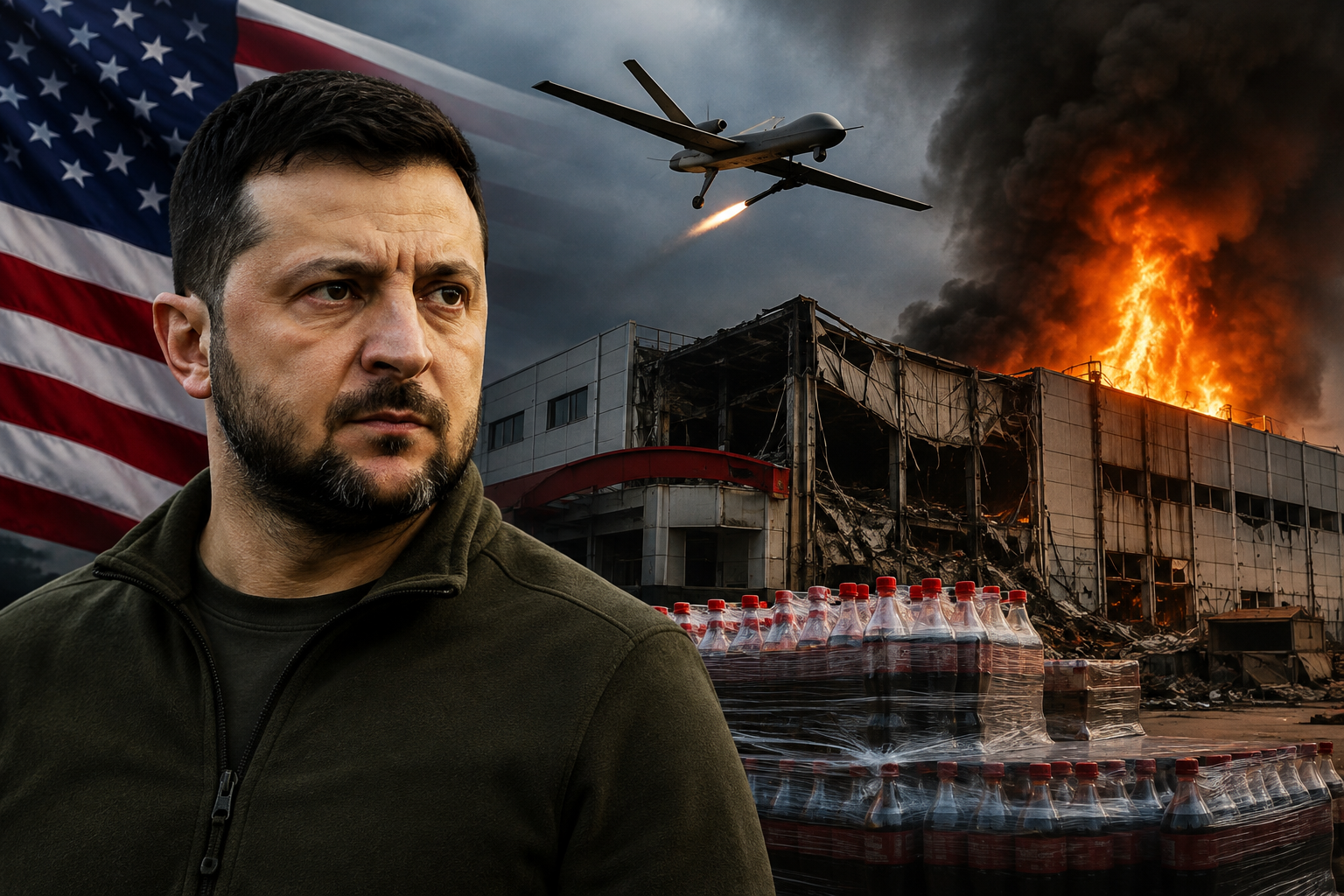
A Coca-Cola production plant in Ukraine’s Kyiv region was damaged by a Russian drone attack on September 3, 2026. The plant is located in Velyka Dymerka, in the Brovary district of Kyiv Oblast.
The attack caused a fire at the site. Videos from the area showed thick smoke after the strike. Early reports said the drone hit warehouses that held finished Coca-Cola products.
Ukrainian President Volodymyr Zelensky later confirmed the attack. He said Russian forces had struck the Coca-Cola plant with a drone and used the incident to send a wider message to the United States.
Zelensky said Russia could not be unaware that the plant belongs to an American company. He called the strike “a clear Russian signal to America.”
Coca-Cola confirms damage
Coca-Cola later confirmed that its production site in the Brovary area had suffered damage from a drone attack.
The company said all of its workers were safe and no employees were hurt. Coca-Cola also said it was working with local authorities to assess the situation.
The safety of its workers remains the company’s main concern, according to its statement.
The confirmation is important because early reports about the plant came before the company itself spoke about the incident. Ukrainian media first reported a fire at the facility and later reported that the site had suffered damage.
There is no report that any Coca-Cola worker died or suffered an injury in the strike.
Zelensky links the attack to America
Zelensky gave the attack a strong political meaning in his evening address.
He said Russian weapons are used not only to hit military targets but also to put pressure on civilian life and the Ukrainian economy. He said the strike on the Coca-Cola plant was another example of that wider pressure.
His main point was about the company’s American connection.
Coca-Cola is one of the best-known American brands in the world. Its plant in Ukraine is part of Coca-Cola Beverages Ukraine. Zelensky argued that Russia knows the company is American and therefore sees the attack as a message to Washington.
This does not, by itself, prove that Russia chose the Coca-Cola site because it is an American company. There has been no independent evidence so far that clearly shows the reason behind the choice of this specific target.
That difference matters. The strike itself has been confirmed. The claim about its purpose comes from Zelensky.
A wider attack on Kyiv
The Coca-Cola plant strike came during a wider Russian air attack on Kyiv and the surrounding region.
September 3 marked the eighth straight day of Russian attacks on Kyiv, according to Ukrainian officials and local reports. The attacks caused damage at several sites and hurt civilians.
Kyiv Mayor Vitali Klitschko said at least 13 people were hurt in the September 3 attack. The group included a 12-year-old girl and six medical workers. Six people were taken to hospital, including the child.
A separate Russian strike also damaged a nine-story apartment building in Kyiv. A fire broke out and residents had to leave the building. Reuters later corrected an early report about one death and said the confirmed figure was 10 injured.
These attacks show the pressure on Kyiv as Russian forces continue to use large numbers of drones and other weapons against Ukraine.
Why the Coca-Cola site matters
The Coca-Cola plant is more than a factory for soft drinks. It is also part of Ukraine’s wider civilian economy.
Factories provide jobs, pay taxes and support local businesses. Damage to a large industrial site can affect workers, suppliers, transport companies and other firms that depend on the plant.
This is why Zelensky described the attack as an economic strike as well as an attack on civilian life.
Ukraine has faced repeated attacks on factories, warehouses, energy sites and other parts of its economy during the war. Damage to such places can make normal life harder even when the main goal is not a military target.
The Coca-Cola case also has a wider international angle because the company is American.
Other American companies have also been hit
The Coca-Cola strike was not the first Russian attack on a site linked to an American company in Ukraine.
In August 2026, Russian drones hit a plant operated by Mondelēz International in Trostianets, in Ukraine’s Sumy region. Ukraine’s Foreign Ministry said the same facility had also been hit in February.
There was also an earlier case in August 2025, when Russian missiles hit a civilian facility in Mukachevo, in western Ukraine. Local officials later said the site belonged to Flex, an American electronics company. Flex confirmed that its plant had been hit.
These cases have added to concerns about the safety of foreign companies that continue to operate inside Ukraine.
Russia has rejected claims that it deliberately targets civilian sites. Russian Foreign Minister Sergei Lavrov has said Russia does not intentionally attack facilities that have no link to Ukraine’s military capability.
A message beyond the factory
Zelensky’s comments show why the Coca-Cola strike has become more than a report about damage to one factory.
The United States remains a major factor in the war between Russia and Ukraine. Washington has provided major support to Kyiv, while US officials continue to take part in diplomatic efforts related to the conflict.
Zelensky has also said that US President Donald Trump’s envoys, Steve Witkoff and Jared Kushner, are expected to visit Kyiv. He said Ukraine had confirmation about their visit.
At the same time, Trump has called on European countries to pay the United States for weapons and ammunition supplied to Ukraine during Joe Biden’s presidency. He has also said the United States is focused on its own military supplies and production.
Against this backdrop, an attack on a major American brand inside Ukraine carries clear political weight.
Ukraine promises a response
Zelensky also said Ukraine is preparing a response to Russian attacks.
He said Ukrainian forces would find Russian personnel responsible for attacks, no matter where they hide. His comments came as Ukraine has increased its use of drones against targets inside Russia.
On September 1, Zelensky had warned that Ukraine would increase attacks on Russian territory in response to strikes on civilian infrastructure.
The war has therefore entered a phase where both sides use long-range drones to hit targets far from the main front lines.
What the strike tells us
The Coca-Cola plant attack shows how deeply the war affects normal business and daily life in Ukraine.
A factory that makes soft drinks can become part of a much larger political story when a war reaches it. The damage to the Coca-Cola site has raised questions about Russia’s choice of targets, the safety of foreign companies and the possible message sent to the United States.
For now, one fact is clear: a Russian drone attack damaged the Coca-Cola production site in the Brovary area on September 3. The company said its workers were safe. Zelensky then described the strike as a clear signal to America.
Whether the attack was deliberately chosen as a message to the United States remains less certain. There is no independent proof yet that confirms Russia selected the plant for that reason.
But the political meaning of the strike is already clear in Kyiv. Zelensky sees it as another sign that Russia is willing to hit civilian and economic sites, even when they are linked to major foreign companies.
As Russian attacks continue across Kyiv and other parts of Ukraine, the Coca-Cola plant has become another symbol of how the war now reaches far beyond the battlefield.
ALSO READ: Nasdaq Composite Rises 362.90 Points to 26,580.73