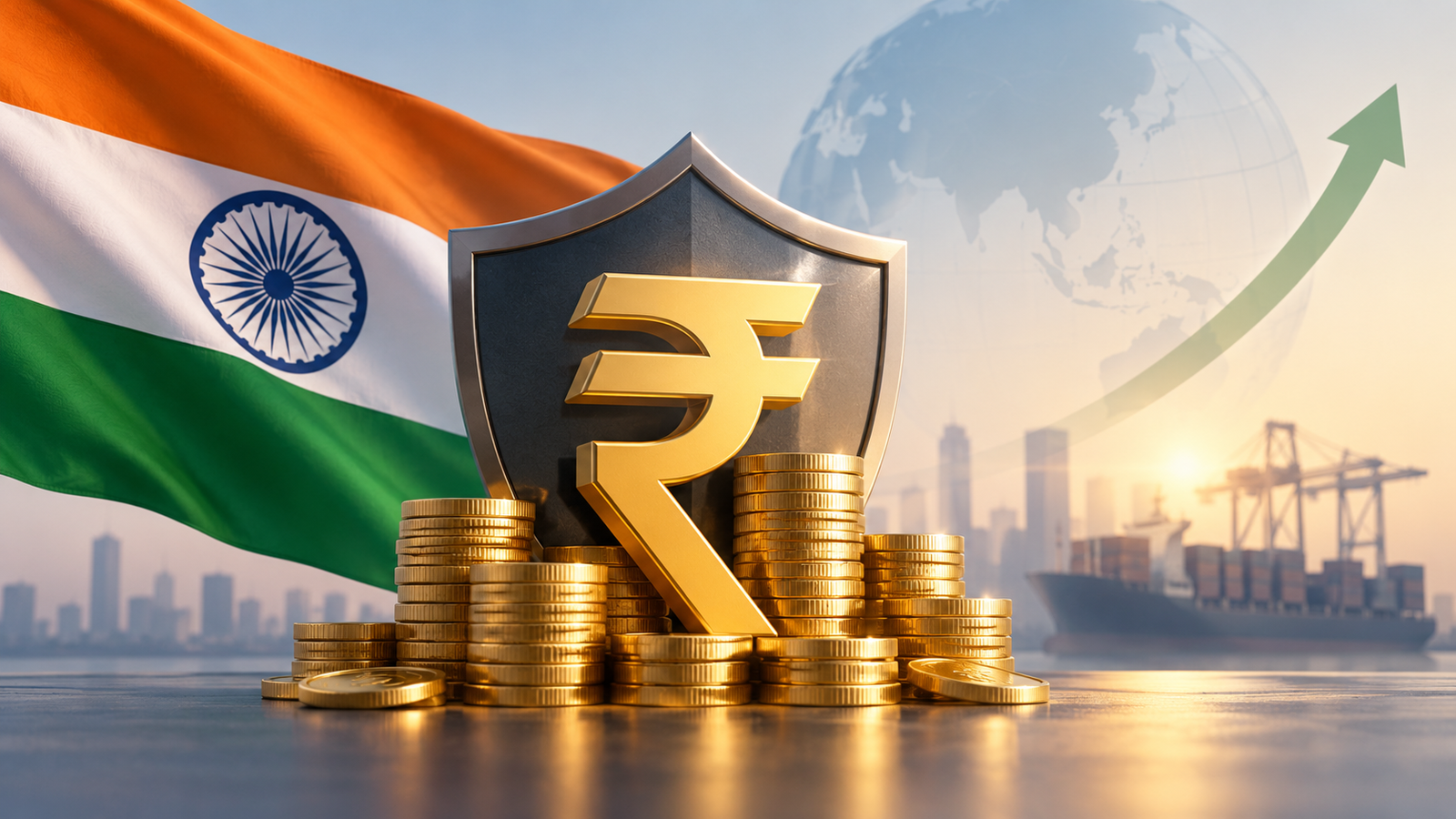
India’s foreign exchange reserves have reached a record $729.3 billion, a major improvement from the pressure seen earlier this year. The reserve stock rose to $729.328 billion in the week ended August 21, 2026, up from $716.907 billion a week earlier. The earlier record was $728.494 billion, set in the week ended February 27.
The rise is important because foreign exchange reserves act as a financial safety cushion for a country. They give the Reserve Bank of India, or RBI, more power to deal with sudden pressure on the rupee, expensive oil, foreign money outflows and other external shocks.
But the record number needs a closer look. A large reserve stock does not mean India can avoid every economic problem. It can soften a shock, give policymakers more time and reduce the risk of a sudden crisis. It cannot remove the basic economic pressures that create the problem in the first place.
Why Did Reserves Rise So Fast?
India’s reserves had fallen to $666.933 billion in the week ended June 26, 2026. That was a sharp drop from the February record. The decline came as the RBI sold dollars to support the rupee during a period of heavy external pressure.
The situation changed after the RBI introduced several measures in June to attract more foreign currency into India. One major step was a special facility for Foreign Currency Non-Resident (Bank), or FCNR(B), deposits.
The response was much stronger than expected. By August 31, banks had raised $127.23 billion through FCNR(B) deposits. There was also $5.26 billion through overseas foreign-currency borrowings and $3.89 billion through external commercial borrowings. Together, these sources brought total foreign-currency inflows under the broader package to $136.38 billion.
The RBI had first planned to keep the deposit window open until the end of September. It later chose to close it on August 31, after the response proved much stronger than expected. More than $60 billion arrived in the final 10 days before the deadline.
This explains why the reserve number rose so sharply in such a short period.
What Is Inside the $729.3 Billion?
The headline figure is made up of several parts.
As of August 21, India had $591.333 billion in foreign currency assets. Gold reserves stood at $114.218 billion. Special Drawing Rights, or SDRs, were worth $18.852 billion, while India’s reserve position with the International Monetary Fund was $4.925 billion. Together, these came to $729.328 billion.
Foreign currency assets are by far the largest part of the reserve stock. Their value can change not only because the RBI buys or sells dollars, but also because of changes in the value of currencies and assets held by the central bank.
Gold also had a major role in the latest rise. Gold reserves increased by about $2.8 billion in the week to August 21. That does not mean the RBI simply bought $2.8 billion worth of new gold. Changes in gold prices also affect the dollar value of the gold already held by the central bank.
How Reserves Can Help the Rupee
One of the biggest benefits of a large reserve stock is the RBI’s ability to support the rupee during periods of heavy pressure.
Suppose companies need more dollars to pay for oil and other imports while foreign investors also want to take money out of Indian markets. Demand for dollars can rise sharply. If dollar supply does not keep pace, the rupee can fall quickly.
The RBI can then sell dollars from its reserves. This adds dollar supply to the market and can reduce sudden moves in the rupee.
This does not mean the RBI can set any exchange rate it wants. It also does not mean the rupee cannot fall. The main benefit is that the central bank has more room to prevent a disorderly fall.
The rupee has already lost more than 5% against the US dollar this year, while foreign investors have sold more than $24 billion of Indian equities on a net basis. A large reserve stock gives the RBI greater room to deal with such pressure.
Oil Is a Major Test
Oil is one of the biggest risks for India because the country relies heavily on imported crude.
When crude prices rise, Indian importers need more dollars to pay for the same amount of oil. That can widen the trade deficit and put more pressure on the rupee.
The current situation shows why reserves matter. Renewed US-Iran tensions have pushed crude prices higher. Brent crude rose 7% this week, reaching its highest level since late July, according to Reuters. At the same time, US bond yields have remained high, which can support the dollar and make life harder for emerging-market currencies.
India’s reserve stock can help the RBI absorb part of this pressure. But it cannot make crude cheaper.
If oil prices stay high for a long period, India still has to pay the larger import bill. Reserves can provide temporary support, but they cannot permanently replace export income.
What Happens If Foreign Money Leaves?
A country with small reserves can face serious problems if foreign investors suddenly pull out money. The central bank may have limited ability to provide dollars to the market.
India is in a much stronger position.
The current reserve level gives the RBI a substantial pool of foreign assets. That makes the country less vulnerable to a sudden external funding crisis.
It also gives investors more confidence that India has enough foreign currency to meet important external payments.
But there is a limit. If capital leaves India for a long period, the RBI cannot keep selling dollars forever. A reserve stock is large, but it is not unlimited.
This is why the RBI’s goal is usually to reduce extreme volatility rather than defend one fixed exchange rate at all costs.
The Record Number Has a Hidden Risk
There is another important point behind the $729.3 billion figure.
A large part of the recent foreign-currency inflow came through deposits and borrowing arrangements. These funds are not the same as permanent national savings.
The $127.23 billion raised through FCNR(B) deposits creates foreign-currency obligations for banks. The RBI also now has a much larger forward foreign-exchange position. Its forward dollar liabilities have reached about $137 billion.
That means the headline reserve number should not be treated as money that India can spend freely without future obligations.
The scheme has still provided a major boost to India’s external position. But the cost and future repayment requirements matter when we judge the true strength of the buffer.
Too Many Dollars Create Another Problem
There is also an unusual side effect from the huge inflow.
When banks receive foreign currency and swap it with the RBI, the process can add rupees to India’s financial system. This has now created a very large liquidity surplus.
As of September 3, the banking system had a liquidity surplus of about ₹9.7 trillion, or $102.67 billion. That was higher than the previous peak of ₹9.2 trillion in September 2021.
This creates a new task for the RBI. It must manage the extra rupee liquidity so that short-term interest rates do not move too far from its desired level.
In other words, the same policy that helped bring dollars into India has also created a large supply of rupees inside the banking system.
What Reserves Cannot Fix
India’s record reserve stock cannot solve every economic weakness.
It cannot permanently protect the rupee from a large and lasting gap between imports and exports. It cannot stop inflation if oil prices remain high. It cannot force foreign investors to return to Indian markets. It cannot replace stronger exports, higher productivity or steady foreign direct investment.
The foreign direct investment picture is also worth watching. A recent Reuters poll cited estimates that FDI could be closer to $5 billion to $10 billion, far below the earlier range of $35 billion to $40 billion.
That shows why reserves alone are not enough. A strong external position needs a steady flow of genuine foreign earnings as well as a healthy domestic economy.
India Is Better Prepared, Not Invincible
The latest reserve figure is still very good news for India.
At $729.3 billion, the country has a much stronger external cushion than it had in late June. The reserve stock covers more than 11 months of goods imports and about 94% of external debt outstanding at the end of March 2026, according to data cited from the RBI.
The RBI now has more room to support the rupee, deal with oil shocks and reduce the risk of panic in the foreign exchange market.
Yet the biggest lesson is simple: reserves can buy time, but they cannot change economic reality.
If oil stays expensive, foreign investment remains weak or global interest rates keep the dollar strong, India will still face pressure. The reserve pile can absorb part of that pressure and give policymakers more choices.
That is why the $729.3 billion figure should be seen as a powerful safety cushion, not a guarantee against every crisis. India is better prepared for an external shock than it was a few months ago. But the real test will be whether the country can maintain that strength through stable exports, investment and sustainable foreign-currency income.
Also Read – 28.09 Crore Folios: Is MF Growth Changing in India?


