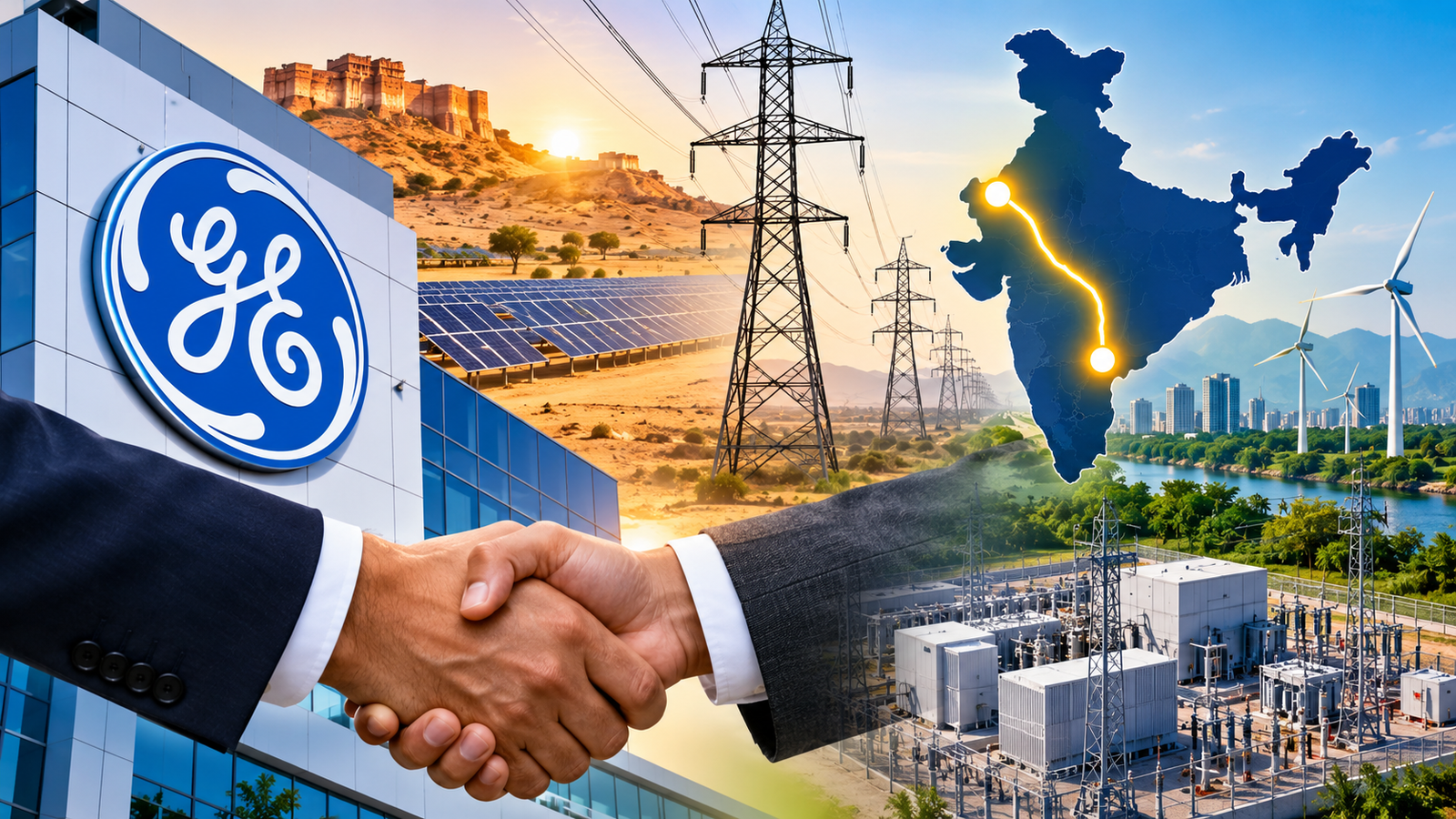
GE Vernova T&D India has emerged as the L1 bidder for a major 6,000 MW High Voltage Direct Current, or HVDC, project from Barmer II in Rajasthan to South Kalamb in Maharashtra. Power Grid Corporation of India informed the company about its L1 status on September 7, 2026.
The project has a capacity of 6,000 MW and will use a ±800 kV HVDC system. It will have two terminal stations, each with a capacity of 3,000 MW. The system will use Line Commutated Converter, or LCC, technology. GE Vernova T&D India will have responsibility for the design, supply and execution of the terminal stations. The work will take place over several years.
The news is important for GE Vernova T&D India because HVDC projects are large, complex and specialised. It also comes at a time when India needs much stronger power transmission systems to move renewable electricity from areas with high solar and wind capacity to major power demand centres.
What does L1 mean?
The term L1 is important in this case. It means GE Vernova T&D India has submitted the lowest commercial bid among the qualified bidders for the project.
However, L1 does not mean that the final contract has already been awarded. Power Grid still has to complete its formal process before it issues the final Letter of Award or signs the contract.
Therefore, investors should not treat the full value of this project as part of GE Vernova T&D India’s confirmed order book at this stage. The company itself has disclosed its position as the L1 bidder. The value of the contract has not been disclosed.
This difference matters because the headline number of 6,000 MW refers to the power transfer capacity of the system. It does not mean GE Vernova T&D India has received a ₹6,000 crore order or any other specific rupee value.
A huge 6,000 MW transmission system
The scale of the project is one of its most important features. The proposed HVDC link will have a total transfer capacity of 6,000 MW.
There will be two HVDC terminal stations. One will be at Barmer II in Rajasthan and the other will be at South Kalamb in Maharashtra. Each station will have a capacity of 3,000 MW.
The system will use ±800 kV technology. This is a very high voltage level and shows the scale of the planned transmission corridor.
The main purpose is to evacuate renewable power from the Barmer II area. Rajasthan has become one of India’s key renewable power regions, with large solar and wind resources. But producing electricity is only one part of the task. The country also needs a strong network that can take this power to areas where demand is high.
That is where a project of this type becomes important.
Why HVDC matters for renewable power
HVDC technology has a major role in long-distance power transfer. It can move very large amounts of electricity over long distances with lower losses than many conventional alternatives.
This makes it useful for India’s renewable power plans.
Large solar and wind projects are often far from major cities and industrial areas. Rajasthan, for example, has strong solar resources, while many large demand centres are located far away.
A high-capacity transmission corridor can connect these two sides of the power system.
The Barmer II to South Kalamb system is therefore more than a simple transmission project. It is part of the wider effort to create a power network that can support a larger share of renewable electricity.
GE Vernova T&D’s role
GE Vernova T&D India is set to handle the design, supply and execution of the 6,000 MW ±800 kV HVDC LCC terminal station package.
The work covers two 3,000 MW terminals. The use of LCC technology also makes the project technically significant.
For GE Vernova T&D India, such a project can add further depth to its HVDC credentials in the Indian market. HVDC work requires specialised equipment, engineering expertise and experience with large power systems.
A successful final award would also give the company a multi-year project. This can provide revenue visibility over a longer period, although the exact financial benefit cannot be calculated until the contract value and commercial terms are known.
A positive sign for India’s power sector
The project also shows how India’s power sector is changing.
For many years, the focus of the electricity sector was mainly on power generation. Today, transmission has become just as important. India can add more solar and wind capacity only if the grid has enough strength to move that power across states.
The Barmer II to South Kalamb corridor is an example of this shift.
Power Grid has taken up the project as part of the country’s interstate transmission network expansion. The National Committee on Transmission approved the 6 GW corridor in May 2025.
This creates a large opportunity for companies that supply transformers, switchgear, HVDC systems and other grid equipment.
A wider HVDC opportunity
The opportunity for HVDC companies may extend well beyond this single project.
A research report from IDBI Capital had earlier identified a sizeable pipeline of HVDC projects in India. Its near-term list included Barmer–South Kalamb, India–Sri Lanka, Lakadia–Alephata, the Paradeep to Port Blair project and the Pusauli HVDC upgrade.
The report put the total cost of these five projects at about ₹943.4 billion. It also showed the Barmer–South Kalamb project at an estimated cost of ₹250 billion, or ₹25,000 crore, with a planned capacity of 6,000 MW. These estimates are project-level estimates and should not be treated as GE Vernova T&D India’s order value.
This wider pipeline matters because it suggests that HVDC may remain a key part of India’s transmission investment cycle.
What it means for investors
For shareholders of GE Vernova T&D India, the L1 status is clearly a positive development, but the exact financial impact is still unknown.
The first point to watch is the final contract award. Once Power Grid completes its process and the final contract is signed, investors will have a clearer view of the value that GE Vernova T&D India will add to its order book.
The second point is the order value. The company has not disclosed the contract size in its announcement. Without this figure, it is not possible to say how much the project could add to revenue or profit.
The third point is execution. Large HVDC projects can run for several years. Good execution, cost control and timely supply will be important for the final profit from the contract.
The bigger renewable power theme
The importance of this development goes beyond one company.
India’s renewable power capacity has grown rapidly, but renewable energy needs a strong transmission network. Solar and wind power can be produced in areas that are far from major demand centres. A stronger interstate grid can help move this electricity to homes, businesses and industries.
That creates a long-term demand case for companies such as GE Vernova T&D India and other power equipment makers.
The Barmer II to South Kalamb project is a strong example of this trend. Its 6,000 MW capacity places it among the large transmission projects that can support India’s next phase of renewable power growth.
What happens next?
The next major event will be the formal award process by Power Grid.
At present, GE Vernova T&D India has the L1 position for the design and establishment of the 6,000 MW ±800 kV HVDC LCC terminal station. The proposed system has two 3,000 MW terminals, with one at Barmer II and the other at South Kalamb.
The company will be responsible for design, supply and execution, with the work spread over multiple years. The contract value remains undisclosed.
Overall, the development is a strong positive signal for GE Vernova T&D India and the wider power transmission sector. It highlights the rising need for advanced grid equipment as India adds more renewable power.
Still, investors should wait for the final contract before treating the project as a confirmed order. The capacity is impressive, the technology is important and the sector outlook is strong, but the actual value for GE Vernova T&D India will depend on the final contract size, execution terms and profit margin.
ALSO READ: India’s First Tokenised Bond: Why REC’s Deal Matters