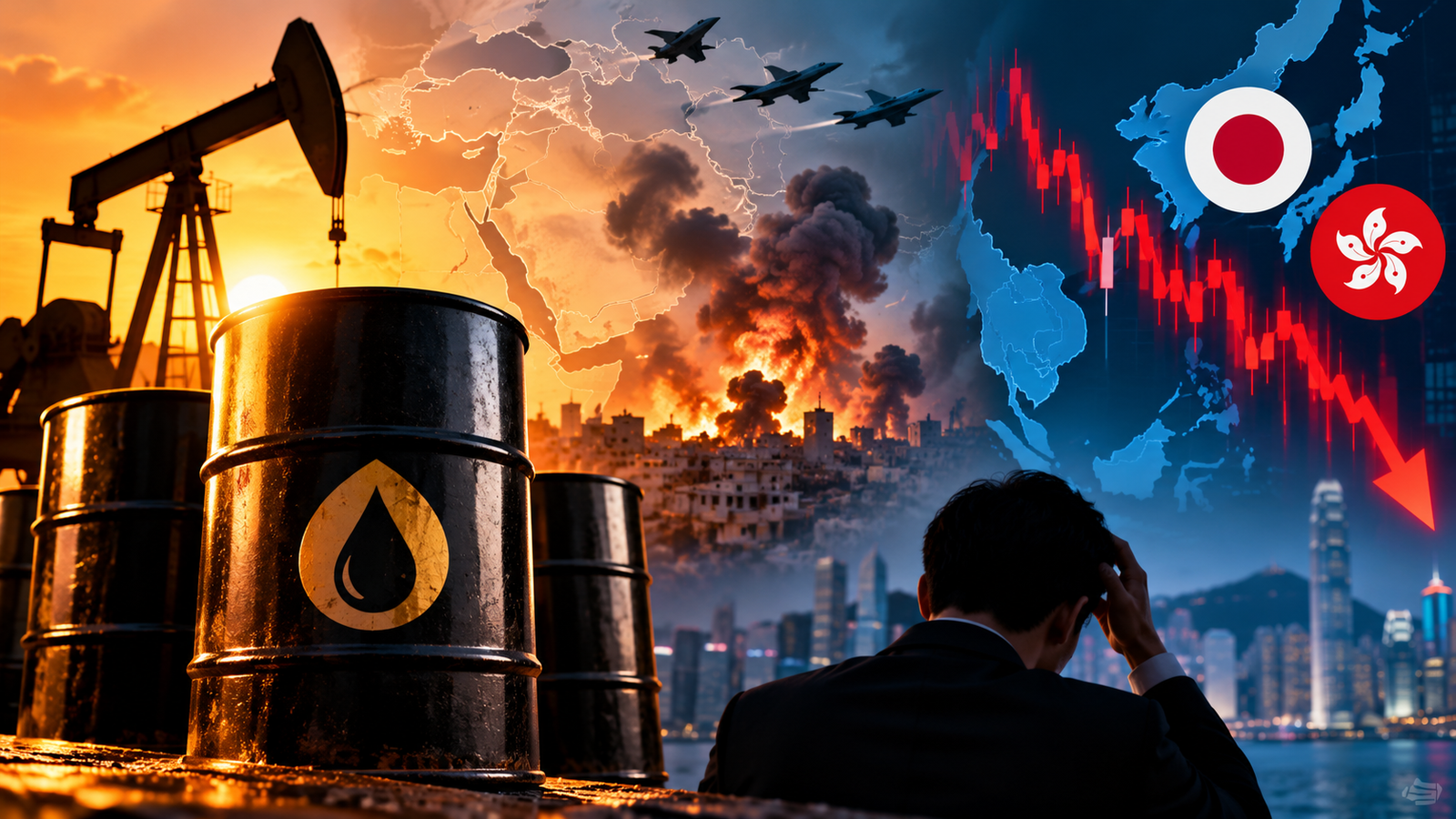
Brent crude moved toward the important level of $100 per barrel as the conflict in the Middle East grew more intense. The rise in oil prices has added a fresh source of concern for financial markets. Investors now face the risk that a wider conflict could affect oil supply, raise energy costs, and add to price pressure across major economies.
The move in crude has also affected the mood across Asia. Japan’s Nikkei and Hong Kong’s Hang Seng were lower, while markets that are more sensitive to oil costs stayed under pressure. The broader market response shows that investors are not looking at the oil price in isolation. They are also assessing what a higher oil price could mean for inflation, interest rates, company costs, consumer demand, and economic growth.
At this stage, the move toward $100 does not by itself prove that a new global inflation shock will occur. The final effect will depend on how high oil prices go, how long they remain at those levels, how the conflict develops, and how governments and central banks respond.
Why the $100 Level Matters
The approach toward $100 a barrel has strong market importance because crude oil is a major input for the world economy. Oil affects fuel prices, transport costs, industrial activity, and many parts of the supply chain. A sustained rise can therefore place pressure on both businesses and households.
For financial markets, the issue is not only the price of oil today. Investors also care about the expected path of oil prices in the weeks and months ahead. A short rise can have a limited effect if prices later fall. A long period of high prices can have a wider effect because companies and consumers may face higher costs for a longer period.
The $100 level is also a clear psychological mark. A move close to this level can attract greater market attention even before there is evidence of a major economic effect. Investors may adjust their expectations based on the risk of further price rises.
This does not mean that $100 oil must cause a recession or a major market decline. Economic outcomes can differ across countries and sectors. The effect also depends on the reason for the price rise and on the ability of consumers, companies, and governments to absorb higher energy costs.
Middle East Conflict and Oil Supply Risk
The main concern in this case is the link between the Middle East conflict and oil supply. As the conflict becomes more intense, markets may assign a higher risk to possible disruption across key energy routes or supply sources.
Oil prices respond not only to actual supply losses but also to expectations. If traders believe that future supply may face a threat, prices can rise before any large physical shortage takes place.
That distinction is important. A higher Brent price does not automatically mean that the world has lost a large amount of oil supply. It can also reflect a higher risk premium. In simple terms, buyers may accept a higher price because the future supply picture looks less certain.
If the conflict remains limited and supply continues without a major disruption, the oil price could later ease. If the conflict spreads or causes a lasting supply problem, the effect could be much more serious.
For this reason, the next phase of the conflict may matter more than the first move toward $100. Markets will watch whether the risk remains temporary or becomes a longer-term energy problem.
The Inflation Question
Higher oil prices can create pressure on inflation through several channels. The most direct effect comes from fuel. When crude prices rise, fuel costs may also rise, although the final retail price depends on taxes, refining costs, currency moves, local policy, and other factors.
Higher energy costs can also affect transport. Businesses that move goods by road, sea, or air may face higher expenses. Some of those costs can pass through to consumers. Other companies may absorb part of the increase through lower profit margins.
The same process can affect industrial firms. Energy is an important cost for many sectors, and a higher oil price can add pressure to production and distribution expenses.
However, it would be too early to assume that a move toward $100 will create a large and lasting inflation shock. Inflation is affected by many factors. Wage growth, food prices, housing costs, demand, currency movements, fiscal policy, and other commodity prices can all play a role.
The key issue is therefore the duration and scale of the oil move.
Why Interest Rates Matter
The oil story becomes more important for investors because of interest rates. Central banks try to control inflation while also supporting economic stability. A sharp rise in energy prices can make that task harder.
If higher oil prices lead to stronger inflation pressure, central banks may have less room for rate cuts. Markets could then revise their expectations for monetary policy.
That matters because interest rates affect borrowing costs and asset values. Higher rates can raise the cost of loans for households and companies. They can also reduce the appeal of some investments whose value depends on lower borrowing costs.
At the same time, an oil price rise can weaken economic demand. Households may spend more on fuel and less on other goods and services. Companies may face higher costs and may reduce investment if profit expectations fall.
This creates a difficult policy balance. Inflation may rise while economic growth faces pressure. Such a situation can make monetary policy decisions more difficult.
The market concern can therefore be described as a possible conflict between price stability and economic growth. A central bank may want to prevent inflation from becoming persistent, but higher rates can also add pressure to an economy that already faces higher energy costs.
Asia’s Cautious Market Response
Asian markets reacted with caution as the oil price moved toward $100. The Nikkei in Japan and the Hang Seng in Hong Kong were lower.
These moves should not be read as proof that oil prices were the only reason for the declines. Stock markets react to many factors at the same time. Global interest-rate expectations, currency moves, company results, trade conditions, investor sentiment, and regional economic data can all affect prices.
Still, the oil move provides an important part of the market backdrop.
Markets that are more sensitive to energy costs can face greater pressure when crude prices rise. Economies that depend heavily on imported energy may face a tougher cost environment because more money may leave the domestic economy to pay for fuel and other energy products.
The effect can differ from one market to another. Oil producers may benefit from higher crude prices, while companies that use large amounts of fuel may face higher costs.
This creates an uneven market effect rather than a simple result in which every company or every country loses.
Oil-Sensitive Markets
Oil-sensitive markets deserve special attention because energy prices can have a direct effect on their trade balance, corporate costs, and consumer prices.
For an oil-importing economy, a sharp increase in crude prices can raise the cost of imported energy. If other factors remain unchanged, that can place pressure on the country’s external balance.
Companies may also face higher costs. Airlines, transport firms, manufacturers, logistics companies, and other energy-intensive businesses can be more exposed to crude price changes.
For an oil-producing economy, the picture may be different. Higher oil prices can increase export revenue and improve the financial position of energy producers.
The market effect is therefore linked to economic structure. The same oil price can create a benefit for one group and a cost for another.
| Market factor | Possible effect of higher oil prices |
|---|---|
| Fuel costs | Higher cost pressure |
| Transport | Higher operating costs |
| Consumer spending | Possible pressure if fuel takes a larger share of income |
| Corporate margins | Possible pressure for fuel-heavy businesses |
| Inflation | Possible upward pressure |
| Interest-rate expectations | Possible reduction in expectations for rate cuts |
| Oil producers | Possible benefit from higher revenue |
| Oil importers | Possible increase in import costs |
| Oil-sensitive markets | Possible greater market pressure |
These are potential effects, not certain outcomes. The actual result depends on the size and duration of the oil price move and on wider economic conditions.
Japan and Hong Kong
The weaker Nikkei and Hang Seng provide a useful view of the cautious mood across parts of Asia.
Japan is a major developed economy with a strong industrial base and significant energy needs. A sustained increase in imported energy costs can therefore matter for companies and consumers.
Hong Kong has a different economic structure, but its equity market is highly connected to wider global financial conditions. Higher oil prices can affect sentiment through the inflation and interest-rate channel even when the direct energy effect is not the main concern.
It is important not to treat both markets as identical. Their economic structures, company groups, currencies, and policy conditions differ.
The common factor is the wider uncertainty created by the conflict and the oil price. Investors may become more careful when there is a risk that higher energy costs could affect global inflation and interest-rate expectations.
The Main Risk for Investors
The largest concern is not simply that Brent may reach $100. The bigger question is what happens after that point.
If oil moves near $100 and then falls back, the economic effect may be less severe than markets fear. A short price shock can be easier for businesses and consumers to absorb.
If crude stays close to or above $100 for a long period, the effect can become more meaningful. Companies may face higher costs for longer. Consumers may have less money for other purchases. Inflation may remain higher for longer. Central banks may then face more pressure to keep rates high.
A much larger rise in oil prices would create a stronger risk.
That does not mean such an outcome is certain. It means that the market has a clear reason to pay attention to the path of crude prices and the development of the conflict.
What Could Change the Market View
Several developments could change the current market view.
A reduction in conflict risk could lower the risk premium in crude prices. If oil supply remains stable, prices may also face less upward pressure.
A larger disruption to supply could have the opposite effect. In that case, markets may need to reassess inflation and economic forecasts.
Central bank statements will also matter. If policymakers view the oil move as temporary, they may focus more on underlying inflation. If they see a risk of wider price pressure, their policy stance could become more cautious.
Economic data will provide another important signal. Strong consumer demand combined with higher energy prices could create a different policy problem from weak demand and higher energy prices.
The currency market may also affect the final impact. A stronger or weaker local currency can change the domestic cost of imported oil.
A Simple Risk Framework
The current situation can be viewed through three broad scenarios.
| Scenario | Oil market | Inflation risk | Rate outlook | Market tone |
|---|---|---|---|---|
| Conflict risk falls | Oil may ease | Lower pressure | More room for rate cuts | Potentially more supportive |
| Conflict stays intense | Oil may remain high | Continued pressure | Rate cuts may face limits | Cautious |
| Supply disruption grows | Oil could rise further | Greater pressure | Policy may stay tight for longer | Higher market risk |
These scenarios are analytical rather than forecasts. Actual market results may differ.
The central issue is the link between the conflict, crude supply, inflation, and monetary policy. A change at any point in that chain can alter the market outcome.
What the Current Move Does Not Prove
The approach toward $100 does not by itself prove that the global economy is headed for a new inflation crisis. It also does not prove that central banks will raise interest rates, that stock markets will continue to fall, or that a recession will follow.
Those outcomes would require more evidence.
Oil prices can move sharply because of geopolitical risk and then reverse if the risk fades. Stock markets can also respond before the economic data show a clear change.
For that reason, the most careful interpretation is that the current oil move has increased market risk and uncertainty. It has not established a final economic outcome.
The Wider Economic Picture
The oil price matters because it sits at the centre of several important economic links.
Higher crude prices can raise energy costs. Higher energy costs can add to inflation. Higher inflation can affect expectations for interest rates. Higher rates can affect borrowing, investment, and asset values. At the same time, higher fuel costs can reduce household purchasing power and place pressure on company profits.
This chain does not always move in a straight line. Some effects may offset others. Governments can also respond through fiscal measures, while companies can change prices, reduce costs, or adjust production.
The result will depend on how the different forces interact.
That is why investors may focus less on the headline number of $100 and more on the duration of the oil move, the level of supply disruption, and the response from policymakers.
Conclusion
Brent crude’s move toward $100 per barrel has added a clear source of concern for global markets. The intensification of the Middle East conflict has increased fears about energy supply, while the possibility of higher oil costs has raised concern about inflation and interest rates.
That backdrop has kept parts of Asia cautious. The Nikkei and Hang Seng were lower, while markets with greater sensitivity to oil costs remained under pressure.
The key issue is whether the oil move remains a short-term market shock or develops into a longer period of high energy prices. A temporary rise may have a limited economic effect. A sustained rise could place more pressure on inflation, company costs, household budgets, and monetary policy.
For now, the most balanced view is that the market faces higher uncertainty rather than a confirmed new economic crisis. The direction of crude prices, the course of the Middle East conflict, and future central bank decisions will be important factors in determining whether the current pressure remains limited or becomes a broader market concern.
The information above is an analytical interpretation of the stated market developments. It is not a prediction, investment recommendation, or assurance about future market performance. Actual outcomes may differ as new information becomes available.