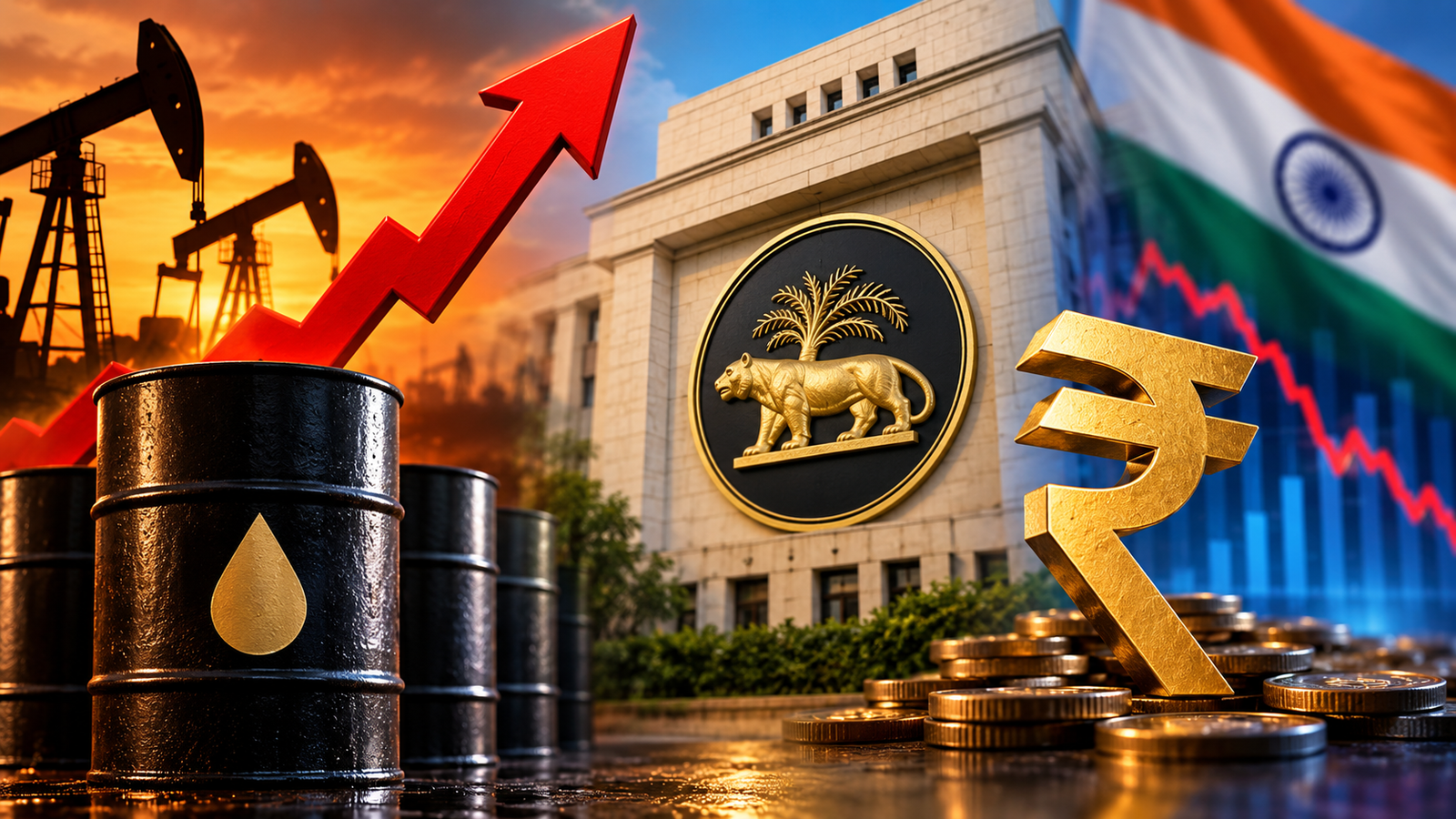
India’s central bank faces a difficult test as crude oil prices move above $100 a barrel and the rupee falls past ₹95 against the US dollar. The Reserve Bank of India, or RBI, has several tools at its disposal, but each has limits. The main challenge is simple: higher oil prices can hurt both inflation and economic growth at the same time.
The RBI must therefore protect price stability without putting too much pressure on demand. A large rate hike could hurt growth, while a rate cut could add more pressure to the rupee and inflation. This leaves the central bank with less room than it may appear to have.
Oil Has Changed the Policy Picture
The RBI last kept the repo rate at 5.25% and retained a neutral stance. Its August forecast placed consumer inflation at 5.9% for the third quarter of FY27, while economic growth was forecast at 6.7%.
The latest oil shock makes that outlook harder to manage. Brent crude has moved above $100 a barrel as conflict in the Middle East has raised fears about global oil supplies. India is especially exposed because it imports a large share of the crude oil it needs.
A higher oil price means a higher import bill. It can also put pressure on the rupee because Indian buyers need more dollars to pay for oil. The rupee fell beyond the important ₹95-per-dollar level on September 9 and closed at ₹95.1050 per dollar. Reuters also reported that the RBI likely stepped into the foreign exchange market to support the currency.
This creates a difficult chain for the central bank. Costlier oil can push inflation higher. A weaker rupee can make imported oil even more expensive in rupee terms. At the same time, higher fuel and transport costs can reduce household demand and raise costs for companies.
Inflation Is Moving Higher
India’s August consumer inflation rate is expected at about 4.8%, according to a Reuters poll of 44 economists. That would mark a 20-month high and the third month in a row above the RBI’s 4% target. Inflation was 4.45% in July.
Food and fuel costs are major reasons for the rise. Core inflation, which leaves out food and fuel, is expected at 4.1%. That figure matters because it shows whether the price shock is spreading into the wider economy.
For the RBI, the key question is not just where headline inflation is today. It is whether higher oil prices start to affect wages, services, business costs and consumer expectations.
If the shock remains limited to oil and food, the RBI can afford to look through part of it. But if companies start to pass higher costs to customers across many sectors, the central bank may need to act.
Why a Rate Cut Is Hard
Under normal conditions, a rate cut can help support economic growth. Lower borrowing costs can help companies invest and can make loans cheaper for households.
The current situation is different. A rate cut could put more pressure on the rupee at a time when oil prices already hurt the external balance. A weaker rupee would raise the local cost of imported oil and other goods.
That does not mean a rate cut is impossible. If oil prices fall back toward $80–90 a barrel and core inflation stays under control, the RBI could regain room to reduce rates.
For now, however, a large cut would carry more risk than usual.
A Rate Hike Is Not a Simple Answer
The RBI also cannot solve an oil shock simply by raising interest rates.
Higher rates can reduce demand. They can help support the currency and control inflation expectations. But they cannot create more oil or reduce the global price of crude.
If Brent stays near $100 for a short period, a large rate hike could cause more damage to growth than benefit to inflation. The RBI may therefore prefer other tools first.
The situation would change if oil stays above $110–120 for several months. At that point, the risk of a wider inflation problem would become much greater. A rate hike could then become necessary to stop temporary imported inflation from turning into a longer domestic price problem.
Liquidity Gives the RBI Another Tool
One of the most important parts of the current situation is the large amount of surplus liquidity in India’s banking system.
The RBI’s special dollar deposit scheme attracted $127.23 billion. This created a liquidity surplus of about ₹9.70 trillion, or $102.70 billion, in the banking system.
The RBI has several ways to absorb this money without an immediate change in the repo rate. These include Variable Rate Reverse Repo operations, dollar-rupee sell-buy swaps, government Treasury bill sales and possible changes to the cash reserve ratio.
The CRR is currently 3%. A rise of 50 to 100 basis points could absorb about ₹1.4 trillion to ₹2.8 trillion from the banking system. The RBI could also use up to $32 billion from its forward book through dollar-rupee swaps.
This gives the central bank an important advantage. It can make financial conditions tighter without making a large change to the main policy rate.
The Rupee Is Another Line of Defence
The RBI has also shown that it is ready to use its foreign exchange reserves when market conditions become too disorderly.
Reuters reported that the RBI may have sold at least $8 billion in recent weeks to support the rupee. The currency closed at ₹94.4850 per dollar on September 7 before the later fall past ₹95.
India also has a large reserve cushion. Foreign exchange reserves were around $729 billion, with expectations that they could move above $750 billion.
These reserves give the RBI room to reduce sharp moves in the rupee. But reserves are not unlimited. The central bank cannot defend one exact exchange rate forever if global oil prices remain very high.
The aim is therefore more likely to be a smooth adjustment rather than a fixed defence of ₹95 or any other particular level.
Growth Could Become the Next Problem
The oil shock is not only an inflation story. It is also a growth story.
India’s fuel demand fell 6.3% month-on-month in August to 18.61 million metric tons. That was the lowest level since September 2024. This suggests that higher energy costs may already affect parts of domestic demand.
If oil stays high, transport costs can rise. Airlines, logistics firms, manufacturers and other businesses can face higher expenses. Households can also have less money for other purchases after they pay more for fuel and essential goods.
This is why the RBI must avoid an excessive policy response. A sharp rate hike could add another burden to an economy already hit by higher energy costs.
What the RBI Can Really Do
The RBI has more room than a simple look at the repo rate suggests. It can use foreign exchange intervention to reduce sharp rupee moves. It can absorb excess liquidity through market operations. It can guide expectations through its communication. It can also adjust the CRR or use bond sales if the situation requires it.
The central bank can therefore manage the financial effects of an oil shock quite well.
What it cannot do is remove the oil shock itself.
If Brent moves from $100 to $120–130 and stays there, India will face a real terms-of-trade problem. The country will have to spend more on energy imports. Monetary policy cannot change that basic fact.
The Real Test Is Duration
The most important factor now is not just the price of oil. It is how long that price stays high.
If Brent remains around $95–105 for a limited period, the RBI can probably keep the repo rate at 5.25%, manage liquidity and support the rupee while it waits for clearer data.
If oil stays above $110–120 for several months, the pressure will become much harder to ignore. The RBI may then need to consider a rate hike, especially if core inflation and inflation expectations move higher.
If oil falls back toward $80–90 and domestic demand weakens, the central bank will have more freedom to cut rates.
The RBI therefore has room, but that room is not unlimited. Its best option is likely to use several tools together rather than rely on the repo rate alone.
The key risk is not simply $100 oil. The bigger danger is $100-plus oil that stays high long enough to push up the rupee cost of imports, raise domestic prices and weaken growth at the same time.
That is the point where the RBI’s policy choices become much harder. For now, the central bank can absorb part of the shock. But if the oil crisis lasts, monetary policy alone will not be enough. India will also need help from fiscal policy, energy policy and measures that reduce its dependence on imported crude.