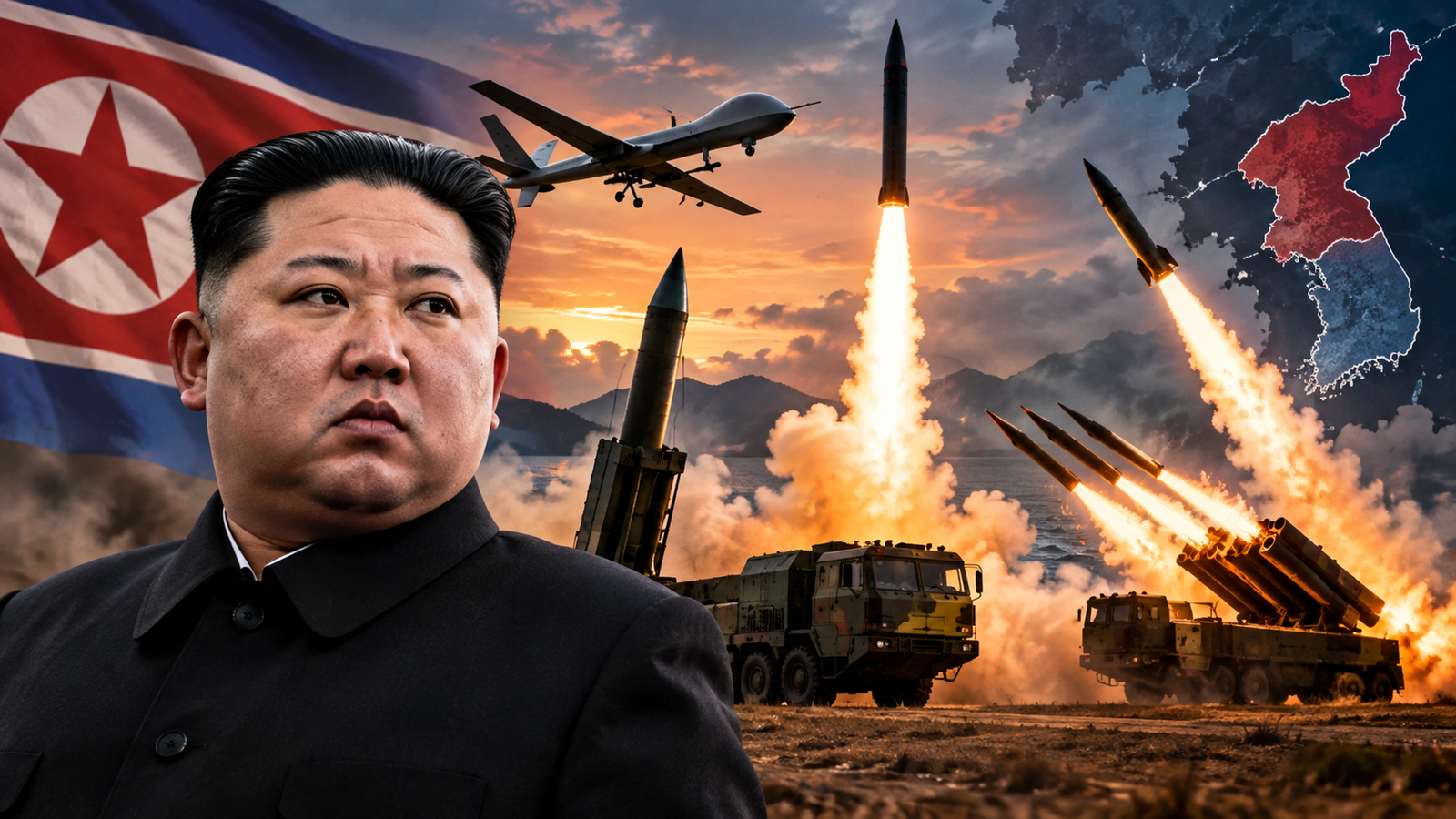
North Korea has announced a major military exercise that involved several types of weapons at the same time. The country said the drill tested what it called “new combat systems” and showed its ability to use different weapons under one fire control system.
The exercise took place on September 12, 2026, and involved selected units from five artillery and missile formations of the Korean People’s Army. North Korea later released details through its state media, the Korean Central News Agency, or KCNA.
The drill included attack drones, tactical cruise missiles, large-caliber thermobaric multiple rocket launchers and tactical ballistic missiles. North Korea said these weapons took part in a joint firepower attack against targets.
The test has drawn attention because it was not limited to one type of missile. Instead, several weapon systems took part in the same exercise. This points to a wider effort by Pyongyang to connect different weapons and use them together during a possible attack.
Four types of weapons used together
The most notable part of the exercise was the mix of weapons. North Korea said its forces used various attack drones, tactical cruise missiles, large-caliber thermal-pressure multiple rocket launchers and tactical ballistic missiles.
Each weapon type can serve a different purpose. A ballistic missile can travel at high speed along a ballistic path. A cruise missile can fly at a lower level and follow a different route toward its target. Drones can provide another way to attack or create pressure on air defenses. Large rocket launchers can fire many rounds over a short period.
When such systems are used together, they can create a more complex situation for an opponent. South Korea and the United States have air and missile defense systems designed to detect and stop incoming threats. A mix of weapons with different speeds, flight paths and ranges can make that task more difficult.
An analysis by the Institute for the Study of War said the September 12 exercise marked the first known North Korean strike exercise to use four different types of weapons together: short-range ballistic missiles, multiple launch rocket systems, cruise missiles and drones.
North Korea claims 100 percent accuracy
North Korean state media said all the weapons hit their assigned targets with 100 percent accuracy. KCNA said the exercise showed the “unity and simultaneity” of the attack.
However, there is no independent confirmation of this accuracy claim. North Korea often presents its military exercises through state media, and outside observers cannot always verify the details or results of such tests.
The country also did not provide clear technical details about the exact weapons used. KCNA described them by their general type rather than giving specific model names for every system.
That makes it difficult to assess how much of the reported capability is new. Some of the weapons may be newer versions of systems North Korea has already tested, while others may represent newer additions to its military forces.
Focus on an integrated fire control system
A key part of the exercise was the use of an integrated fire control system. North Korean officials said the drill would help units learn how to operate different weapons through a combined system.
This is important because modern warfare depends not only on the weapons themselves but also on how quickly information can move between units.
A missile unit, artillery unit and drone unit need separate equipment and crews. If they can receive information and attack under one command system, their actions can become more closely linked.
North Korean officials said the exercise would improve the automatic control of different combat systems and help units react faster during an emergency. KCNA also said the drill would improve cooperation between missile units and long-range artillery forces.
Military analysts have described the exercise in a similar way. The event appeared to be a demonstration of an integrated strike network, rather than a simple test of one weapon.
The timing of the drill matters
The exercise came soon after a major military exercise by South Korea, the United States and Japan.
The three countries held the Freedom Edge exercise from September 7 to September 11. The drill focused on cooperation between the three countries and their ability to respond to security threats in the region.
North Korea has long opposed such exercises. Pyongyang says US-led military drills near the Korean Peninsula are hostile actions and has often used them as a reason for its own weapons tests.
North Korea carried out its joint firepower drill on September 12, just one day after Freedom Edge ended. South Korean authorities had already detected missile launches from North Korea that day.
The close timing has led analysts to view the exercise as both a military test and a message to South Korea, the United States and Japan.
North Korea’s recent missile activity
The September 12 drill was not an isolated event.
On September 20, North Korea launched two short-range ballistic missiles from the Wonsan area toward the East Sea, according to South Korea’s Joint Chiefs of Staff.
The first missile flew about 450 kilometers. The second missile was launched about three hours later and flew more than 600 kilometers, according to South Korean authorities.
The United States said there was no immediate threat to US personnel or its allies from the launches. The tests nevertheless added to concern about the pace of North Korea’s missile activity.
The September 20 launches also came after North Korea had criticized US-led military activity in the region. Pyongyang has repeatedly said it will respond to what it sees as military pressure from the United States and its partners.
Why drones matter
The use of attack drones is another important part of the latest drill.
Drones are smaller and can be cheaper to produce than many traditional missiles. They can also offer military forces another way to attack targets. A large number of drones could force an enemy to spend time and resources on detection and defense.
North Korea has increased its attention on drones in recent years. The September exercise suggests that the country wants drones to work alongside missiles and artillery rather than operate as a separate part of its forces.
This could give North Korea more options during a conflict. It could use different weapons at different stages of an attack, while its command system attempts to coordinate their actions.
What the exercise means for South Korea
For South Korea, the main concern is the possible growth of North Korea’s ability to combine several types of weapons.
South Korea already faces a large number of artillery and missile threats from the North because of the two countries’ close geographic distance. The addition of drones and other systems creates another challenge for air and missile defense.
The September 12 exercise also showed an effort to improve coordination between units. This matters because a military force can become more difficult to counter when its weapons do not operate separately.
Still, the exact level of North Korea’s capability remains unclear. Much of the information about the drill came from North Korean state media, and outside experts do not have access to all the data from the exercise.
Kim Jong Un was not present
North Korean leader Kim Jong Un did not attend the September 12 exercise.
Instead, the drill was supervised by Pak Jong Chon, vice-chairman of the Central Military Commission of the Workers’ Party of Korea, and Major General Yu Chang Son, director of the Artillery Bureau of the Korean People’s Army.
The absence of Kim is worth noting because he has personally overseen many major North Korean weapons tests in recent years. His absence does not by itself show that the exercise was less important, but it may indicate that the event had a more practical military training focus.
A broader shift in North Korea’s weapons strategy
The latest exercise fits into a wider pattern in North Korea’s weapons development.
The country has continued work on short-range ballistic missiles, cruise missiles, large rocket launchers and drones. The September 12 drill suggests that Pyongyang is now paying more attention to how these systems can work together.
That is different from simply testing a new missile. The focus is on the complete process: command, target selection, communication, weapon choice and simultaneous attacks.
The East Asia Institute said the exercise was intended to test North Korea’s integrated firepower command system and improve coordination between several weapons.
What remains unclear
There are still major unanswered questions about the exercise.
North Korea has not provided full technical details about the weapons. It has also not offered independent evidence for its claim of 100 percent accuracy.
It is therefore difficult to determine how advanced the systems are, how reliable they are under real combat conditions, or how well the different weapons can operate together outside a controlled military exercise.
The September 20 missile launches provide evidence that North Korea continues to test its short-range missile forces, but they do not by themselves prove that every capability shown in the September 12 drill is ready for combat.
For now, the clearest message from Pyongyang is that it wants its military to use missiles, drones and artillery as part of one coordinated force. The September 12 exercise gave North Korea a chance to display that concept, while the later missile launches showed that its weapons program remains active.
The developments add another layer to the already tense security situation on the Korean Peninsula. South Korea, the United States and Japan continue to watch North Korea’s tests closely, while Pyongyang continues to present its military buildup as a response to what it calls pressure from its rivals.
ALSO READ: Rupee Near ₹96/$: What It Means for Indian Stocks