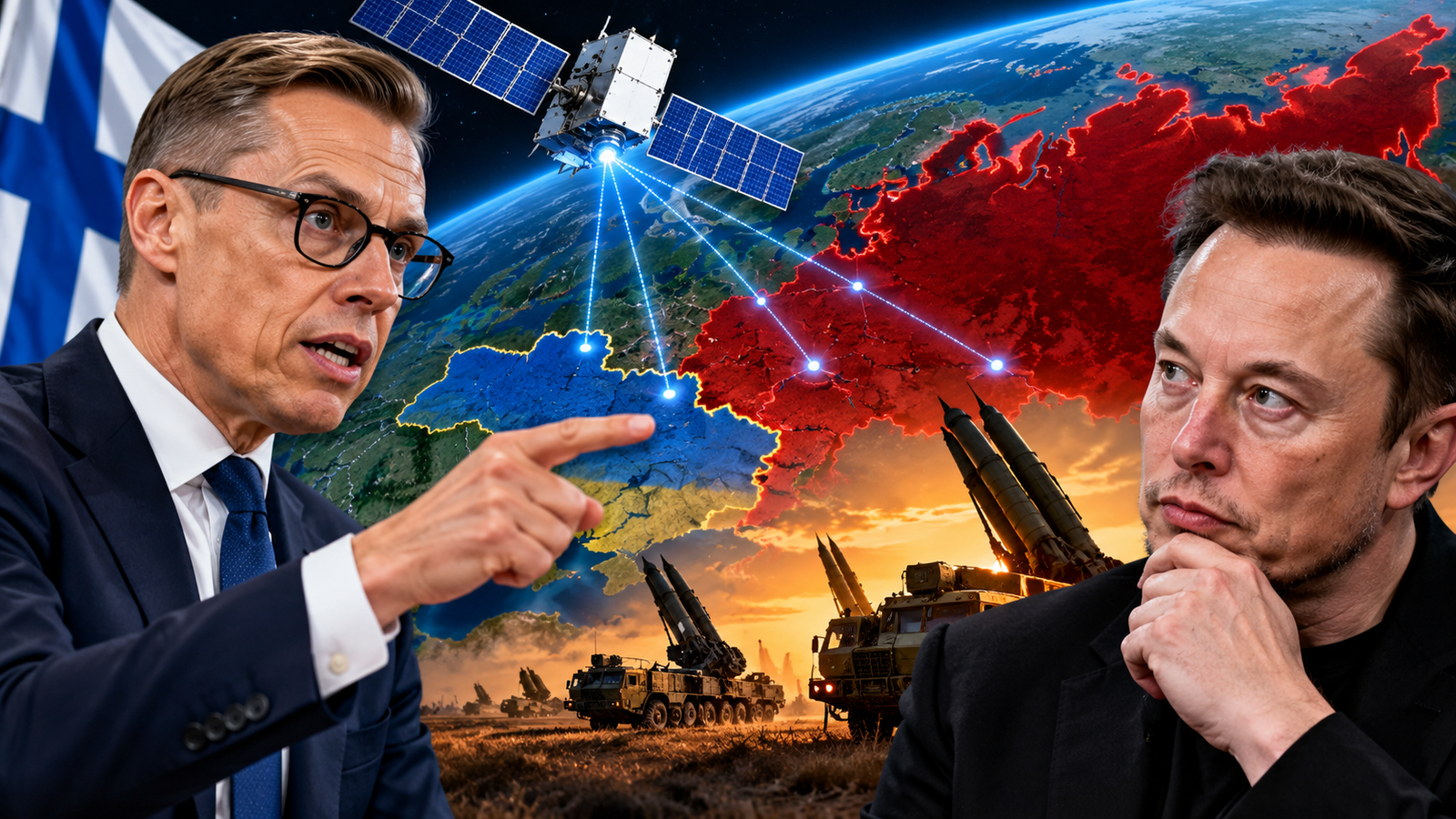
Finnish President Alexander Stubb has asked SpaceX owner Elon Musk to expand Starlink satellite internet access to parts of Russia and to Ukrainian areas under Russian control. The stated aim is to help Ukraine locate and target Russian ballistic missile launchers. Stubb made the remarks in an interview with Reuters in New York on September 24, 2026, during the United Nations General Assembly.
The request is notable because Starlink is not just a normal internet service in the Ukraine war. Since Russia’s full-scale invasion in 2022, Starlink has become a major part of Ukraine’s battlefield communications. It has also supported drone operations. Starlink does not currently work over Russian territory. Ukrainian officials believe access in areas close to Russia could help Ukraine find mobile ballistic missile launchers located several hundred kilometres from the border.
It is important to separate the request from any confirmed policy change. Stubb has asked Musk to allow wider access, but the available reports do not say that Musk or SpaceX has agreed to the request. There is also no report of a new Starlink service over Russia as a result of Stubb’s remarks. The matter remains a request rather than a confirmed operational change.
What Stubb Has Asked For
Stubb said he wanted Ukrainian forces to have Starlink access in areas where Russian ballistic missile launchers are present. He referred both to occupied Ukrainian territory and to areas inside Russia.
His stated reason was the protection of lives. He linked the request to Ukraine’s shortage of air defence systems and to the threat from Russian ballistic missiles. In his view, better access to Starlink could help Ukraine locate missile launchers and reduce the threat before more missiles are fired.
The request can therefore be understood as a proposal for wider access to an existing commercial satellite network for a military purpose. That distinction matters. Stubb did not announce a new Finnish system or a new Ukrainian satellite network. Instead, he asked the private company that operates Starlink to change the area in which its service is available.
The ScanX report describes the request in similar terms. It says the proposed coverage would extend to Russia and occupied areas, with the stated objective of helping Ukraine target Russian ballistic missile launchers. ScanX also states that its article was AI-generated from LiveSquawk data and carries a disclaimer about possible inaccuracies.
Why Air Defence Is Central to the Request
Ukraine faces a serious problem with Russian ballistic missiles. Reuters reported that Russia’s use of ballistic missiles reached record levels this summer and that Ukraine has a severe shortage of air defence capacity. Reuters also reported that Ukraine’s Patriot systems are able to intercept such missiles, while supplies of the required ammunition are severely depleted.
This creates a difficult military problem. Air defence can try to stop a missile after its launch, but Ukraine also seeks ways to reduce the threat before launch. If mobile missile launchers can be found before they fire, Ukrainian forces may have more options to deal with them.
That is the basic logic behind Stubb’s request. The proposal does not mean that Starlink itself would become an air defence missile system. Rather, Starlink could provide a communications link that supports military activity. Stubb described Starlink as a possible part of Ukraine’s broader air defence effort, but the technical and military effect would depend on how Ukrainian forces use the service and what other systems they have available.
The difference is important from both a factual and legal point of view. Starlink is a communications service. Whether its use can directly improve the detection or defeat of missile threats depends on the wider military system around it.
The Main Facts at a Glance
| Issue | Reported fact |
|---|---|
| Person who made the request | Finnish President Alexander Stubb |
| Person asked | Elon Musk |
| Company linked to Starlink | SpaceX |
| Proposed coverage | Russia and Russian-occupied areas of Ukraine |
| Stated purpose | Help Ukraine locate and target Russian ballistic missile launchers |
| Current Starlink position | Service does not work over Russian territory |
| Ukraine’s reported problem | Severe shortage of air defence capacity |
| Key system cited by Reuters | Patriot air defence |
| Reported missile issue | Russian ballistic missile use reached record levels this summer |
| Main time concern | Winter |
| Status of the request | No reported confirmation that Musk has accepted it |
The table reflects the facts reported by Reuters and other sources cited above. It should not be read as evidence that the proposed Starlink expansion has already taken place.
Starlink’s Role in the Ukraine War
Starlink has had an important role in Ukraine since Russia’s full-scale invasion in 2022. Musk activated Starlink service over Ukraine soon after the invasion. Reuters described the network as a major part of Ukrainian battlefield communications and said it is also used for drone control.
This history helps explain why the latest request has wider importance. A satellite internet network can provide communications over large areas without the same dependence on local ground infrastructure. In a war where power networks, telecom systems and other infrastructure can face attack, such a network can have considerable military value.
At the same time, the use of a private satellite network in a war creates questions about the role of commercial technology. A company may provide a service for civilian or commercial purposes, while a military customer may use that service as part of its defence system. The boundary between commercial infrastructure and military support can therefore become less clear.
The present request would take that issue a step further because it concerns access over territory where the network is currently unavailable. The proposed use would also have a direct connection to military activity against missile launchers.
A Question of Corporate Control
One important part of this story is the role of SpaceX as a private company. Stubb’s request is directed at Musk rather than at a national military command or a government-owned satellite system.
That gives the issue a different character from a normal request between two governments. A private company controls an important piece of infrastructure that has become relevant to a state’s military operations.
The request therefore raises a basic question: how much control should a private technology company have over access to a service that has major military value?
There is no simple answer to that question. Governments may view satellite communications as part of national security. A company may have commercial, technical, contractual and security reasons for limiting service in particular areas. The company may also have to consider the possible effects of a service change on its customers, staff, satellites and wider operations.
None of those issues by itself establishes what SpaceX should do. They show why a decision to expand service could have consequences beyond the immediate military purpose.
The Risk of a Wider Security Problem
A further issue is the possibility of a response from Russia. The ScanX report itself raises questions about possible cyber attacks or physical attacks linked to SpaceX satellites, although those questions are presented as issues for analysis rather than as confirmed events.
It would therefore be premature to state that an expansion of Starlink would cause a Russian cyber attack or an attack on SpaceX equipment. There is no factual basis in the available reports to say that such a response would definitely occur.
The more careful conclusion is that a service change could create additional security concerns. Starlink satellites and related ground infrastructure already operate as part of a large international network. Any decision that gives the network a more direct role in military activity could increase the attention it receives from states involved in the conflict.
That risk is one reason why the decision cannot be viewed only as a technical question about satellite coverage.
The Winter Factor
Winter is a major part of Stubb’s argument. He said Ukraine needs three main things before winter: air defence, energy infrastructure and money. He also said he did not expect the war to end before winter.
The concern is linked to Ukraine’s power and heating systems. Reuters reported that Ukrainian officials fear Russian attacks could target energy and heating infrastructure during the winter period. That concern adds urgency to the debate over air defence.
Stubb’s comments suggest that Finland sees the issue as part of a broader winter support package for Ukraine. Starlink is only one part of that package. Air defence systems, energy support and financial assistance are also part of the wider picture.
This point is important because the Starlink proposal should not be viewed as a single solution to Ukraine’s air defence problem. Even if access were expanded, Starlink would not replace Patriot systems or other forms of air defence. It would remain one part of a much larger military and communications structure.
Stubb Also Supports a Ceasefire
There is another side to Stubb’s comments that is important for context. His appeal to Musk came at the same time as he expressed support for efforts toward a ceasefire between Russia and Ukraine.
Reuters reported that Stubb said US-led peace talks had resumed in August after visits by US envoys to Moscow and Kyiv. He said he continued to view an unconditional ceasefire as the simplest option, followed by talks on security, territory, reconstruction and compensation.
Stubb also referred to a possible freeze along the existing line of contact, with 30-kilometre buffer zones on both sides. He described a partial ceasefire for energy and grain-related targets as another option. These are his stated views and should not be treated as an agreed peace plan between Russia and Ukraine.
This wider context shows that the Starlink request sits alongside diplomatic efforts rather than replacing them.
What Has Not Been Confirmed
Several points should remain clear until more information becomes available.
There is no confirmed report that Musk has accepted Stubb’s request. There is no confirmed report that Starlink has begun service over Russian territory. There is also no evidence in the cited reports that SpaceX has made a final decision on the matter.
There is also no basis to say that wider Starlink access alone would allow Ukraine to destroy Russian missile launchers. The Reuters report says Ukrainian officials believe such access would help their weapons strike mobile launchers located several hundred kilometres from the border. That is a statement about the Ukrainian view of the proposed capability, not proof of a guaranteed military result.
This distinction is especially important when discussing military technology. Satellite connectivity can support communications and other military functions, but the final result depends on many systems, such as sensors, intelligence, command networks, weapons and defence systems.
Why the Request Matters Beyond Starlink
The wider issue is the growing role of commercial technology in modern conflict.
Satellites, cloud systems, communications networks and private technology platforms can now have direct value for national defence. A service created for commercial users can also become important to military forces.
That creates difficult questions about responsibility and control. If a commercial service becomes important to one side in a war, a decision by its operator can affect military capabilities. At the same time, the operator remains a private company rather than a government military institution.
The Starlink case therefore has relevance beyond Ukraine. It shows how private technology firms can become part of the strategic environment during a major conflict.
Legal and Regulatory Questions
The proposal also creates legal questions, but those questions should be handled with care. The available reports do not establish that SpaceX would violate a specific law merely by expanding Starlink access over Russia.
The legal position would depend on the exact service arrangement, the users involved, the technical function of the service, applicable US and international rules, contractual terms, export controls, sanctions and the precise military use.
A communications provider does not automatically become a party to every military action that uses its network. At the same time, the legal analysis can become more complex if a commercial service is deliberately designed or supplied for a specific military operation.
For that reason, broad claims that the proposed action would be either clearly lawful or clearly unlawful would go beyond the available facts. A proper legal view would require a detailed review of the specific service, users, contracts and military functions.
What Happens Next
The immediate question is whether Musk or SpaceX responds to Stubb’s appeal.
If SpaceX agrees to wider access, the next questions would concern the exact area of coverage, the type of users who could access it, the technical limits of the service and the conditions placed on its use. If SpaceX does not agree, the existing Starlink limits over Russia would remain in place.
For Ukraine, the larger problem will remain the same: how to protect its cities, energy systems and population from Russian missile and drone attacks, especially through the winter.
For Finland and its allies, the issue also reflects a broader question about how much commercial technology should form part of national defence support.
A Request, Not Yet a Policy Change
The key fact is simple. Finnish President Alexander Stubb has asked Elon Musk to expand Starlink access to areas in Russia and occupied Ukrainian territory where Russian ballistic missile launchers may be located. His stated reason is to help Ukraine deal with a serious missile threat and save lives.
Starlink already has a major role in Ukraine’s military communications, but it does not currently operate over Russian territory. Ukraine faces a reported shortage of air defence capacity, while Russia’s use of ballistic missiles has reached high levels. These facts form the basis for Stubb’s request.
For now, however, the proposal remains just that: a proposal. There is no confirmed agreement from Musk or SpaceX in the available reports. The next response from SpaceX could clarify whether the request leads to any technical or policy change.
Until then, the safest reading is that the episode shows the growing strategic value of commercial satellite networks and the difficult questions that arise when private technology becomes closely tied to military operations.
ALSO READ: Iran Seeks Ceasefire Before US Midterm Vote