
Canara Bank is one of India’s major public sector banks. Over the years, it has built a large customer base, a wide branch network and a strong presence across the country. The bank plays an important role in India’s financial system through its retail loans, corporate loans, deposits and other financial services.
For investors, Canara Bank is an interesting stock because it offers a mix of business growth, healthy profits, a reasonable dividend and a relatively low market valuation. However, like every bank, it also faces risks related to loan defaults, deposit costs and changes in interest rates.
The bank has made good progress in recent years, especially in terms of asset quality and profitability. Its latest financial results also show healthy growth in core interest income. At the same time, a few areas, such as net interest margins and deposit growth, need close attention.
In this article, we will look at Canara Bank’s financial performance, asset quality, business growth, profitability, capital strength, valuation and future prospects. We will also examine its technical chart to understand the possible price levels that investors should watch.
Latest Financial Performance: A Healthy Set of Results
The latest available financial results for Canara Bank are for the second quarter of FY2026–27, which ended on September 30, 2026.
The bank reported a consolidated net profit of ₹5,382 crore for the quarter. This was an increase of 11% compared with the same quarter of the previous year. Its net interest income stood at ₹11,005 crore, which was a strong rise of 20.39% year-on-year.
Net interest income is one of the most important measures for a bank. It represents the difference between the interest a bank earns from loans and other assets and the interest it pays on deposits and borrowings. A rise in this figure usually points to better core business performance.
Canara Bank also reported an operating profit of ₹8,758 crore, up 1.98% year-on-year. Its net profit for the first half of FY2026–27 stood at ₹10,563 crore, which was a rise of 31.3% compared with the same period last year. The reported earnings per share for Q2 stood at ₹5.93, up 10.8% year-on-year.
These figures show that the bank has maintained healthy growth in net profit and core interest income. However, the difference between the growth in net interest income and operating profit deserves attention. Net interest income rose by more than 20%, while operating profit grew by only about 2%.
This suggests that other parts of the bank’s income and expenses affected its overall operating performance. Investors should therefore look beyond net profit and check whether the bank can maintain healthy growth through its regular business activities.
Asset Quality: One of the Bank’s Biggest Strengths
Asset quality is one of the most important factors in the analysis of any bank. It tells us how well a bank manages its loans and how much of its loan book may face repayment problems.
When a borrower fails to repay a loan for a specified period, the bank may classify that loan as a non-performing asset, or NPA. A high NPA level can hurt profits because the bank may have to set aside money to cover possible losses.
Canara Bank has made notable progress in this area.
In September 2025, its gross NPA ratio stood at 2.35%. By September 2026, this figure had fallen to 1.33%. Its net NPA ratio also declined from 0.54% to 0.30% over the same period.
This is a positive sign. A lower gross NPA ratio means a smaller share of the loan book has turned bad. A lower net NPA ratio also suggests that the bank has a smaller level of bad loans after its provisions are taken into account.
Another positive figure is the provision coverage ratio, which stood at 95.34%. This means the bank has made provisions for a large share of its gross bad loans.
The improvement in asset quality can help the bank in two ways. First, it can reduce the need for large provisions in the future. Second, it can help the bank report more stable profits.
In my view, this is one of the strongest reasons to consider Canara Bank from a long-term investment perspective. However, investors must keep a close watch on NPAs because a change in the economic cycle can affect loan repayment capacity.
Business Growth: A Large and Expanding Loan Book
Canara Bank has a large business base, and its latest figures show healthy expansion.
As of September 2026, its global business stood at ₹30.72 lakh crore, which was a rise of 15.88% year-on-year. Global advances grew by 19.46%, while global deposits rose by 13.13%.
Advances refer to the loans that a bank gives to customers and businesses. Deposits refer to the money that customers keep with the bank. Both are important because a bank needs a healthy deposit base to support its loan business.
The growth in advances is higher than the growth in deposits. This is positive from the point of view of loan demand and business expansion. However, the bank must also make sure that its deposit base grows at a healthy pace.
A bank cannot depend only on loan growth. It must have enough deposits to support that growth without a sharp rise in its cost of funds.
Another important factor is the CASA ratio. CASA refers to current account and savings account deposits. These deposits are usually cheaper for banks than fixed deposits. A higher CASA ratio can help a bank reduce its interest costs and protect its profit margins.
Canara Bank’s domestic CASA ratio was about 29.84% in March 2026. Its target for FY2026–27 was in the range of 30–32%.
The bank has room to improve this figure. A rise in CASA deposits could help it lower its cost of funds and support better margins in the future.
Profitability: Good Returns, but Margins Need Attention
A bank may have a large loan book, but that alone does not make it a good business. What matters is how much profit it can earn from its assets and capital.
For FY2025–26, Canara Bank reported a return on assets of 1.10% and a return on equity of 19.61%. Its net interest margin stood at 2.51%, while its cost-to-income ratio was 48.45%. The bank’s net profit for the full financial year was ₹19,187 crore.
Return on assets, or ROA, shows how much profit a bank earns from its total assets. Return on equity, or ROE, shows how well it uses shareholder funds to create profit.
These figures are respectable for a large public sector bank. An ROE close to 20% is particularly encouraging because it shows that the bank can create a healthy return on its equity base.
However, there is one issue that investors should not ignore. The net interest margin declined from 2.80% in FY2024–25 to 2.51% in FY2025–26.
NIM is the difference between the interest a bank earns and the interest it pays, measured against its interest-earning assets. A fall in NIM can reduce profit even when the loan book grows.
Management’s FY2026–27 NIM guidance was in the range of 2.50–2.60%, with an objective of about 2.55%.
This means the bank must focus on loan growth, deposit costs and better operating efficiency to maintain its profit growth. If it can stabilise NIM and protect asset quality, its future profit performance could remain healthy.
Capital Adequacy: A Comfortable Financial Cushion
Capital is very important for a bank because it helps absorb unexpected losses and supports future business growth.
Canara Bank reported a capital adequacy ratio of 17.04% for FY2025–26. This is a comfortable level and provides a reasonable cushion against possible credit losses.
A healthy capital adequacy ratio also gives a bank more room to expand its loan book without an immediate need for fresh capital.
This is a positive factor for shareholders because a bank with a strong capital base can support its future growth while also maintain a reasonable level of financial safety.
Valuation: Is Canara Bank Available at a Reasonable Price?
A good company is not always a good investment at every price. Investors must also check whether the share price offers enough value compared with the company’s financial performance.
Based on the market data used in this analysis, Canara Bank traded at around ₹128.10 on November 9, 2026. Its price-to-earnings ratio was estimated at 5.7–6.5, while its price-to-book ratio was around 1.00–1.04. Its dividend yield was approximately 3.3%, and its market capitalisation was close to ₹1.16 lakh crore.
For banks, the price-to-book ratio is often more useful than the P/E ratio alone.
The P/B ratio compares the market price of a share with the bank’s book value per share. Book value gives an idea of the net worth of the bank after its liabilities are deducted from its assets.
Canara Bank was trading close to its book value. Based on the reported ROE of 19.61%, ROA of 1.10% and improved asset quality, this valuation appears reasonable.
The market may still apply a discount because Canara Bank is a public sector bank. Investors may also have concerns about its NIM, deposit costs and the risks linked to the wider credit cycle.
However, if the bank can maintain its ROE, improve its margins and keep bad loans under control, there may be room for a better market valuation over time.
Valuation Scenarios: What Could Be a Reasonable Share Price?
For this exercise, we can use an estimated book value of ₹122.68 per share.
At this book value, different price-to-book multiples give us different possible share values.
At a P/B ratio of 0.85, the estimated share value would be about ₹104. This represents a conservative case in which the market applies a lower valuation to the bank.
At a P/B ratio of 1.10, the estimated value would be around ₹135. This can be treated as a base case if the bank maintains its current level of profitability and asset quality.
At a P/B ratio of 1.30, the estimated value would be close to ₹159. This would require better market confidence and healthy financial performance.
At a P/B ratio of 1.50, the estimated value would be around ₹184. This is a more optimistic case and would likely require a clear improvement in margins, profit growth and market sentiment.
These are not guaranteed price targets. They are simple valuation scenarios based on the assumed book value of ₹122.68. Actual book value can change due to profits, dividends and other capital movements.
At a market price of ₹128.10, the stock appears reasonably valued. It is not necessarily a deeply undervalued opportunity, but it may offer room for further value growth if the bank meets its financial goals.
Major Risks That Investors Should Watch
Despite the positive financial picture, Canara Bank is not free from risks.
The first major risk is a further fall in NIM. If the bank has to pay higher interest on deposits but cannot raise loan rates at the same pace, its profit margins may come under pressure.
The second risk is its CASA ratio. A weak CASA base can raise the bank’s cost of funds because it may have to rely more on higher-cost deposits.
The third risk is a reversal in the credit cycle. If customers and businesses face financial stress, loan defaults may rise. This can lead to higher NPAs and more provisions, which can hurt profits.
The fourth risk is the valuation discount that the market often applies to public sector banks. Even when financial performance improves, the share price may not receive a higher valuation at the same pace.
The fifth risk is slower deposit growth. If deposits do not grow fast enough, the bank may find it harder to support its loan expansion without a rise in funding costs.
There is also a point worth note about the Q2 FY2026–27 results. Other income declined sharply year-on-year, while operating profit rose by only 1.98%. This means investors should check the next two quarterly results to see whether the bank can maintain its core profit growth.
Technical Analysis: What Does the Weekly Chart Tell Us?
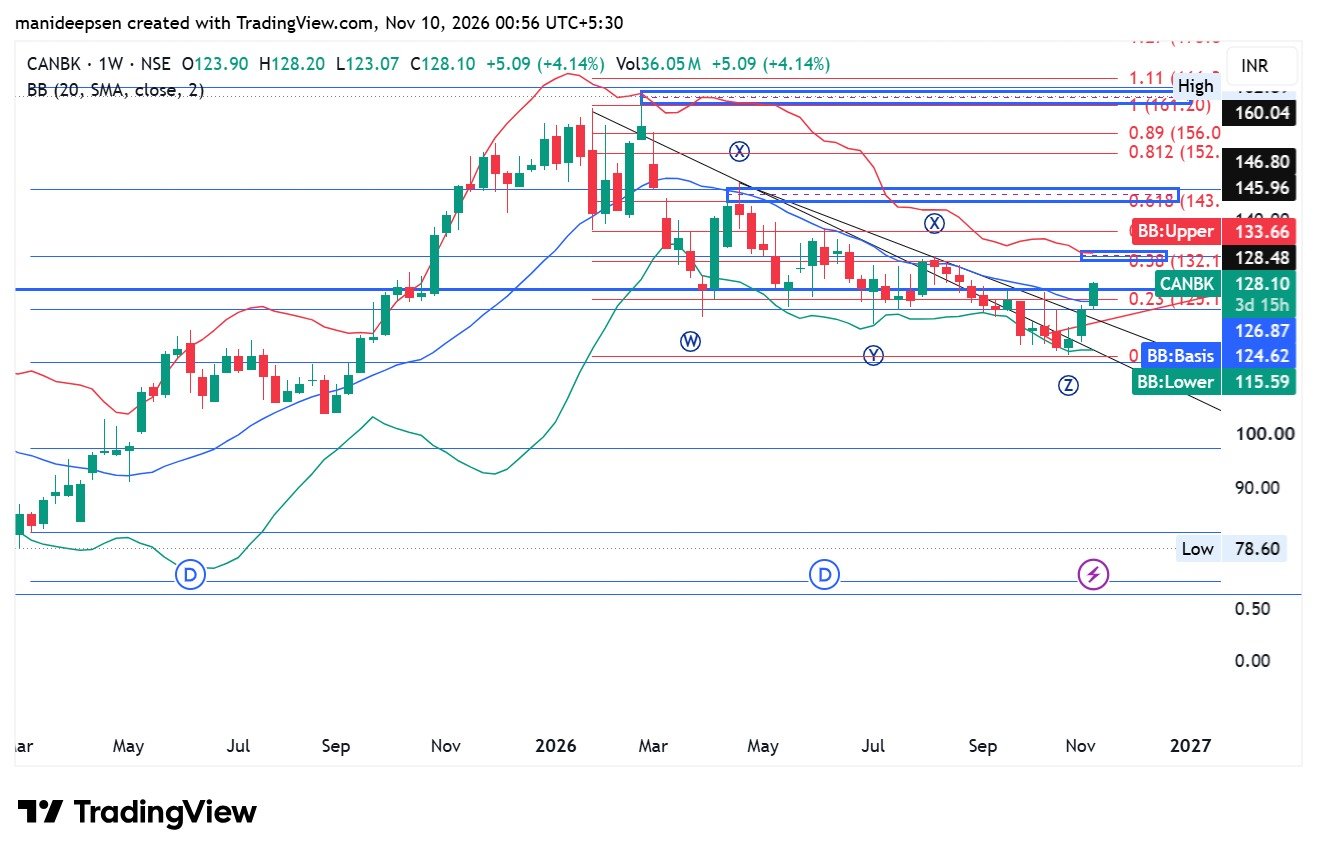
Along with its financial performance, the share price chart also gives us useful information about market sentiment.
On the weekly chart dated November 10, 2026, Canara Bank traded at ₹128.10 after a weekly rise of 4.14%. Its upper Bollinger Band stood at ₹133.66, while the middle band, based on the 20-week simple moving average, was at ₹124.62. The lower band stood at ₹115.59.
The stock had recovered from the ₹115–120 zone and moved above its 20-week average. This is a positive short-term signal. However, the broader chart still showed a downward trendline that had restricted price recoveries for several months.
The immediate resistance zone was around ₹132–134. A weekly close above ₹134, supported by healthy volume, could improve the chance of a larger recovery.
Above this level, the next important resistance zone was ₹143–146. If the stock moves above that zone, the next possible levels would be ₹152–156 and ₹160–161.
On the downside, ₹126.87 was a near-term support level, while ₹124.62 was an important support based on the middle Bollinger Band. A fall below ₹124 could weaken the short-term recovery. The next possible support zones were ₹120 and ₹115–116.
The Elliott Wave labels on the chart also suggest a possible complex correction after the earlier high near ₹160. The W-X-Y-Z structure may represent a corrective pattern. The recent recovery from ₹115–116 could be the start of a new upward move, but this interpretation is not confirmed.
The chart therefore gives a cautiously positive signal, not a clear long-term trend reversal. Also, the weekly candle had about three days and fifteen hours left at the time of the chart, so the price of ₹128.10 was not yet a confirmed weekly close.
Overall Outlook: Is Canara Bank Worth Considering?
Canara Bank has several positive points that make it worth a closer look. Its asset quality has improved, its net profit has grown, its loan book has expanded and its capital adequacy remains comfortable.
Its ROE of 19.61% is also a positive sign. The bank trades close to its book value, which makes its valuation look reasonable based on its current financial performance.
However, there are areas that need attention. NIM has declined, the CASA ratio has room to improve, and deposit growth is slower than advance growth. The latest quarter also showed a large gap between net interest income growth and operating profit growth.
In my view, Canara Bank has positive long-term potential, but investors should not base their decision only on its low P/E ratio or its recent rise in share price.
The bank must show that it can maintain healthy profit growth, protect its margins and keep bad loans under control. A sustained improvement in these areas could support a better valuation over time.
For investors who already hold the stock, the next two quarterly results will be important. For new investors, a staggered approach may be more sensible than a large one-time purchase, especially while the share price remains close to its immediate resistance zone.
Conclusion
Canara Bank appears to be a fundamentally sound public sector bank with a healthy capital base, better asset quality and respectable returns on equity. Its loan book has grown at a good pace, and its valuation near book value makes it worth consideration.
The main question is whether the bank can protect its NIM and improve its deposit base while it expands its loan business. If it succeeds, its profit growth could remain healthy and the market may assign it a higher price-to-book multiple.
My overall view is positive but cautious. Canara Bank deserves a place on the watchlist of medium- to long-term investors, but the final investment decision should depend on its future results, valuation and the investor’s risk tolerance.
A good business can create wealth over time, but the price paid for its shares and the quality of its future profits matter just as much.
ALSO READ: Indian Mutual Fund Assets Fall by ₹4.44 Lakh Crore
Frequently Asked Questions (FAQs) About Canara Bank
1. Is Canara Bank a fundamentally strong stock?
Yes, Canara Bank has several positive fundamental factors. Its asset quality has improved, its capital adequacy ratio is healthy, and its return on equity stood at 19.61% in FY2025–26. However, investors should also watch its net interest margin and deposit growth before making an investment decision.
2. Is Canara Bank a good stock for long-term investment?
Canara Bank may be worth consideration for medium- to long-term investors. Its healthy loan growth, lower NPA levels and reasonable valuation offer a positive outlook. However, its future performance will depend on profit growth, deposit mobilisation and its ability to maintain healthy margins.
3. What is the target price of Canara Bank?
Based on an estimated book value of ₹122.68 per share, the illustrative valuation range is ₹104 in the conservative case, ₹135 in the base case, ₹159 in the optimistic case and ₹184 in the strong re-rating case. These are valuation scenarios, not guaranteed price targets.
4. Is Canara Bank undervalued at ₹128?
At around ₹128.10, Canara Bank trades close to its book value, with an estimated P/B ratio of 1.00–1.04. Considering its ROE of 19.61% and improved asset quality, the valuation appears reasonable. However, it is not necessarily a deeply undervalued stock.
5. What is the biggest strength of Canara Bank?
One of its biggest strengths is the improvement in asset quality. Its gross NPA declined from 2.35% in September 2025 to 1.33% in September 2026. Its net NPA also fell to 0.30%. This can help reduce credit losses and support future profitability.
6. What are the major risks associated with Canara Bank?
The main risks include a fall in net interest margins, slower deposit growth, a weak CASA ratio and a possible rise in bad loans. The public sector banking discount may also limit its valuation, even if its financial performance improves.
7. Does Canara Bank pay dividends?
Yes, Canara Bank pays dividends to its shareholders, subject to its financial performance and board approval. Based on the market data used in this analysis, its dividend yield was approximately 3.3%. However, dividend payments and yields can change over time.
8. What are the important support and resistance levels for CANBK?
Based on the weekly chart dated November 10, 2026, the immediate resistance zone is ₹132–134, followed by ₹143–146 and ₹156–161. On the downside, important support levels are ₹126.87, ₹124.62 and ₹115–116. A weekly close above ₹134 could improve the short-term outlook.
9. Can Canara Bank reach ₹160?
A move towards ₹160 is possible under the optimistic valuation and technical scenarios, but it is not guaranteed. The stock would first need to cross the ₹132–134 resistance zone and then the ₹143–146 supply zone. Healthy profit growth and stable margins would also support such a move.
10. Should investors buy Canara Bank shares now?
Canara Bank has positive fundamentals, but its share price is close to an important resistance zone. Investors may consider a staggered investment approach after they assess their risk tolerance and investment horizon. A sustained weekly close above ₹134 would improve the technical outlook, while a fall below ₹124 could weaken it. Investors should also review the latest financial results before making a decision.
ALSO READ: SEBI Makes Direct Mutual Funds the Default Option