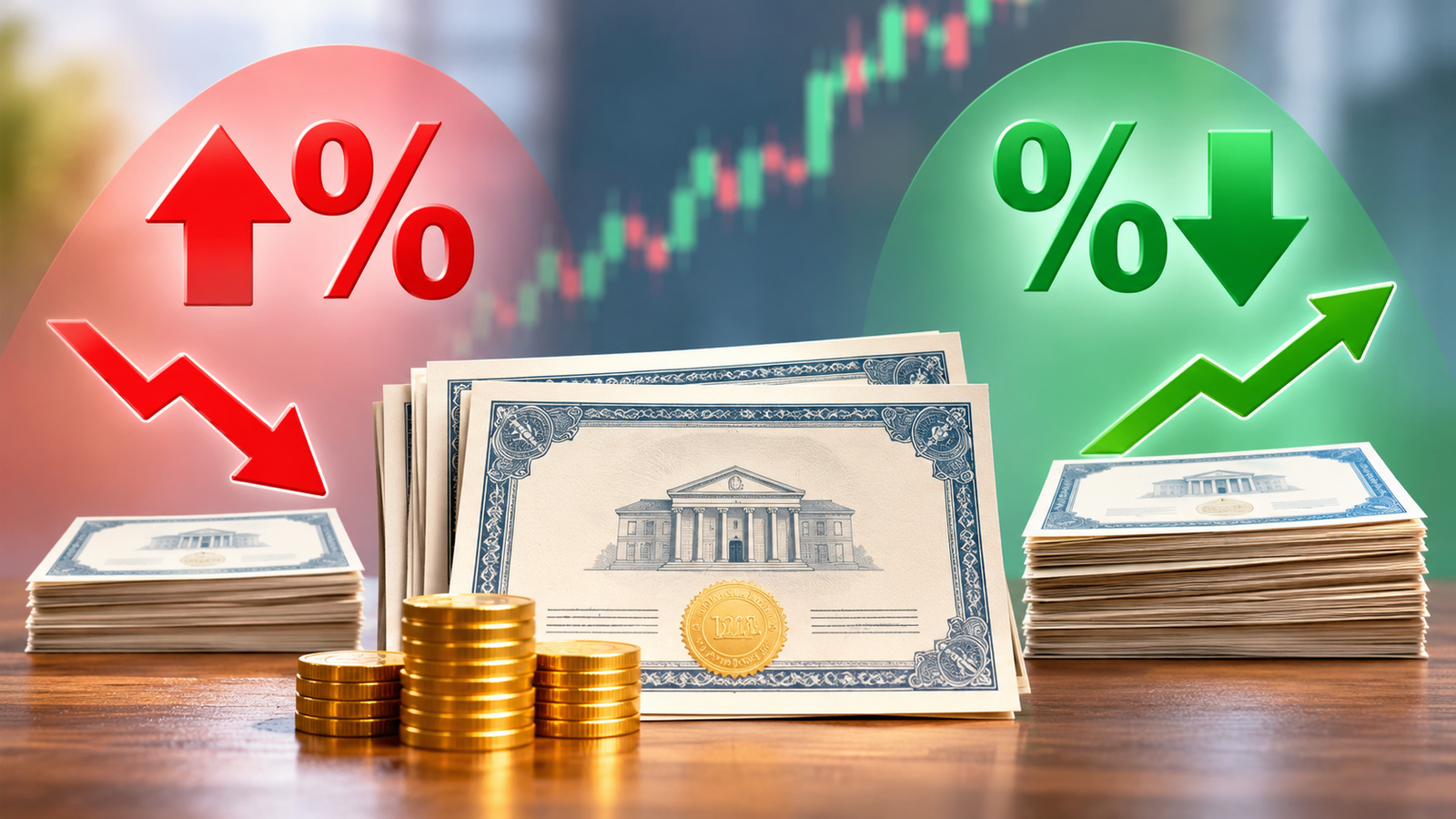
Bond prices and interest rates have an inverse relationship. This means that when interest rates rise, bond prices usually fall. When interest rates fall, bond prices usually rise. This is one of the most important rules of the bond market.
At first, this idea may seem a little hard to understand. After all, why should the price of a bond change when interest rates change? The answer is quite simple. A bond offers a fixed amount of interest. But market rates can change over time. As a result, an old bond may become more or less attractive than a new one.
To understand this better, let us look at how bonds work, why their prices change, and what happens when market interest rates rise or fall.
What Is a Bond?
A bond is a type of loan. When you buy a bond, you lend money to a company or a government. In return, the issuer promises to pay you interest at set times. It also promises to return your original money on a fixed date.
For example, suppose you buy a bond worth $1,000. It has an annual interest rate of 5% and a term of 10 years. This means you will receive $50 each year as interest. At the end of 10 years, you will also get your original $1,000 back, as long as the issuer meets its promise.
The $1,000 is called the face value of the bond. The $50 annual payment is called the coupon payment. The date on which the issuer returns your original money is known as the maturity date.
The key point is that the bond promises a fixed interest payment. If the bond has a 5% coupon rate, you will usually receive $50 each year on a face value of $1,000, even if market interest rates change later.
Why Do Bond Prices Change?
A bond has a fixed interest payment, but market interest rates do not stay the same forever. They may rise or fall due to changes in the economy and decisions by central banks.
When market rates change, new bonds may offer better or lower returns than old bonds. This affects how much people are willing to pay for existing bonds.
For example, imagine that you own a bond that pays $50 each year. Later, new bonds come into the market with an annual payment of $70 on the same face value. Most investors may prefer the new bond because it offers more interest.
As a result, your old bond may lose some of its market value. You may have to sell it for less than its original price if you want to find a buyer.
The reverse can also happen. If new bonds offer less interest than your old bond, more people may want to buy yours. This can raise its market price.
This is the main reason bond prices change when market interest rates change.
What Happens When Interest Rates Rise?
Suppose you buy a bond with a face value of $1,000. Its annual interest rate is 5%, so you receive $50 every year.
Now imagine that market interest rates rise from 5% to 7%. New bonds may now offer $70 each year on a face value of $1,000.
Your old bond still pays only $50 per year. It does not offer the same return as the new bonds. Because of this, many investors may choose the new bonds instead.
But this does not mean your old bond has no value. It still offers its promised $50 annual payment. However, if you want to sell it, you may need to accept a lower price.
For example, a buyer may not want to pay the full $1,000 for a bond that pays only $50 per year when new bonds offer a higher return. The price of your bond may fall below $1,000 to make it more attractive to buyers.
This is why bond prices usually fall when market interest rates rise.
What Happens When Interest Rates Fall?
Now let us look at the opposite situation.
Suppose you own the same bond worth $1,000, which pays $50 every year. Its annual interest rate is 5%.
Later, market interest rates fall from 5% to 3%. New bonds may now offer only $30 each year on a face value of $1,000.
Your old bond still pays $50 every year. This makes it more attractive than the new bonds because it offers a higher annual payment.
As a result, more investors may want to buy your bond. They may even agree to pay more than its original face value of $1,000.
For example, an investor may pay $1,050 or another amount above $1,000 to own a bond that offers a higher payment than new bonds.
The exact market price depends on several factors, such as the time left until maturity and the market rate. However, the main idea remains the same.
When market interest rates fall, the price of an existing bond usually rises.
The Inverse Relationship Between Bond Prices and Interest Rates
The relationship between bond prices and interest rates is called an inverse relationship. In simple words, they usually move in opposite directions.
When interest rates rise, existing bonds become less attractive because new bonds may offer better returns. As a result, the prices of old bonds usually fall.
When interest rates fall, existing bonds become more attractive if they offer higher payments than new bonds. This can push their market prices up.
For example, if interest rates rise from 4% to 6%, the price of an existing bond that pays 4% will usually fall. If market rates drop from 6% to 3%, the price of a bond that pays 6% will usually rise.
It is important to remember that this rule applies to market prices. The fixed coupon payment on an existing bond does not usually change just because market interest rates change.
Why Are Long-Term Bonds More Sensitive to Interest Rates?
Not all bonds react to interest rate changes in the same way. Some bonds see larger price changes than others.
Long-term bonds are usually more sensitive to changes in market interest rates than short-term bonds.
A short-term bond may have only two years left before its maturity date. This means the investor has to wait for a shorter period to get the face value back.
A long-term bond may have 20 years left before maturity. Its future interest payments and final repayment are spread over a much longer period.
When market interest rates change, the value of these future payments also changes. A long-term bond has more future payments, so its price may react more strongly to a change in market rates.
For example, a rise in interest rates may cause a small price fall in a short-term bond but a much larger price fall in a long-term bond.
This is not an absolute rule for every bond, but it is a useful way to understand the market.
What Is Bond Duration?
Duration is a measure of how sensitive a bond’s price is to changes in interest rates.
In simple terms, it helps investors understand how much a bond’s price may change when market rates rise or fall.
A bond with a higher duration is usually more sensitive to interest rate changes. This means its market price may rise or fall by a greater amount when rates change.
A bond with a lower duration is usually less sensitive. Its price may change by a smaller amount when market rates move.
For example, a bond with a duration of 8 years will generally show a larger price response to a change in interest rates than a similar bond with a duration of 2 years.
Duration is useful because it helps investors understand the risk of a bond before they buy it. It is especially important for people who invest in long-term bonds.
The Mathematics Behind Bond Prices
A bond’s market price depends on the value of all the money that the investor expects to receive in the future.
This includes the regular coupon payments and the final return of the face value. But money that you receive in the future is not worth exactly the same as money you have today.
This is because money today can be invested to earn a return. The market interest rate helps investors calculate the present value of future bond payments.
The basic bond price formula is:
P = Σ [C / (1 + r)^t] + F / (1 + r)^n
Here, P means the price of the bond. C means the coupon payment. F means the face value. The letter r stands for the market interest rate, while n refers to the total number of periods until maturity. The letter t refers to each payment period.
The formula may look complex, but the main idea is simple.
When the market interest rate rises, the future payments from the bond have a lower present value. This reduces the bond’s market price.
When the market interest rate falls, those future payments have a higher present value. This raises the bond’s market price.
So, the formula explains why bond prices and market interest rates usually move in opposite directions.
What Happens If Interest Rates Stay the Same?
If market interest rates do not change, a bond’s price may remain fairly stable, all else being equal.
However, this does not mean that its market price will always stay exactly the same. Other factors can also affect bond prices.
For example, the financial health of the company or government that issued the bond can affect its value. Changes in credit risk, market demand, and the time left until maturity may also affect its price.
As a bond gets closer to its maturity date, its market price usually moves closer to its face value, as long as the issuer can repay the debt and no other major problems arise.
Therefore, interest rates are a major factor in bond prices, but they are not the only factor.
A Simple Example to Remember
Imagine that you own a bond worth $1,000. It pays $50 every year, which means its coupon rate is 5%.
Now, there are two possible situations.
In the first situation, market interest rates rise to 7%. New bonds offer more interest than your old bond. As a result, investors may not want to pay the full $1,000 for your bond. Its market price may fall below $1,000.
In the second situation, market interest rates fall to 3%. New bonds offer less interest than your old bond. Your bond now looks more attractive because it still pays $50 each year. Investors may agree to pay more than $1,000 for it.
This simple example shows why bond prices rise when interest rates fall and fall when interest rates rise.
Quick Summary
Bond prices and market interest rates usually move in opposite directions. When market rates rise, the prices of existing bonds usually fall. When market rates fall, the prices of existing bonds usually rise.
The reason is simple. Existing bonds have fixed coupon payments, while new bonds may offer different rates. Investors compare these returns before they decide how much to pay for an old bond.
Long-term bonds are usually more sensitive to interest rate changes than short-term bonds. Duration helps measure this sensitivity. A higher duration usually means a larger price change when market rates move.
A bond’s price also depends on the present value of its future coupon payments and face value. This is why changes in market rates affect the value of future payments.
Conclusion
The link between bond prices and interest rates is simple once you understand how bonds work. A bond offers a fixed payment, but market interest rates can change over time.
When new bonds offer higher interest, old bonds with lower coupon rates become less attractive. Their prices usually fall. When new bonds offer lower interest, old bonds with higher coupon rates become more attractive. Their prices usually rise.
This is why bond prices and interest rates have an inverse relationship.
The most important rule to remember is this: when interest rates rise, bond prices usually fall. When interest rates fall, bond prices usually rise.
This basic idea can help you understand bond markets, fixed-income investments, and the effect of changes in interest rates on investors.
ALSO READ: How to Create an Investment Thesis: A Simple Guide