Tax remains one of the most debated topics in India. Almost every year, especially after the Union Budget, millions of people discuss the same issue. Many say taxes in India are too high. Salaried workers often feel that a large part of their income goes to the government. At the same time, many others argue that India does not even collect enough taxes compared to other countries.
This creates an important question. If taxes feel so high, how many people in India actually pay them?
The answer surprises many people.
India now has a population of nearly 147 crore people. Out of this massive number, only a very small section pays direct income tax. The burden mainly falls on a limited group of honest and formally employed citizens. This reality explains why tax conversations in India often become emotional.
To understand the full picture, it is important to look at actual numbers, tax reforms, government collections, and the difference between direct and indirect taxes.
India’s Population and Actual Taxpayers
India has one of the world’s largest populations. However, the number of people who pay income tax remains surprisingly low.
The country has around 147 crore citizens. Among them, nearly 95 crore people fall in the working-age group. The total workforce stands close to 55 to 60 crore people.
But only a small fraction enters the formal tax system.
Recent estimates show that around 7.2 to 8 crore people file Income Tax Returns each year. Filing a return, however, does not always mean paying tax. After exemptions, rebates, and deductions, only about 3 to 4 crore people actually pay meaningful income tax.
Even more surprising, experts estimate that only around 1.5 to 2 crore Indians pay a large amount of income tax every year.
The gap becomes very clear in the numbers below.
| Category | Approximate Number |
|---|---|
| Total population | 147 crore |
| Working age population | 95 crore |
| Total workforce | 55–60 crore |
| ITR filers | 7.2–8 crore |
| Actual income taxpayers | 3–4 crore |
| Major taxpayers | 1.5–2 crore |
This means less than 3 percent of India’s total population pays meaningful income tax.
That number becomes even smaller when compared with the total workforce.
Why Many Indians Do Not Pay Income Tax
Many people assume that every working citizen should pay income tax. In reality, that does not happen.
One major reason is low income. A very large section of India’s population earns below the taxable limit. Daily wage workers, farm workers, small vendors, domestic helpers, and millions in low-income jobs simply do not earn enough to enter the tax system.
The second reason is India’s huge informal economy.
Unlike developed countries where most work happens through registered companies, a large part of India’s economy still depends on cash transactions. Small businesses, contractors, traders, and service providers often work outside formal systems.
Another major reason comes from agriculture.
Agricultural income in India remains largely exempt from income tax. This rule helps small farmers, but it also creates situations where some wealthy agricultural landowners legally pay no income tax.
Tax evasion also plays a role. Even though digital payments and better monitoring have reduced this issue, under-reporting income still exists in many sectors.
Why Salaried Employees Feel Tax Pressure
The strongest tax complaints usually come from salaried employees.
The reason is simple.
A salaried worker has very little room to avoid taxes. Companies deduct Tax Deducted at Source, also called TDS, before salary reaches the employee’s account.
This means the tax payment happens automatically.
A business owner may adjust expenses and reduce taxable income legally. Some people in cash-based businesses may even under-report income.
A salaried worker usually cannot do either.
This creates a feeling of unfairness.
Two people may earn similar income, but one pays tax immediately while the other may legally reduce tax burden or avoid proper reporting.
This difference creates frustration among middle-class taxpayers.
India’s Direct Tax Collection Continues to Rise
Even with a small taxpayer base, India collects a large amount through direct taxes.
Government data for the financial year 2024–25 shows net direct tax collection at nearly ₹22.26 lakh crore.
This number shows healthy annual growth of around 13.5 percent.
Direct taxes mainly include corporate tax and personal income tax.
The rough division looks like this.
| Tax Type | Collection |
| Corporate tax | ₹9–10 lakh crore |
| Personal income tax | ₹10–11 lakh crore |
| Other direct taxes | Small share |
| Total direct taxes | ₹22.26 lakh crore |
This data shows how important direct taxpayers are for government revenue.
A relatively small number of citizens contribute a massive amount.
Tax Burden Does Not End With Income Tax
Many people who pay no income tax still pay taxes every day.
This happens because of indirect taxes.
Indirect tax means tax attached to products and services.
The biggest example is GST.
Whenever a person buys clothes, books a hotel room, orders food online, or pays for mobile service, tax becomes part of the bill.
GST rates usually stay at 5 percent, 12 percent, 18 percent, or 28 percent depending on the product.
Fuel taxes also create a major burden.
Petrol and diesel prices include excise duty and state taxes.
Vehicle owners pay registration tax. Home buyers pay stamp duty. Drivers pay toll tax. Property owners pay property tax.
This means even poor citizens who pay zero income tax still contribute to government revenue.
That changes the larger debate.
Not paying income tax does not mean not paying tax at all.
Why Middle Class Citizens Feel Overburdened
The middle class often feels pressure because tax appears in multiple places.
Consider a person with annual income of ₹20 lakh.
First, income tax takes a direct portion of salary.
After salary reaches the bank account, daily spending attracts GST.
Investment profits may attract capital gains tax.
Fuel purchases include heavy taxes.
Buying property requires stamp duty.
Owning property brings yearly local taxes.
This creates what many people describe as multiple layers of taxation.
A person feels taxed at every stage of life.
That feeling becomes stronger when the same person sees others escaping direct tax completely.
This explains why salaried taxpayers often complain loudly.
Government Has Reduced Income Tax Burden Recently
The government has introduced several changes in recent years to reduce tax pressure, especially for middle-income earners.
The biggest change came through the new tax regime.
This system reduced complexity and simplified tax slabs.
Recent changes made lower incomes largely tax-free.
The government also expanded the standard deduction benefit.
This reduced taxable income for many salaried employees.
The newer structure looks much simpler compared to the older tax system.
A basic comparison shows the shift.
| Tax Policy Change | Effect |
| New tax regime | Simpler structure |
| Standard deduction increase | Lower taxable income |
| Higher rebate benefit | More lower earners pay zero tax |
| Fewer slab complications | Easier filing |
These reforms reduced burden for many citizens, although some taxpayers still prefer the old regime because of deduction benefits.
India Still Has Low Tax Collection Compared to Other Nations
One surprising fact is that India does not actually collect very high taxes compared with many developed economies.
Economists measure this using tax-to-GDP ratio.
This ratio compares tax collection with total economic output.
India’s tax-to-GDP ratio stays near 11 to 12 percent.
Many developed countries collect much more.
The difference becomes clear here.
| Country | Tax to GDP Ratio |
| India | 11–12% |
| United Kingdom | 33% |
| Germany | 38% |
| France | 45% |
This shows India is not a high-tax country in global comparison.
So why do taxes feel heavy?
The answer lies in a narrow tax base.
Too few people carry the burden.
Government Wants More People Inside the Tax System
The government understands this challenge.
To improve tax collection without raising rates, the focus has shifted toward better compliance.
GST became a major reform because it brought business transactions into digital records.
PAN and Aadhaar linking helped reduce identity duplication.
UPI growth increased digital payment records.
Faceless tax assessment reduced corruption and improved transparency.
TDS now applies in more situations than before.
All these steps have one common purpose.
The government wants more people inside the formal economy.
A wider tax base reduces pressure on honest taxpayers.
Wealthy Citizens Sometimes Pay Less Than Expected
Another reason for public anger comes from tax inequality.
Many high-income salaried employees pay taxes immediately.
However, some wealthy individuals use legal tax planning systems.
Business structures allow expense deductions.
Investment income sometimes receives better tax treatment.
Capital gains taxes often remain lower than normal income tax rates.
Trust structures and company arrangements may also reduce tax burden legally.
This creates a strange situation.
A corporate employee earning ₹30 lakh may pay higher effective tax than a wealthy business owner earning much more.
This difference creates frustration.
People begin to feel the system rewards complexity rather than honesty.
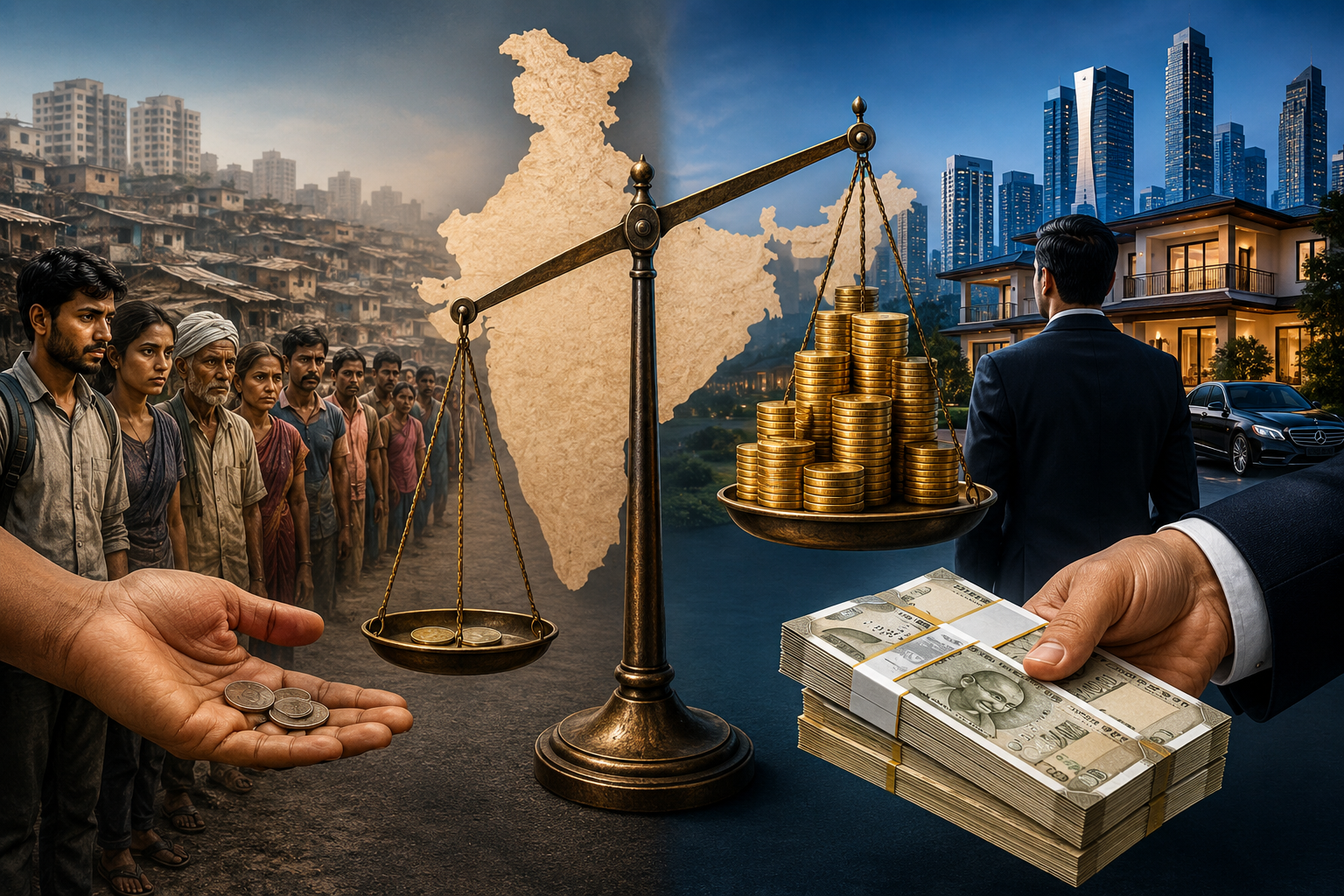
The Core Problem Is Unequal Burden
India’s tax debate often focuses on rates.
But rates are not the biggest problem.
The bigger issue is unequal distribution.
Out of every 100 Indians, more than 90 do not pay direct income tax.
Only around 6 or 7 people file tax returns.
Among them, just a very small group contributes most direct tax revenue.
This creates pressure on compliant citizens.
The government needs money for roads, railways, defense, education, healthcare, welfare programs, and infrastructure.
If very few people pay direct taxes, revenue must come from somewhere else.
That often means indirect taxes or higher borrowing.
Neither option solves the deeper issue.
The Real Truth Behind India’s Tax Debate
The common statement that India has very high taxes is only partly correct.
India does not have unusually high taxes compared with developed countries.
The real issue is concentration.
Too few people pay direct tax.
Honest salaried citizens carry a large share of the burden because their income remains fully visible.
At the same time, millions remain outside the formal tax system because of low income, exemptions, informal work, or under-reporting.
This creates an imbalance.
The average taxpayer feels trapped.
That feeling leads to anger every time tax discussions begin.
The final reality is simple.
India is not a high-tax country.
India is a country where too few people pay direct tax.
Until the tax base becomes wider, the pressure on compliant citizens will continue.
And that explains why tax remains one of the most sensitive topics in modern India.
Also Read – Stock Market Boom: 47 NSE Shares Touch 52-Week High