India’s stock market may see extra caution in select counters after the National Stock Exchange increased margin requirements on 23 stocks for trade date June 15, 2026. This change came under the category called Additional Extreme Loss Margin, often known as Additional ELM.
At first look, this may appear like a routine exchange update. But such changes often reveal early signs of rising risk in specific stocks. For traders, especially those who use leverage, this development deserves attention because it can affect position size, capital use, and short-term market behaviour in the next session.
This move does not automatically suggest negative news around these companies. It simply shows that the exchange wants more protection due to a possible rise in price swings.
What Exactly Changed
NSE revised Additional Extreme Loss Margin requirements on 23 stocks. This means traders who take positions in these counters may now need extra capital compared to previous sessions.
Margin acts as a safety deposit. When exchanges raise this amount, traders cannot borrow the same level of exposure as before. As a result, leverage becomes lower and speculative activity often slows down.
Exchanges usually take this step when price movement appears unusually sharp or when market activity rises faster than normal.
In simple terms, the exchange has placed these stocks under tighter risk control for the next trading session.
Why Exchanges Raise Margins
Stock exchanges regularly monitor unusual market behaviour. When sudden price movement, high trading volume, or aggressive speculation appears in a stock, exchanges sometimes increase margin requirements.
This step protects the market ecosystem from excessive risk.
A higher margin requirement does not mean a stock will fall. It only means the exchange expects unusual movement and wants traders to maintain extra capital before they take positions.
For short-term traders, this matters because even a small margin increase can reduce trade size.
If a trader earlier required ₹1 lakh to hold a leveraged position, the new margin rule may push that amount higher depending on exchange calculations.
This creates immediate pressure on highly leveraged participants.
The Stocks Under Margin Revision
The latest NSE circular shows 23 stocks under this margin revision.
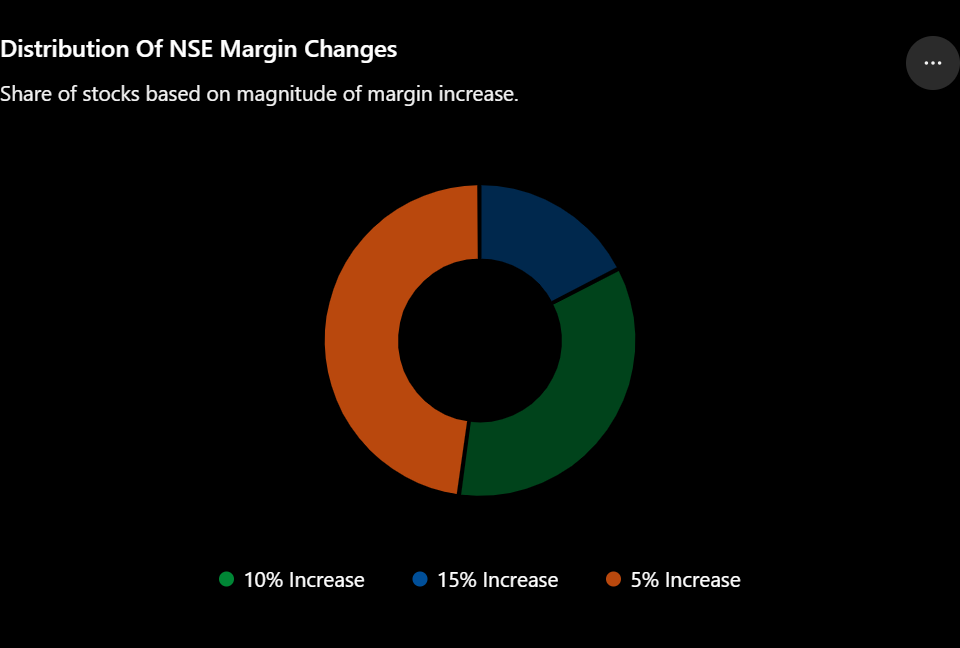
Among the most notable names are Adani Energy Solutions and Ambuja Cements where additional margin moved higher by around 15 percent.
Other important names include Wipro, Vodafone Idea, JSW Steel, BHEL, SAIL, Bandhan Bank, RBL Bank, DLF, IEX and NMDC.
These companies belong to very different sectors such as banking, cement, energy, telecom, steel, real estate, and technology.
That wide spread suggests this action does not relate to one sector alone.
Distribution Of NSE Margin Changes
What Traders May Notice Tomorrow
The immediate effect usually appears in leverage availability.
Traders who depend on margin-funded positions may face restrictions because brokers follow exchange margin rules. Lower leverage often reduces aggressive short-term trades.
This may lead to temporary decline in speculative volume.
Sometimes such changes create extra volatility because traders adjust positions before market close or during the next opening session.
In certain cases, price action becomes unstable for a short period because fewer participants can deploy the same capital size.
For retail traders, this creates a market environment where caution becomes more important than aggressive exposure.
Why This Data Matters More Than Many Realise
Most investors focus only on company news, quarterly earnings, or price charts. But exchange-level risk controls often reveal information that ordinary market participants ignore.
An exchange has access to large volumes of trading data. When it notices unusual behaviour, margin changes act as an early response mechanism.
This makes margin updates an underrated market signal.
Unlike rumours or market opinions, these decisions come directly from risk monitoring systems inside the exchange framework.
Because of this, experienced traders often watch margin circulars very closely.
Such changes may not predict direction, but they often indicate unusual activity below the surface.
This Does Not Mean Stocks Become Weak
It is important to understand one thing clearly.
A margin increase does not mean the stock has become fundamentally weak. It does not mean the company faces financial trouble. It also does not guarantee price decline.
The exchange only adjusts risk exposure rules based on market conditions.
A strong stock can face margin revision if unusual price movement appears.
Similarly, a speculative stock may also receive tighter restrictions after sudden trading activity.
This action should therefore be viewed as a risk management measure rather than a judgment on company quality.
The Larger Market Signal
The bigger takeaway lies beyond these 23 stocks.
When exchanges begin margin adjustments, they quietly communicate that certain pockets of the market have become more active than normal.
This often happens during periods when speculative positions rise rapidly.
The market may continue upward, remain stable, or even move lower. But one thing becomes clear.
The exchange wants more protection against sudden sharp moves.
That itself becomes a signal worth watching.
Final Take
The June 15 NSE margin revision may look like a routine operational update, but the deeper message deserves attention.
Twenty-three stocks now carry higher margin requirements ahead of the next session. This means traders may need more capital, leverage may reduce, and short-term price movement can become less predictable.
Many market participants watch stock charts every minute.
But exchanges monitor risk behind those charts.
And sometimes, those quiet exchange signals reveal market stress much earlier than price action itself.
For traders who follow market structure closely, this remains one of the most overlooked indicators in the Indian equity market today.
Frequently Asked Questions (FAQs)
1. Why did NSE raise margin requirements on certain stocks?
NSE raised margin requirements because its risk monitoring system detected higher than usual market activity or the possibility of sharp price movement in certain stocks.
2. What does Additional Extreme Loss Margin mean?
Additional Extreme Loss Margin, or Additional ELM, is an extra safety margin that traders must maintain when the exchange expects higher volatility in a stock.
3. Does a margin hike mean a stock will fall?
No, a margin hike does not mean a stock price will fall. It only shows that the exchange expects unusual price movement and wants traders to maintain more capital.
4. How does a margin increase affect traders?
A margin increase means traders need more money to take the same position size. This reduces leverage and can limit aggressive short-term trades.
5. Why do exchanges increase margins on stocks?
Exchanges raise margins when they notice sudden price swings, unusual trading volume, or higher speculative activity that may increase market risk.
6. Which stocks were affected by the latest NSE margin revision?
A total of 23 stocks came under margin revision, including major names such as Adani Energy Solutions, Ambuja Cements, Wipro, and Vodafone Idea.
7. Can higher margin requirements reduce stock volatility?
Higher margin requirements can reduce speculative trades because traders receive lower leverage, but actual stock price movement depends on overall market conditions.
8. Do long-term investors need to worry about margin changes?
Long-term investors usually face little direct impact because margin changes mainly affect short-term traders and leveraged market participants.
9. How often does NSE revise margin requirements?
NSE reviews margin requirements regularly and can revise them whenever market conditions show higher risk, sudden volatility, or unusual trading behaviour.
10. Why do experienced traders track exchange margin updates?
Experienced traders track margin updates because exchange-level risk changes can reveal hidden market stress before major price action becomes visible on stock charts.
ALSO READ: Crypto Crash Shows Rising Danger of AI Powered Hacking
DATA SOURCE: NSE INDIA