Market participants usually pay attention to visible indicators such as stock price movement, trading volumes, quarterly earnings, and major corporate announcements. These are the signals that dominate everyday market discussions and often shape short-term sentiment among investors.
However, some of the most valuable market signals come from areas that receive far less public attention.
Deep within exchange infrastructure, clearing corporations continuously monitor market conditions and adjust their internal risk frameworks based on changing levels of uncertainty. These adjustments rarely attract attention from retail investors, yet they often reveal how exchanges themselves assess underlying market risk long before broader market sentiment begins to shift.
One of the clearest indicators comes from daily collateral valuation data published as part of exchange risk management systems.
Clearing corporations regularly evaluate securities that traders and institutions pledge as collateral against margin requirements. Based on internal models, exchanges assign haircut percentages to these securities, which determine how much value the exchange recognizes when collateral supports leveraged positions.
When exchanges decide to increase haircut percentages across a broad range of securities, it usually means the system has started to apply more cautious assumptions toward asset quality, liquidity conditions, or overall market stability.
Recent exchange data shows a noticeable rise in collateral haircuts across a large number of securities in both equity and mutual fund collateral segments.
While these revisions may appear technical at first glance, they often provide valuable insight into how market infrastructure currently views risk beneath the surface.
Unlike price charts, which reflect public behaviour, collateral adjustments reflect internal exchange-level risk assessment.
This distinction matters because exchanges sit at the center of settlement and margin systems, which means their risk models often react earlier than broader market narratives.
For institutional participants, proprietary trading desks, and serious market observers, this type of data can act as an early signal that market conditions are beginning to change quietly, even before that stress becomes visible in price action itself.
Sometimes, the earliest warnings do not come from market headlines.
They first appear inside the exchange’s own risk management framework.
Why Collateral Haircuts Matter
In Indian markets, clearing corporations such as National Securities Clearing Corporation Limited allow traders and institutions to pledge approved securities as collateral against margin requirements.
Each security carries a haircut percentage.
A haircut decides how much value the exchange accepts from the pledged asset.
For example, if a participant pledges securities worth ₹100 and the haircut stands at 15 percent, the exchange only accepts ₹85 as usable collateral.
If the haircut rises, the collateral loses effective value.
This means market participants need more capital to maintain the same trading exposure.
Because of this, changes in haircut values often reveal how exchange risk systems assess market conditions internally.
A higher haircut usually suggests that the exchange now sees greater uncertainty in that asset.
Equity Collateral Shows Broader Risk Repricing
Data from the APPSEC collateral valuation file shows a broad increase in haircut percentages across listed securities.
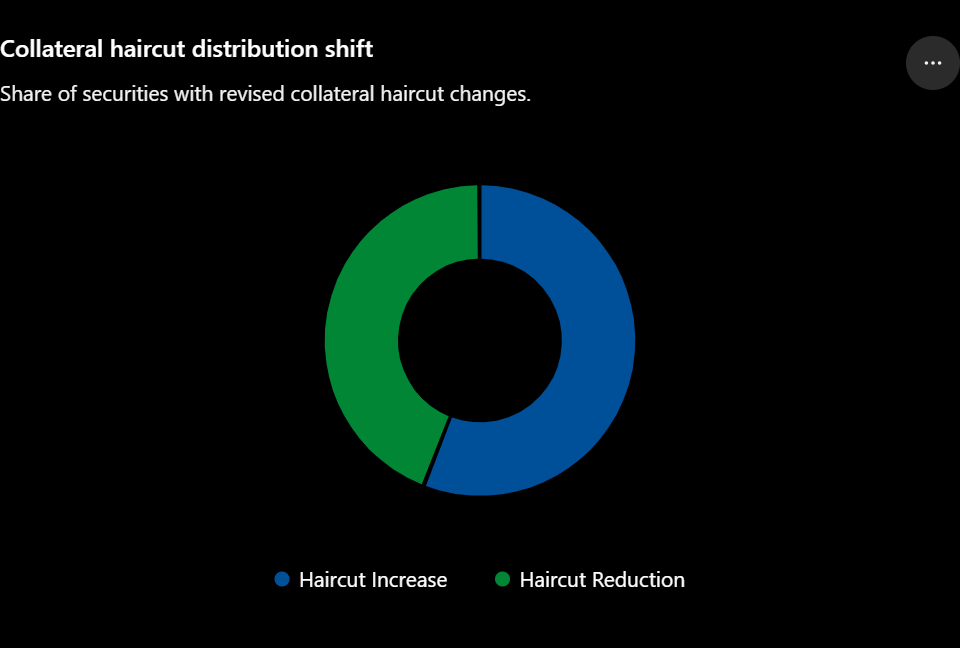
The latest comparison shows 421 securities recorded an increase in haircut values, while 331 securities recorded a reduction.
This difference suggests that exchange systems have become slightly more conservative toward a larger part of the equity collateral universe.
Some securities recorded notable upward revisions.
PREMEXPLN moved from 26.22 percent to 26.30 percent.
APEX moved from 26.01 percent to 26.05 percent.
APOLLO moved from 25.72 percent to 25.89 percent.
WALCHANNAG moved from 24.95 percent to 25.27 percent.
MTARTECH moved from 23.82 percent to 24.59 percent.
Although these percentage changes appear small, they directly affect collateral efficiency.
When this pattern appears across hundreds of securities at the same time, it may reflect a broader shift in exchange risk assumptions.
Mutual Fund Collateral Also Shows Similar Pattern
The same pattern also appears in the mutual fund collateral segment, which makes the overall trend more noteworthy.
Recent exchange data shows that 1,859 mutual fund units recorded an increase in haircut percentage. On the surface, this may look like a small technical adjustment. However, within market infrastructure, such changes often carry deeper meaning because they reflect how exchange risk systems currently assess asset quality.
Mutual fund units play an important role in the collateral ecosystem. A large number of market participants use these instruments to meet margin requirements and support leveraged positions across different trading strategies.
This segment remains particularly important for high-net-worth investors, proprietary trading desks, arbitrage participants, and portfolio managers who regularly rely on pledged assets to improve capital efficiency.
A closer review also shows individual revisions across several securities.
Security code 152415 moved from 9.87 percent to 9.92 percent.
Security code 151650 moved from 9.72 percent to 9.79 percent.
Security code 152521 moved from 12.52 percent to 12.61 percent.
Individually, these percentage revisions appear small. Yet when this type of adjustment takes place across a large number of instruments at the same time, it often signals that exchange systems have begun to apply stricter collateral assumptions.
The fact that similar revisions now appear in both equity collateral and mutual fund collateral makes the overall pattern more significant.
This suggests the change may not remain limited to one isolated category. Instead, it may reflect a wider reassessment of risk across multiple segments of the market.
Why Exchanges Usually Raise Haircuts
Clearing corporations constantly evaluate the quality and safety of securities accepted as collateral.
To make these decisions, exchanges rely on internal risk models that study multiple market variables before assigning acceptable collateral value.
One major factor involves volatility.
When price fluctuations become larger or more unpredictable, the exchange may decide that certain securities now carry greater risk. In such situations, raising the haircut allows the clearing corporation to create an additional safety buffer.
Liquidity conditions also play an important role.
If an exchange believes that selling a pledged asset could become difficult during sudden market stress, it may reduce the collateral value attached to that security. Lower liquidity usually increases the difficulty of forced liquidation during adverse market conditions.
Sector weakness can also influence these decisions.
If a specific group of stocks begins to show unstable price behaviour, exchanges may respond by applying tighter collateral standards to securities within that segment.
At times, exchanges act even before visible market weakness appears.
Risk systems often react earlier than broader market sentiment because their primary objective focuses on protecting settlement infrastructure and reducing the possibility of systemic disruption.
For this reason, collateral haircut revisions deserve careful observation even when broader market indices appear relatively stable.
Why Institutional Traders Watch This Data
Most retail investors focus on stock prices, corporate news, and index movement.
Institutional participants often look much deeper.
Professional traders pay close attention to exchange risk data because it reveals how core market infrastructure currently views asset risk beneath the surface.
When exchanges raise collateral haircuts, leverage becomes more expensive.
This happens because traders receive lower usable value against the securities they pledge.
As a result, market participants must allocate additional capital to maintain the same exposure.
In highly leveraged environments, even small changes can affect funding efficiency and position management.
For large trading desks that operate with margin-heavy strategies, these adjustments can influence how capital moves through the system.
If this pattern expands further, it may eventually affect derivatives exposure, margin deployment, and overall leverage capacity within certain market segments.
It is important to understand that this type of signal does not automatically indicate immediate weakness in the market.
However, it often reveals how exchange infrastructure currently evaluates market risk.
This information becomes valuable because clearing corporations operate at the center of settlement systems and financial stability.
Their internal risk frameworks often react earlier than public narratives or visible market price movement.
What Current Data May Suggest
The latest exchange data reveals a consistent pattern across multiple collateral categories.
The equity collateral segment shows 421 securities with higher haircut values.
The mutual fund collateral segment shows 1,859 units with increased haircut percentages.
When similar adjustments appear across multiple categories at the same time, it usually suggests that exchange risk systems have adopted tighter collateral assumptions compared with previous sessions.
The broader market may still look calm on the surface.
Price movement alone may not immediately reveal any unusual stress.
Yet the underlying exchange framework now appears more cautious than before.
This data does not confirm immediate market weakness.
It simply shows that the core infrastructure responsible for settlement and risk management has begun to assign lower effective value to a large number of collateral assets.
For serious market observers, this creates an important signal worth monitoring closely.
When exchanges quietly reduce collateral efficiency across broad asset categories, it often reflects a shift in internal risk perception that deserves attention.
Final Observation
Most market participants watch price action every day.
Very few study exchange-level risk data.
Yet clearing corporations remain one of the most important pillars of market stability.
Changes in collateral haircuts can reveal subtle shifts long before broader market sentiment begins to change.
Current exchange data suggests that stricter risk assumptions have started to appear across several market segments.
This does not automatically signal immediate market stress.
However, it shows that exchange infrastructure now views collateral quality more conservatively than before.
For institutional participants, signals like these often provide one of the earliest indications of changing market conditions.
Sometimes the most important market warnings do not appear on price charts.
They first appear deep inside the exchange risk system itself.
Frequently Asked Questions
1. What is a collateral haircut in the stock market?
A collateral haircut is the percentage reduction that an exchange applies to a security when traders pledge it for margin. If the haircut rises, the usable value of that security falls.
2. Why do exchanges increase collateral haircuts?
Exchanges may raise haircut values when internal risk systems detect higher volatility, lower liquidity, or greater uncertainty in certain securities or market segments.
3. What does a higher collateral haircut indicate?
A higher haircut usually suggests that the exchange considers that asset relatively riskier compared with earlier sessions. It often reflects a more cautious risk assessment.
4. Why is clearing corporation data important for market analysis?
Clearing corporation data helps reveal internal exchange-level risk management decisions. These changes sometimes provide early signals before wider market stress becomes visible.
5. What did the latest equity collateral data show?
The latest APPSEC collateral valuation data showed that 421 securities recorded higher haircut values, while 331 securities recorded lower haircut values.
6. What changes appeared in mutual fund collateral data?
The MF_VAR file showed that 1,859 mutual fund units saw an increase in haircut percentages, which suggests tighter collateral valuation across this segment.
7. How do higher haircuts affect traders?
When haircut percentages rise, traders receive lower collateral value against pledged assets. This means they may need more capital to maintain the same market exposure.
8. Can collateral haircut changes affect leverage in the market?
Yes. Higher haircut values reduce collateral efficiency. This can lower leverage capacity and increase capital requirements for market participants.
9. Do rising haircut values mean the market will fall?
Not necessarily. Higher haircuts do not confirm an immediate market decline. They simply suggest that exchange risk systems have adopted more conservative assumptions.
10. Why do institutional investors track exchange risk data?
Institutional participants often study clearing corporation data because it helps identify hidden shifts in market risk conditions that may not yet appear in price movement alone.
ALSO READ: Crypto Crash Shows Rising Danger of AI Powered Hacking
DATA SOURCE: NSE INDIA