
Open Interest data often helps traders understand where large market participants place their positions before an important trading session. While price movement gives one side of the story, Open Interest usually offers deeper insight into how institutions may prepare for the next move.
The latest derivatives data shows unusual activity in several stocks where institutional participation looks stronger than normal. This does not confirm future direction, but it may help options traders identify counters where market interest remains high ahead of tomorrow’s session.
Open Interest analysis becomes more useful when traders study it together with price movement. Market participants usually divide these signals into four common categories. When price moves higher and Open Interest also rises, traders often classify it as Long Build-Up. This may suggest fresh bullish positions. When price declines but Open Interest rises, the market often reads it as Short Build-Up, which may indicate fresh bearish activity.
In cases where price rises but Open Interest drops, traders usually call it Short Covering. This often shows exit of earlier short positions. If both price and Open Interest move lower together, the pattern may reflect Long Unwinding, where traders exit earlier bullish positions.
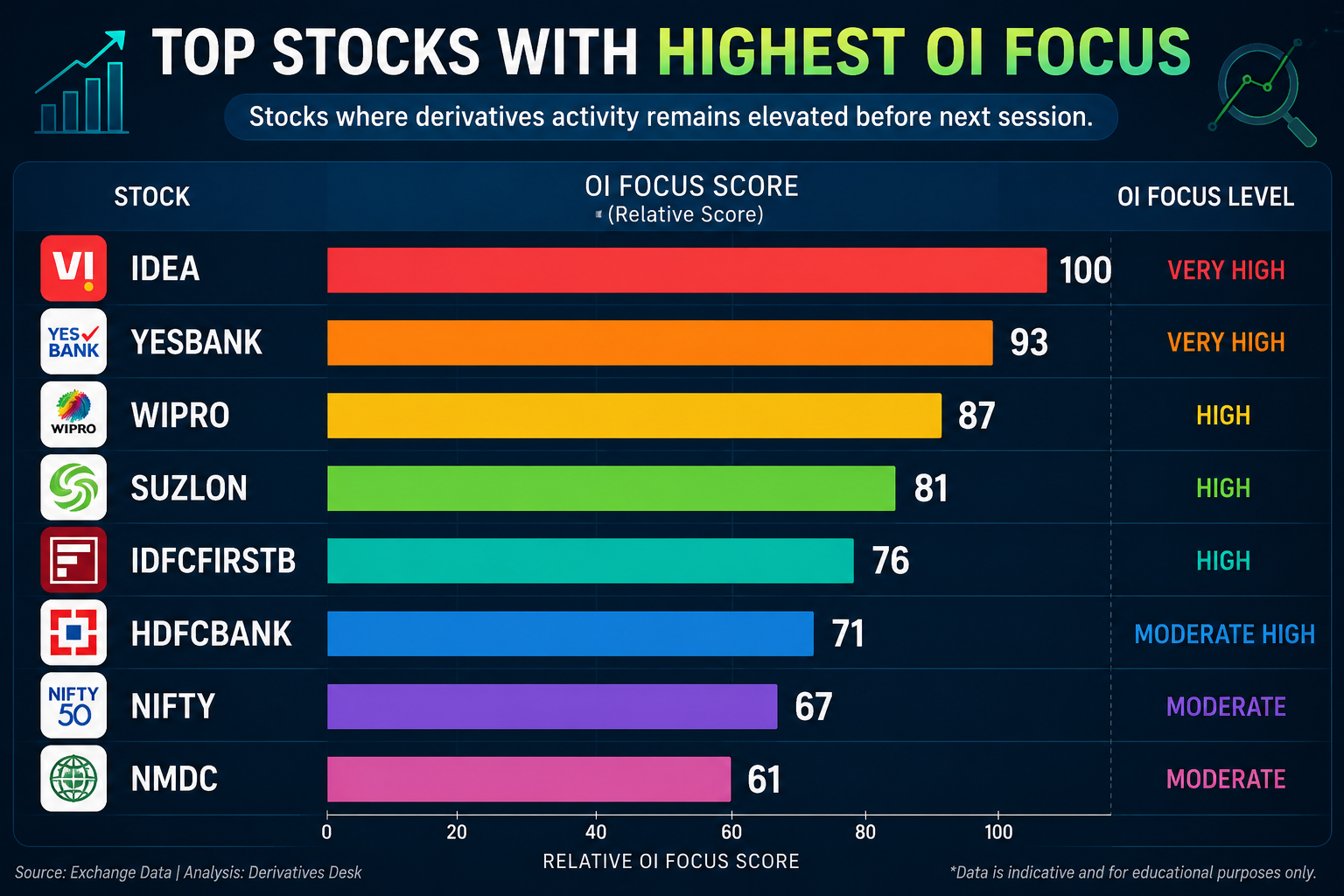
The latest derivatives data highlights eight stocks where institutional positioning appears stronger compared with the broader market.
Vodafone Idea Draws Heavy Derivatives Attention
Vodafone Idea remains one of the most closely watched counters after showing the highest concentration of Open Interest among actively traded futures stocks.
Such elevated activity often shows strong market participation from both institutional and speculative traders. Since the stock already attracts aggressive short-term trading interest, tomorrow’s opening move may become important for understanding market direction.
If price strength appears with fresh Open Interest addition, traders may interpret this as possible Long Build-Up. A failed breakout, however, may shift attention toward fresh bearish positions.
Yes Bank Continues To See Active Position Build-Up
Yes Bank also stands among the most active counters in the derivatives segment.
The stock has consistently attracted large futures participation over recent sessions. Higher Open Interest generally suggests traders continue to build exposure rather than exit existing positions.
If price weakness appears alongside fresh contract additions, market participants may read the move as Short Build-Up. Strong price recovery with lower Open Interest may instead indicate short covering activity.
Wipro Shows Rising Institutional Focus
Wipro Limited has emerged as another stock where futures activity remains unusually high.
Technology stocks often attract institutional participation ahead of sector-specific moves, and current data suggests traders maintain active exposure in the counter.
If the stock moves higher while fresh contracts enter the market, it may indicate fresh bullish positioning. Price weakness with rising Open Interest could reflect a bearish view.
Suzlon Energy Remains Highly Active
Suzlon Energy continues to attract strong derivatives participation.
The stock remains popular among both retail traders and larger market participants because of frequent short-term volatility. Elevated Open Interest usually shows that traders expect movement over the near term.
If sudden upside appears while Open Interest declines, traders often interpret such a pattern as short covering where earlier bearish positions close quickly.
ALSO READ: Vedanta Iron and Steel Limited IPO Full Business Analysis
IDFC First Bank Sees Increased Exposure
IDFC First Bank also appears among stocks where institutional activity has increased.
Banking stocks often attract attention whenever market participants expect sector rotation. Higher futures participation sometimes shows institutions prepare for larger directional movement.
If the stock falls while Open Interest expands, traders may classify the move as fresh bearish build-up. If contracts reduce with price weakness, long unwinding becomes a possible interpretation.
HDFC Bank Holds Institutional Interest
HDFC Bank remains one of the most important banking counters because institutional positioning in large-cap financial stocks often influences broader market sentiment.
Higher Open Interest in heavyweight stocks usually reflects hedging activity or fresh directional exposure by larger participants.
Price strength supported by rising contracts may indicate bullish participation. Traders often monitor such moves closely because large-cap banking stocks frequently influence index direction.
Nifty Signals Broad Market Preparation
Nifty 50 Index itself has also recorded notable futures positioning.
Heavy index participation usually shows institutions prepare for wider market movement instead of stock-specific action. Traders often watch index Open Interest closely because large index exposure can affect sentiment across sectors.
If the market rises while Open Interest falls, it may suggest short covering across broader positions.
NMDC Enters The Institutional Watchlist
NMDC Limited has also entered the list of actively positioned stocks.
Commodity-linked counters often attract institutional interest when traders expect movement in metals and raw material sectors. Higher participation may signal growing focus on the stock ahead of the next trading session.
If weakness appears with falling contracts, traders sometimes interpret the move as long unwinding where earlier buyers reduce exposure.
What The Data Suggests For Tomorrow
Open Interest data does not predict future price movement with certainty, but it often helps traders identify where market attention currently sits.
Based on current positioning, IDEA, YESBANK, WIPRO, SUZLON, IDFC First Bank, HDFC Bank, NIFTY, and NMDC appear to have stronger institutional participation compared with many other F&O counters.
For options traders, tomorrow’s first hour may provide the clearest signal. Price movement combined with fresh Open Interest changes usually reveals whether institutions add bullish positions, create bearish exposure, close short bets, or exit earlier long trades.
In derivatives trading, price often reacts later. Open Interest frequently reveals where market conviction already exists.
The latest data suggests these eight counters deserve closer attention as traders prepare for tomorrow’s session.
Frequently Asked Questions
1. What does Open Interest mean in stock market trading?
Open Interest refers to the total number of active futures or options contracts that traders hold in the market. It helps traders understand how much participation exists in a stock.
2. Why do traders track Open Interest data?
Traders track Open Interest because it helps show where large market participants may have created fresh positions. It often gives clues about market sentiment before major price movement.
3. What is Long Build-Up in Open Interest analysis?
Long Build-Up happens when stock price moves higher and Open Interest also rises. This usually suggests traders have created fresh bullish positions in the market.
4. What does Short Build-Up indicate in derivatives trading?
Short Build-Up happens when stock price falls while Open Interest rises. This often suggests traders have taken fresh bearish positions and expect weakness.
5. What is Short Covering in stock market terms?
Short Covering happens when stock price moves higher but Open Interest falls. This usually shows traders have closed earlier bearish positions.
6. What does Long Unwinding mean in futures trading?
Long Unwinding happens when both stock price and Open Interest move lower together. This often shows traders have exited earlier bullish positions.
7. Why is Open Interest data important for options traders?
Open Interest helps options traders identify stocks where market activity remains high. It may help traders understand where institutions have increased exposure.
8. Which stocks currently show the highest Open Interest activity?
Based on recent derivatives data, Vodafone Idea, Yes Bank, Wipro Limited, Suzlon Energy and several other stocks currently show elevated market participation.
9. Can Open Interest data predict stock price movement?
Open Interest data cannot predict future price movement with certainty. However, it often helps traders understand where market attention and institutional activity currently exist.
10. How can traders use Open Interest data for tomorrow’s session?
Traders usually compare price movement with fresh Open Interest changes during market hours. This helps identify whether bullish positions rise, bearish bets increase, or existing positions close.
ALSO READ: Crypto Crash Shows Rising Danger of AI Powered Hacking
DATA SOURCE: NSE INDIA