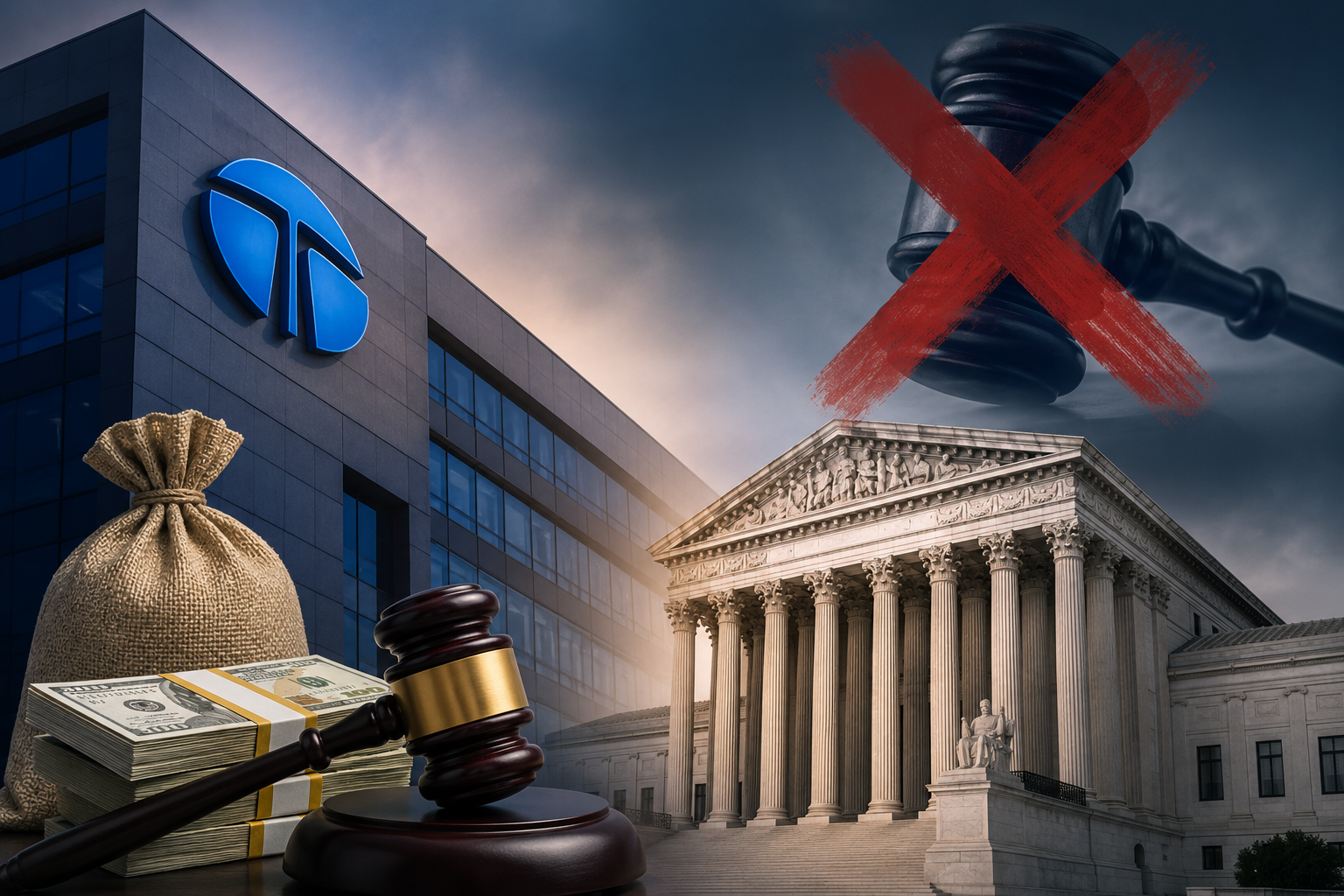
India’s largest IT services company, Tata Consultancy Services, has suffered a major setback in one of its longest legal battles in the United States. The company has announced that it will set aside an additional 70 million dollars after the Supreme Court of the United States refused to review its appeal in a legal dispute linked to DXC Technology.
This latest decision has now brought an end to a case that has lasted for several years. The development has attracted attention because TCS is one of India’s biggest technology companies, and the financial impact of this case is quite large. The company now expects its total liability in the matter to rise to around 220 million dollars.
Although this may not create a major threat to TCS as a business, the legal defeat has become an important event for the company and also for the wider Indian IT industry.
Supreme Court Refuses to Hear TCS Appeal
The latest update came after the Supreme Court of the United States declined to hear TCS’s appeal in the case. This means the company has now exhausted its final legal option in the American court system.
TCS had approached the top court in an attempt to challenge an earlier ruling against the company. However, the court decided not to review the case, which means the previous judgment remains valid.
After this decision, TCS confirmed that it would set aside another 70 million dollars to deal with the financial impact of the case.
The company has also said that this amount will appear as a one-time exceptional expense in its first quarter results for the financial year 2027.
The Legal Battle Began Years Ago
The dispute began several years back when Computer Sciences Corporation, widely known as CSC, filed a case against TCS in the United States.
CSC later became part of DXC Technology after a corporate merger. After the merger, DXC continued the legal fight against TCS.
The case centered around software used in the life insurance sector. CSC accused TCS of illegally using confidential information connected to its own software products.
According to the allegations, TCS gained access to important information while work took place on projects connected to insurance giant Transamerica Corporation.
CSC claimed that TCS later used that confidential knowledge to improve its own software platform.
Accusations Against TCS
The main accusation in the case involved trade secret theft. DXC claimed that TCS used proprietary knowledge connected to software products known as CyberLife and Vantage.
Trade secrets usually include valuable confidential business information that gives companies a competitive advantage. In technology companies, such information often includes software design, coding systems, and technical architecture.
DXC argued that TCS used information connected to these products without proper permission.
The company further claimed that TCS used that knowledge to improve its own banking and insurance software platform called TCS BaNCS.
The case eventually reached a US court, where judges ruled in favor of DXC.
Earlier Court Ruling Hurt TCS
Before the latest Supreme Court decision, lower courts in the United States had already ruled against TCS.
The court had awarded damages to DXC Technology and found TCS responsible in the trade secrets dispute.
TCS tried to challenge this ruling through appeals in higher courts. The company hoped that the US Supreme Court would review the case and possibly overturn the earlier judgment.
However, that final attempt has now failed.
Since the Supreme Court refused to hear the appeal, the earlier court order will remain in effect.
This has forced TCS to prepare for the financial burden connected to the case.
Total Liability Now Reaches 220 Million Dollars
Before this latest development, TCS had already set aside 150 million dollars for the legal dispute.
After the Supreme Court decision, the company has now decided to reserve an additional 70 million dollars.
This takes the total expected liability to nearly 220 million dollars.
In Indian currency, this amount stands close to 1,850 to 1,900 crore rupees.
For any company, this is a significant financial amount. However, because TCS is one of the biggest IT firms in the world, analysts believe the company can absorb the impact without major long-term damage.
Still, investors will closely watch the company’s upcoming financial results.
Impact on TCS Financial Results
The biggest short-term impact will likely appear in the company’s quarterly earnings report.
Since TCS has classified the amount as a one-time exceptional expense, profits in the upcoming quarter may come under pressure.
A one-time expense usually means the company does not expect this cost to repeat in future periods.
Despite this financial hit, the company’s normal business operations remain unaffected.
Its major contracts, service operations, and global business activities continue as usual.
Because of this, market experts believe the company will recover from the financial impact over time.
Reputation Concerns May Matter More
While the financial burden remains manageable, the bigger concern may involve reputation.
Technology companies deal with large global clients and often work with highly sensitive information.
A legal case connected to trade secret misuse can raise questions about internal controls and compliance systems.
Clients may pay closer attention to how companies handle confidential information and intellectual property rights.
For TCS, trust has always been an important part of its business image.
Cases like this can create concerns even when the company remains financially strong.
Bigger Message for Indian IT Companies
The TCS case also sends a wider message to the Indian information technology sector.
Large Indian companies such as Infosys, Wipro, and HCL Technologies handle projects for major global corporations, especially in the United States.
As international technology laws become stricter, companies now face stronger scrutiny in areas such as client confidentiality, intellectual property rights, and software licensing rules.
The TCS legal defeat shows that overseas legal compliance has become more important than ever.
Companies can no longer treat such legal disputes as small operational issues.
What This Means Going Forward
The latest decision is clearly a major legal defeat for Tata Consultancy Services.
The company now faces an additional 70 million dollar charge, which raises total expected liability to around 220 million dollars.
Financially, TCS remains strong enough to handle the setback.
However, the case serves as a reminder that even the biggest technology companies must follow strict legal and compliance standards while dealing with global clients.
For TCS, the legal battle may have ended, but the lessons from this case will likely shape future business decisions for years ahead.
Also Read – FII vs Retail Positions Signal Market Caution