
The first fifteen minutes after market open often help traders and investors understand the mood of the market for the rest of the day. Early price action does not confirm the final trend, but it gives useful clues about how participants react during the opening session. The current market data shows noticeable weakness across several major stocks, which suggests a cautious start and a clear preference toward selling activity during the opening phase.
The stocks shown in the market data represent companies from different sectors, and almost every visible stock opened with immediate downside movement. Since these movements happened within the first fifteen minutes of trading, the data suggests that selling pressure entered the market very early in the session.
Opening Session Reflects Negative Sentiment
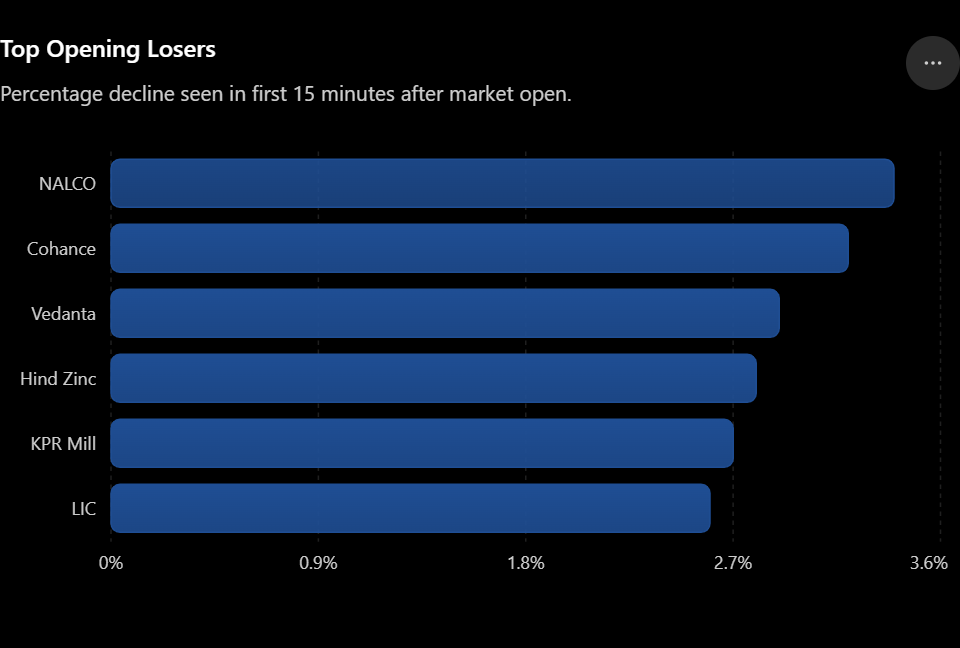
The strongest immediate observation from the data is the dominance of red across the major stock list. Every visible stock in the losing section reported a decline between roughly 2.5 percent and 3.5 percent.
The largest decline came from National Aluminium Company Ltd., which traded at 336.70 after a fall of 11.85 points, equal to 3.4 percent. This placed it at the top of the losing list during the opening session.
Cohance Lifesciences Ltd. followed closely and traded at 447.75, with a decline of 14.60 points, which represented a 3.2 percent fall.
The presence of multiple companies with losses above two percent during the first few minutes often reflects immediate caution among market participants.
Metal Sector Faces Immediate Pressure
One of the clearest patterns in the data comes from the metal sector. Three major companies from this sector entered the top loser list almost immediately after the market opened.
Vedanta Ltd. traded at 274.25 after a decline of 8.30 points, equal to 2.9 percent. At the same time, Hindustan Zinc Ltd. traded at 526.55 after losing 15.40 points, which reflected a 2.8 percent decline.
Along with National Aluminium Company Ltd., these three companies belong to the non-ferrous metals category. When multiple stocks from the same sector decline together in the opening phase, it usually suggests that market participants reacted negatively toward that sector as a whole rather than reacting to company-specific developments.
Such early movement may connect with broader commodity-related sentiment, global market reaction, or short-term sector weakness. However, early movement alone does not confirm the reason behind the decline.
Healthcare Sector Also Opens Weak
The healthcare segment also showed weakness during the opening phase. Cohance Lifesciences Ltd. remained among the top losing stocks with a 3.2 percent decline.
Healthcare stocks often behave differently from cyclical sectors such as metals. When healthcare companies also appear in the early loser list, it sometimes suggests that weakness exists across multiple sectors rather than inside a single industry group.
This kind of market behavior often points toward broader caution during the opening session.
Textile Sector Shows Early Selling Activity
The textile sector also entered the weak zone as K.P.R Mill Ltd. traded at 1,185.95 after a decline of 32.50 points. This represented a 2.7 percent fall during the early session.
Textile stocks do not always move alongside metals or healthcare stocks. Because this stock also entered the loser list so early, it suggests that weakness during the opening period spread across different parts of the market.
When unrelated sectors begin the session with similar downside movement, it usually indicates wider selling activity rather than isolated sector pressure.
Finance Sector Also Trades Lower
Financial stocks also showed weakness soon after market open. Life Insurance Corporation of India traded at 425.10 after losing 11.50 points, equal to a 2.6 percent decline.
Manappuram Finance Ltd. also appeared in the loser section, although full price data is not fully visible in the image.
Financial stocks often receive close attention because they reflect confidence within the broader market. Weakness inside financial companies during the opening session can sometimes indicate a cautious market environment.
This observation becomes more important when finance sector weakness appears alongside weakness in metals, healthcare, and textile companies.
Market Breadth Suggests Broad Selling
The data does not show weakness inside a single sector. Instead, it presents losses across metals, healthcare, finance, and textiles at the same time.
This type of market structure usually suggests broad selling pressure across the market during the opening phase. Since the stocks shown belong to the “Major Stocks” category, the movement becomes more significant because larger companies generally require stronger selling activity to move sharply within a short period.
A decline above two percent within fifteen minutes often indicates active participation from larger traders and institutions, although the exact source of selling cannot be confirmed from price data alone.
Early Session May Shape Intraday Direction
The first fifteen minutes often act as a price discovery phase. Traders react to overnight news, global market movement, sector sentiment, and institutional orders.
In this case, early numbers suggest that sellers controlled the opening session. If prices continue lower after the first thirty to sixty minutes, the market may continue under pressure during intraday trade.
If prices stabilize and recovery begins after the opening phase, then early weakness may remain temporary.
At this stage, the data only shows early market behavior and does not predict final market closing levels.
Overall Market Interpretation
The first fifteen minutes of market activity show a clear negative opening tone. The strongest weakness came from the metal sector, where National Aluminium Company Ltd., Vedanta Ltd., and Hindustan Zinc Ltd. all reported sharp declines.
At the same time, Cohance Lifesciences Ltd. from healthcare, K.P.R Mill Ltd. from textile, and Life Insurance Corporation of India from finance also entered the top losing list.
Because multiple sectors reported losses at the same time, the early market structure suggests broad selling pressure rather than isolated weakness.
Based only on the available data, the opening session reflects cautious sentiment and a negative short-term market tone. However, further price action during later trading hours remains necessary before drawing conclusions about the full market direction for the day.
ALSO READ: Inside the Market: Early Trade Signals and Trends