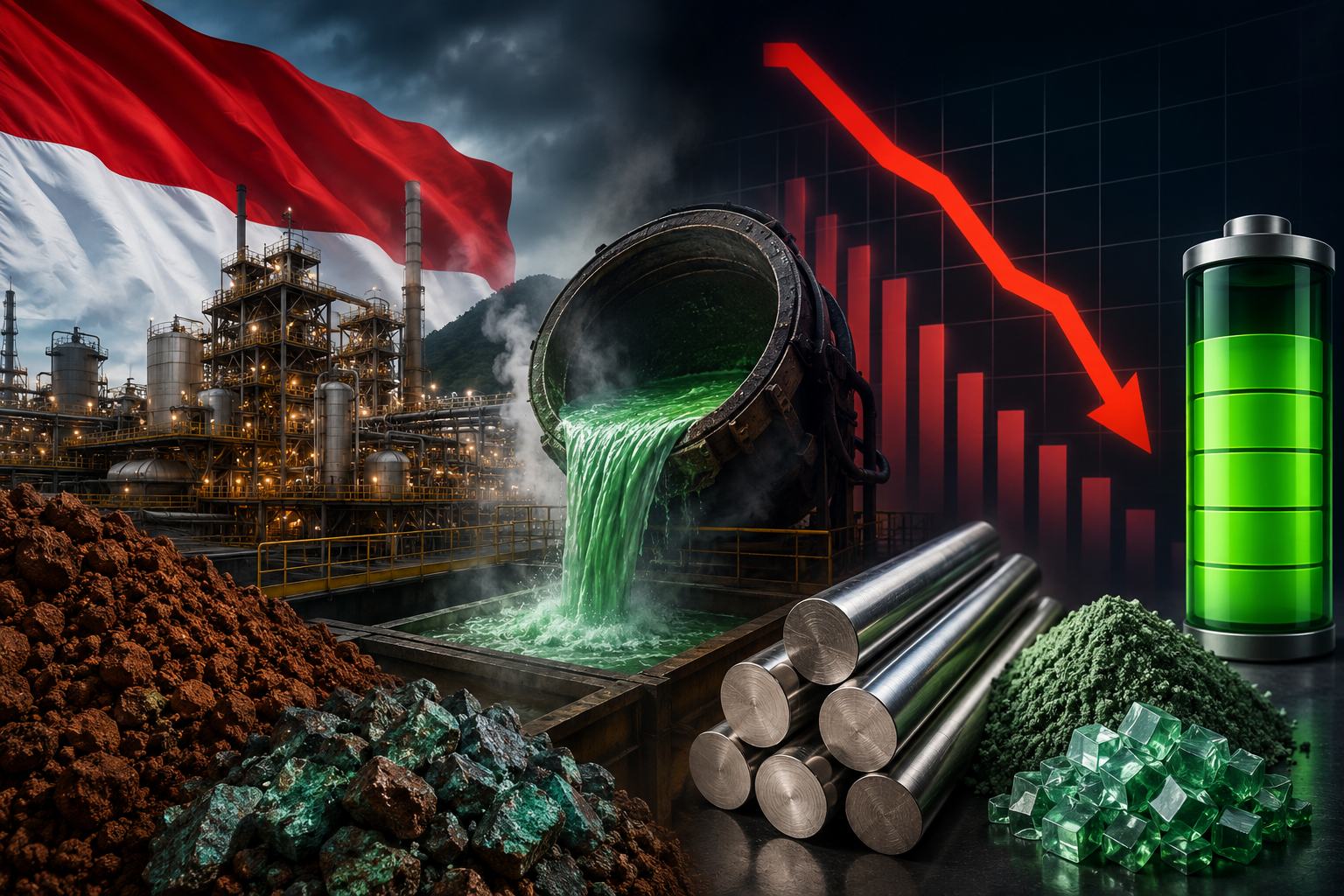
Indonesia’s nickel industry faces a potentially important change in the economics of high-pressure acid leach, or HPAL, plants. Several Indonesian HPAL producers may reduce output as they deal with higher raw material costs, lower ore availability and a sharp rise in sulfur costs. Some industry reports have referred to production cuts of about 30%, while reports on individual producers have cited reductions in a wider range of about 30% to 50%.
This development matters because HPAL plants produce mixed hydroxide precipitate, or MHP. MHP is an important intermediate material for nickel sulfate, which is used in the production of some types of electric vehicle batteries. A lower level of HPAL output could therefore affect the supply of battery-grade nickel material.
The possible effect on the wider nickel market, however, is less certain. Indonesia remains the largest source of nickel supply, but the global refined nickel market has also faced a surplus and relatively high inventory levels. A reduction in HPAL production does not automatically mean that the global nickel market will move into a shortage.
The more cautious view is that the current situation may place greater pressure on the upstream and battery-material parts of the nickel supply chain. The final effect on nickel prices will depend on the scale and duration of the production cuts, future Indonesian ore quotas, sulfur prices, global demand and the response of other producers.
The Core Issue
HPAL plants use laterite nickel ore, particularly limonite, to produce MHP. The process requires large amounts of sulfuric acid. This makes HPAL economics sensitive not only to nickel ore prices but also to sulfur and sulfuric acid costs.
The current pressure comes from both sides.
Indonesia has reduced the amount of nickel ore that can be supplied under its 2026 quota system. The reported 2026 nickel-ore quota is about 260 million to 270 million tonnes, compared with about 379 million tonnes in 2025.
This represents a significant reduction in the potential amount of ore available to the domestic processing industry. Industry group FINI has estimated that the lower quota could eventually result in smelter utilisation falling by about 25% to 30%.
The second major issue is sulfur.
Sulfur is an important input for HPAL operations because the process requires sulfuric acid. Indonesia imports a substantial share of its sulfur from the Middle East. Higher sulfur prices therefore have a direct effect on the cost base of HPAL facilities.
The combination of restricted ore availability and higher sulfur costs can put pressure on plant margins. Where production costs rise above economically acceptable levels, producers may have an incentive to reduce output until market conditions improve.
The Role of HPAL
HPAL has become increasingly important to Indonesia’s broader nickel strategy. Indonesia has large reserves of laterite nickel ore, and HPAL technology allows producers to process limonite resources that are less suitable for some traditional nickel-processing routes.
The output from an HPAL plant is generally MHP rather than finished nickel metal. MHP can then serve as a feedstock for the production of nickel sulfate.
Nickel sulfate is relevant to the battery supply chain, especially for some high-nickel battery chemistries. This means that a reduction in HPAL output can have a different market effect from a reduction in traditional nickel pig iron or ferronickel production.
This distinction is important for investors and market participants.
A fall in NPI or ferronickel output has a more direct link to the stainless-steel supply chain. A fall in MHP output can have a stronger effect on the supply of material used for battery-related nickel products.
The two markets remain connected, but their economics are not identical.
Ore Availability
The reduction in Indonesia’s ore quota is one of the most important factors in the current situation.
For 2026, the reported quota stands at approximately 260 million to 270 million tonnes. The comparable figure for 2025 was approximately 379 million tonnes.
| Measure | Reported figure |
|---|---|
| Indonesia nickel-ore quota, 2026 | 260–270 million tonnes |
| Indonesia nickel-ore quota, 2025 | 379 million tonnes |
| Estimated possible fall in smelter utilisation | 25%–30% |
| Reported HPAL cuts at some producers | 30%–50% |
The lower quota does not mean that every Indonesian smelter will automatically reduce production by the same percentage. The impact can differ from one plant to another based on ore stocks, contracts, plant efficiency, available feedstock, operating costs and access to other sources of material.
The government may also make adjustments to individual allocations. Reports indicate that additional ore quotas may be granted selectively to smelters that face shortages.
For this reason, the headline quota number should not be treated as a direct forecast for national nickel output.
Sulfur Cost Pressure
Sulfur has become another important variable for HPAL economics.
HPAL plants require sulfuric acid as part of the processing route. A rise in the cost of sulfur can therefore raise the cost of producing MHP.
Reports have stated that sulfur prices have risen sharply and have become a major cost concern for Indonesian HPAL operators. Indonesia relies on imports for a significant part of its sulfur requirements, with the Middle East an important source.
This creates an additional external cost risk for Indonesian processors.
If sulfur prices remain high, HPAL producers may face lower margins even if nickel prices remain stable. If nickel prices also fall at the same time, the pressure can become more severe.
The reverse is also possible. If nickel prices rise enough to offset higher input costs, some producers may have less reason to cut output.
The relationship between these variables is therefore important. It is not enough to assess the nickel price alone.
Evidence From MHP Output
There are already signs of weaker MHP production.
One industry report cited MHP production of about 42,000 tonnes of contained nickel in January and about 29,900 tonnes in June.
| Period | MHP output |
| January | About 42,000 tonnes of contained nickel |
| June | About 29,900 tonnes of contained nickel |
The difference is about 12,100 tonnes of contained nickel between the two reported periods.
This represents a decline of roughly 29% from the January level to the June level. The figures should not, however, be interpreted as proof that the same rate of decline will continue for the rest of the year.
Monthly production can change because of maintenance, ore availability, operating conditions, input costs and commercial decisions. A longer period of data would provide a stronger basis for assessing the underlying trend.
Still, the reported movement provides useful evidence that the pressure on Indonesian HPAL production is not only theoretical.
What a 30% Cut Could Mean
A reported 30% production reduction would be material if it applied across a large part of Indonesia’s HPAL sector and remained in place for a sustained period.
The direct effect would be lower MHP supply.
The next effect could be tighter availability of feedstock for nickel sulfate production. This could place upward pressure on prices for certain nickel intermediates, although the size of that effect would depend on inventories, demand and the availability of alternative supplies.
The impact on the global nickel price is more difficult to estimate.
Nickel is traded through a broad global market. A reduction in one part of Indonesian production does not necessarily translate into the same percentage change in global refined nickel supply.
Other producers may increase output if prices rise. Existing inventories can also absorb part of a temporary supply disruption. Buyers may also change their procurement patterns.
For these reasons, a 30% reduction in HPAL production should not be described as a 30% reduction in global nickel supply.
Why Nickel Prices Could React
The development is potentially positive for nickel prices because it could reduce the amount of nickel material available from Indonesia.
The market response may be stronger if the cuts occur at the same time as other supply constraints.
A sustained decline in MHP production could be particularly relevant if battery-sector demand remains firm. In that case, buyers may compete for a smaller amount of suitable feedstock.
There is also a possibility that market expectations move before physical supply changes become large.
Commodity prices often respond to expected future supply conditions. If traders believe that Indonesian production cuts will last for several months, they may price part of that expectation into nickel contracts before the full physical impact appears.
That does not guarantee a sustained price increase. Market expectations can change quickly if Indonesia provides more ore, sulfur costs fall, producers restore output or demand weakens.
Why the Story Is Not Fully Bullish
There are several reasons to avoid an overly bullish interpretation.
First, the global refined nickel market has had a surplus backdrop. Higher inventories can provide a buffer against temporary production losses.
Second, Indonesia has considerable influence over the global nickel supply chain. Government policy can change the balance between ore supply and processing capacity.
Third, producers may adapt to high costs. They can seek cheaper inputs, adjust operating rates, use existing inventories or change production schedules.
Fourth, nickel demand is not guaranteed to rise at the same rate as battery demand. The battery market is also changing, with different battery chemistries gaining or losing market share over time.
These factors mean that the HPAL cuts are best viewed as a potential tightening factor rather than proof of an immediate global nickel shortage.
Impact on Battery Materials
The battery connection is one of the more important parts of this story.
MHP is a key intermediate for the production of nickel sulfate. Nickel sulfate can then be used in certain battery supply chains.
If Indonesian HPAL plants reduce output, the supply of MHP may become tighter. This could increase the cost of some battery-related nickel feedstock.
However, the impact on electric vehicle battery costs would not necessarily be immediate or proportional.
Battery manufacturers have several ways to manage raw material risk. They can use inventories, sign longer-term supply agreements, adjust sourcing or change the chemistry of their batteries.
The importance of nickel also differs across battery technologies. Some battery chemistries use little or no nickel.
Therefore, the HPAL issue should not be treated as a direct forecast for electric vehicle prices.
Impact on Indonesian Producers
For Indonesian HPAL producers, the current environment creates a difficult balance.
Higher nickel prices can improve revenue per tonne. At the same time, higher sulfur prices and tighter ore availability can increase production costs.
A producer with access to lower-cost ore and secure sulfur supply may be in a stronger position than a producer with limited feedstock.
Plant efficiency is also important. HPAL projects are technically complex, and their economics can differ substantially.
This means that the effect of the current market conditions will not necessarily be equal across all Indonesian HPAL facilities.
The reported 30% figure should therefore be treated as an industry signal rather than a precise forecast for every individual plant.
What Investors Should Watch
The first major indicator is actual HPAL utilisation.
Announcements about planned production cuts are useful, but actual monthly output provides stronger evidence. If MHP production continues to fall, the case for a tighter market becomes stronger.
The second indicator is sulfur.
A sustained rise in sulfur costs would increase pressure on HPAL margins. A fall in sulfur prices could provide some relief and reduce the need for production cuts.
The third factor is Indonesia’s ore policy.
Any increase in ore allocations could allow affected smelters to raise production. Conversely, a continued restrictive quota could prolong the supply pressure.
The fourth factor is nickel inventories.
If global inventories remain high, they may limit the effect of Indonesian production cuts on refined nickel prices. If inventories decline at the same time as Indonesian supply falls, the market could become more sensitive to further disruptions.
The fifth factor is demand.
Stronger stainless-steel or battery demand would make a supply reduction more significant. Weak demand could offset part of the supply-side effect.
Market Scenarios
A cautious base case is that Indonesian HPAL producers continue to face cost pressure, but the scale of production cuts varies between facilities. Under this scenario, MHP supply remains under pressure, while the wider nickel market stays relatively balanced because inventories and other supply sources provide some protection.
A more bullish scenario would involve sustained HPAL cuts, continued high sulfur prices, limited ore availability and stronger nickel demand. Under those conditions, the market could face a more meaningful supply deficit in some nickel products.
A less bullish scenario would occur if Indonesia raises ore allocations, sulfur prices decline and producers restore output. High global inventories could then continue to limit the upside in nickel prices.
These scenarios show why the 30% headline should not be used as a standalone price forecast.
Conclusion
The reported possibility of a 30% cut in Indonesian HPAL production is an important development for the nickel market. The issue has a clear economic basis: Indonesian producers face tighter ore availability while sulfur costs have increased.
The reported 2026 nickel-ore quota of about 260 million to 270 million tonnes is well below the approximately 379 million tonnes reported for 2025. Industry estimates suggest that this could reduce smelter utilisation by about 25% to 30%.
At the same time, some reports have cited HPAL production cuts of about 30% to 50% at individual producers. Reported MHP output also fell from about 42,000 tonnes of contained nickel in January to about 29,900 tonnes in June.
Taken together, these figures suggest that Indonesian HPAL producers are under genuine cost and feedstock pressure.
The main potential market effect is a tighter supply of MHP and other battery-related nickel intermediates. The effect on the global refined nickel price is less certain because inventories, other producers, government policy and demand can all change the outcome.
The most important point is therefore not that a 30% HPAL cut guarantees a large nickel-price rally. Rather, it is that Indonesia’s supply conditions have become a more important variable for the nickel market.
If the production reductions prove temporary, the broader effect may remain limited. If they persist for a longer period and coincide with lower inventories and firm demand, the market could become materially tighter.
For now, the development is best viewed as a potentially supportive factor for nickel prices, with a stronger direct impact on Indonesian MHP and battery-grade supply than on the entire global refined nickel market.
All figures and estimates above should be treated as reported or industry estimates rather than independently verified forecasts. Actual production, quotas, costs and market prices may differ from the figures cited.