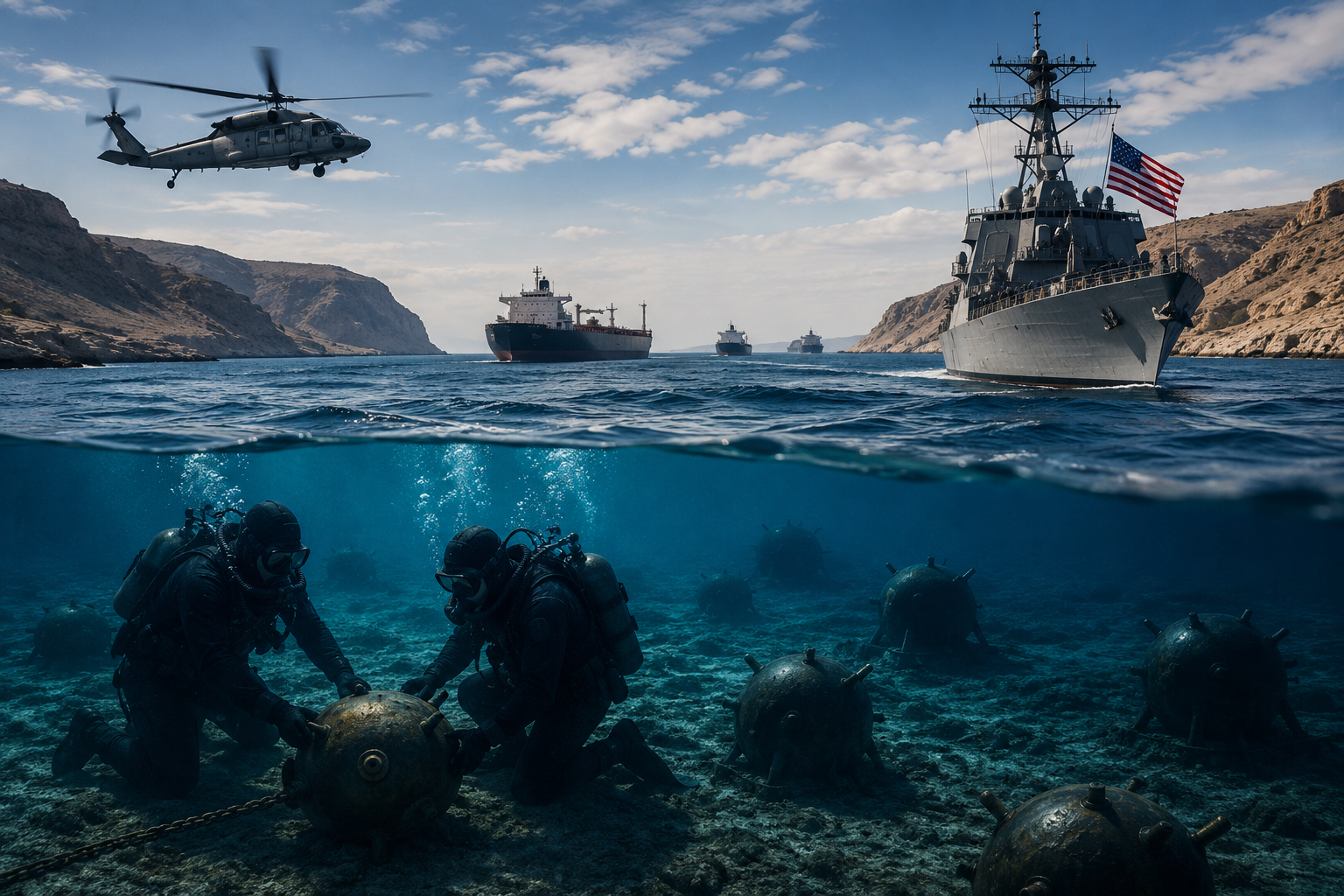
The Strait of Hormuz has entered a new phase. The United States says its forces have removed Iranian sea mines from the internationally recognised commercial lanes in the strait. At the same time, the United States continues its naval blockade of Iranian ports. This creates a situation that may appear simple at first but is more complex when the facts are examined together.
The key point is that the word “open” does not mean that the Strait of Hormuz has returned to normal. The United States says commercial vessels can use the main transit lanes. Yet Washington also says that ships cannot freely enter or leave Iranian ports without U.S. permission, apart from certain humanitarian cases. These two actions exist at the same time. One supports wider commercial access to the waterway, while the other places direct limits on Iran’s maritime trade.
U.S. Central Command commander Admiral Brad Cooper said U.S. forces had cleared sea mines from the established international transit lanes. He said Navy divers, special forces and aircraft from several parts of the U.S. military took part in the operation. He also said that almost 1,500 commercial vessels had passed through the strait under U.S. protection over recent months, with almost 750 million barrels of crude oil on those ships.
These figures are important because they show that some commercial movement has already taken place. At the same time, current vessel data shows that traffic remains far below the level seen before the conflict. Reuters reported that only seven commodity vessels passed through the strait on August 27, compared with 17 on the previous day and a 10-day average of 15. The number can change as some ships switch off their tracking systems.
The result is a narrow but important distinction. The United States says the main lanes are physically usable. The wider market has not yet treated the strait as a fully normal trade route.
What the United States Says Has Changed
The latest U.S. claim concerns the established Traffic Separation Scheme in the Strait of Hormuz. This is the system of lanes used by commercial vessels for safe passage. Admiral Cooper said U.S. forces had spent months removing mine threats from these routes. The statement was narrower than a claim that every part of the wider waterway is free of all possible maritime hazards.
That distinction matters. A mine-free commercial lane can support safe passage, but it does not remove every risk. Recent maritime reports have continued to note the possibility of drifting or uncharted mines, and vessel attacks have also remained a concern. The wider security picture therefore remains unsettled even after the U.S. mine operation.
The U.S. military has also said that more than 20 warships and hundreds of aircraft took part in related operations. Admiral Cooper said about 75 vessels were turned back after attempts to pass the U.S. blockade, while three vessels were disabled after they did not comply with U.S. orders. These figures come from the U.S. military and should therefore be treated as official U.S. claims unless independently verified.
The table below sets out the main figures now available.
| Measure | Latest reported figure | Source or qualification |
|---|---|---|
| Commercial vessels assisted by U.S. forces | Nearly 1,500 | U.S. Central Command |
| Crude oil carried by those vessels | Nearly 750 million barrels | U.S. Central Command |
| Vessels turned back from the U.S. blockade | About 75 | U.S. Central Command |
| Vessels disabled after non-compliance | 3 | U.S. Central Command |
| U.S. warships involved | More than 20 | U.S. Central Command |
| Commodity vessels through Hormuz on Aug. 27 | 7 | Preliminary Kpler data via Reuters |
| 10-day average on Aug. 27 | 15 vessels | Preliminary Kpler data via Reuters |
| Pre-war oil flow through Hormuz | More than 20 million barrels per day | Reuters and related market data |
The figures do not all measure the same period or the same type of activity. That is important when they are compared. The nearly 1,500 vessel figure covers several months, while the seven-vessel figure refers to one day. The numbers therefore should not be used to suggest that 1,500 vessels now pass through the strait each day.
The Meaning of the U.S. Blockade
The second part of the situation is the U.S. blockade of Iranian ports. Admiral Cooper said no ships had entered or left Iranian ports without U.S. permission since the blockade resumed in mid-July, except for vessels allowed on humanitarian grounds. He also said Iran had exported zero oil from its shores under the current blockade.
That claim has major economic importance for Tehran. Iran depends heavily on oil sales for foreign currency income. Restrictions on maritime exports can therefore place pressure on government revenue, trade and access to overseas markets.
However, the statement should be read as a U.S. military assessment rather than as a universally accepted fact about every Iranian oil transaction. Reuters has reported that Iran still has access to oil buyers and uses methods designed to avoid sanctions and conceal the origin or route of some cargoes. China remains an important buyer of Iranian oil, although recent U.S. measures have reduced visible and reported flows.
This makes the U.S. strategy easier to understand. Washington appears to be separating two issues. It seeks to permit wider commercial use of the Strait of Hormuz while limiting Iran’s own use of the same maritime system. The policy therefore does not represent a full return to unrestricted trade.
Why the Strait Matters So Much
The Strait of Hormuz is one of the most important energy routes in the world. Before the current conflict, roughly one-fifth of global oil and liquefied natural gas shipments passed through the waterway. A sustained disruption can therefore affect crude prices, fuel costs, insurance rates, refinery supply and broader inflation.
The economic risk does not depend only on a complete closure. Even a sharp fall in vessel traffic can create problems. Oil buyers may pay more for alternative cargoes. Traders may seek longer routes. Ship owners may demand higher insurance premiums. Refineries may hold more stock as protection against delays.
This is why the latest mine-clearance claim matters. If the main commercial lanes remain physically safe and vessel traffic rises, some of the risk premium in energy markets may fall. Yet that outcome depends on more than mine removal. Ship owners also need confidence that their vessels will not face attack, detention, inspection or forced diversion.
The present data suggests that such confidence has not fully returned. Seven commodity vessels crossed the strait on August 27, according to preliminary Kpler data cited by Reuters. That was below the recent 10-day average of 15.
A Route That Is Open, But Not Normal
The most accurate description of the current situation may be that the principal international lanes are available under a U.S. security umbrella, while the wider maritime system remains under political and military pressure.
That difference is important for businesses. A tanker operator does not look only at whether a lane is physically clear. The operator also considers insurance, crew safety, cargo contracts, port access, sanctions, possible military orders and the risk of sudden policy change.
For that reason, the U.S. statement may improve confidence without producing an immediate return to normal trade. A large energy company may still decide to wait before sending a vessel through the strait. A ship owner may require a higher risk premium. A trader may prefer a longer route if the cost difference is acceptable.
The market response is therefore likely to depend on actual vessel numbers rather than official statements alone. If daily traffic rises for several weeks, that would provide stronger evidence that the security situation has improved. If traffic remains weak, the claim of an “open” strait would have limited economic effect.
Iran’s Position
Iran does not accept the U.S. position as the final basis for the future of the strait. Tehran has continued talks with Oman about a possible temporary corridor. Iran has also said that the strait cannot return to normal unless Washington meets its conditions.
Reuters reported that Iran is preparing a list of conditions for the restoration of normal traffic. Tehran has linked the issue to the U.S. blockade, sanctions, compensation and the wider conflict. Iran and Oman have also discussed a route that would include parts of Iranian and Omani waters.
Oman has a special role because it shares control of part of the strait and has long acted as a channel for talks between Iran and Western governments. Recent discussions have focused on a temporary navigation corridor, future traffic rules, information exchange and longer-term arrangements for the waterway.
This creates another important layer. The physical question of whether ships can pass is only one part of the dispute. The political question is who sets the rules for that passage and under what conditions.
The Legal Question Requires Care
The legal position should be treated with caution. Statements by either side do not by themselves settle whether a blockade, interception, vessel inspection or use of force complies with international law.
The Strait of Hormuz has a special place under the law of the sea, and questions about transit rights can involve the status of the waters, the rights of coastal states, security measures and the rules that apply during armed conflict. The legality of a specific U.S. action would depend on facts that may not yet be public.
It would therefore be unsafe to state simply that the U.S. blockade is legal or illegal. The same caution applies to Iranian restrictions on vessels. A proper legal assessment would require a review of the relevant treaties, customary international law, the status of the conflict, the identity and conduct of the vessel involved, and the precise basis claimed for each military action.
For commercial readers, the practical point is more direct. A legal dispute can exist even when a route remains physically usable. Companies must therefore assess both security risk and legal or sanctions risk before they send cargo through the area.
The Energy Market Effect
The immediate market effect may depend on whether the mine-clearance operation leads to a sustained rise in traffic. If more tankers use the strait, the world market may see less pressure from supply fears. That could reduce some of the risk premium in oil prices.
The effect would be different if the number of vessels remains low. In that case, the physical route may be available, but the market may continue to treat Hormuz as a high-risk corridor.
Before the conflict, more than 20 million barrels of oil per day passed through the strait. Reuters also reported recent oil flows at levels far below that amount. On August 24, separate Vortexa data showed about 5 million barrels per day had passed through the strait, compared with more than 20 million barrels per day before the war.
The difference is large enough to show why the word “open” should not be confused with “normal.”
| Issue | Current position | What would show a return to normal |
| Main transit lanes | U.S. says they are free of Iranian mines | Sustained safe vessel use |
| Commercial traffic | Still far below normal | A steady rise over several weeks |
| Iranian port access | Restricted by U.S. blockade | A political deal or removal of restrictions |
| Iranian oil exports | U.S. says direct exports are zero | Verified return of regular export flows |
| Maritime security | Improved in cleared lanes but risks remain | Lower number of attacks and warnings |
| Diplomacy | Qatar and Oman continue efforts | A formal and durable agreement |
| Energy flows | Well below pre-war levels | Movement toward pre-war volumes |
What Comes Next
The next stage will depend on three developments. The first is vessel traffic. More ships through the established lanes would be the clearest sign that the security situation has improved.
The second is diplomacy. Iran, Oman and other regional actors are seeking a framework for regular passage. Qatar has also placed fresh emphasis on freedom of navigation and a return to normal maritime trade.
The third is the U.S. blockade. Even if the main commercial lanes remain open, the wider dispute cannot settle while Washington and Tehran continue to hold opposing positions on Iranian ports, sanctions and maritime access.
The risk is that a physical improvement may not produce a political settlement. Mine removal can reduce one threat, but it cannot by itself resolve the dispute over control, sanctions, port access or Iran’s oil exports.
Conclusion
The U.S. claim that it has cleared Iranian sea mines from the main international lanes of the Strait of Hormuz is a significant military and commercial development. It can reduce one of the most direct risks to vessel passage and may help restore confidence in a route that carries a major share of global energy trade.
But the wider picture remains unresolved. The United States still says it has a blockade on Iranian ports. Iran still rejects the U.S. position and has set conditions for a return to normal traffic. Vessel numbers remain well below normal levels, and maritime security risks have not fully disappeared.
The safest analytical conclusion is therefore simple: the main Hormuz transit lanes may now be physically open, but the Strait of Hormuz is not yet politically or commercially normal.
For energy markets, the next proof will come from actual vessel traffic, oil volumes and insurance conditions. For governments, the key issue will be whether a temporary security arrangement can become a stable political agreement. For Iran and the United States, the central dispute remains much wider than mine removal.
The latest development should thus be seen as an operational step, not as the end of the Hormuz crisis. It reduces one risk, but it does not remove the wider dispute that caused the disruption in the first place.