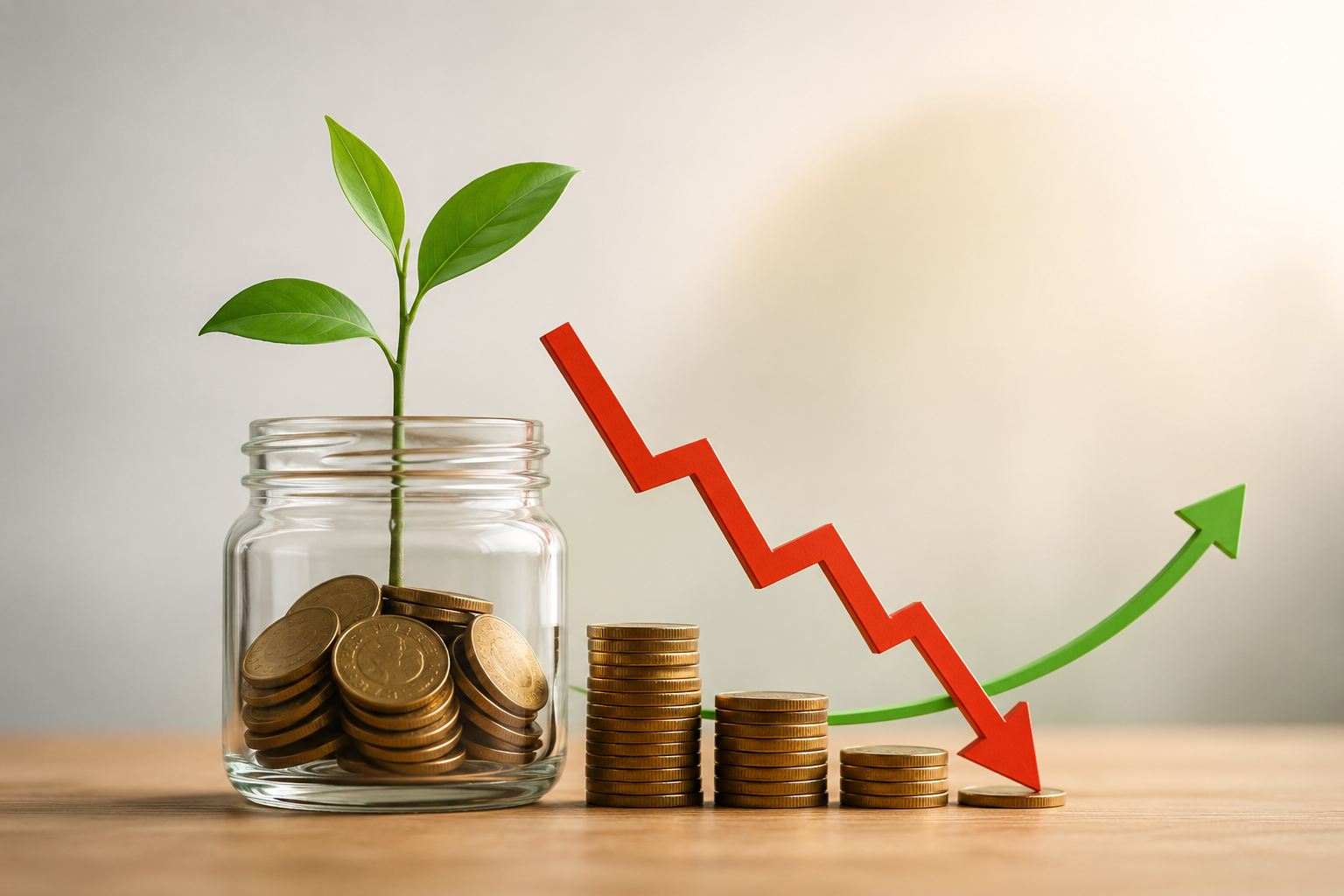
Tax-loss harvesting is a simple tax strategy for investors who own stocks, ETFs, mutual funds, or other investments that have fallen below their purchase price. The idea is to sell an investment at a loss and use that loss to reduce taxes on investment gains.
At first, this may sound strange. Why would anyone sell an investment at a loss? The reason is that a loss can have tax value. If you also have investments that rose in value, the loss may reduce the taxable gain from those investments.
For example, suppose you have a $20,000 capital gain from one investment. You also have another investment that is down by $8,000. If you sell the second investment and realize the $8,000 loss, your net gain can fall to $12,000. That means less of your investment profit may face capital gains tax.
The important point is that tax-loss harvesting does not erase money you lost. Instead, it can reduce your current tax bill and may help you manage your portfolio in a more tax-efficient way.
How Capital Gains and Losses Work
When you sell an investment for more than you paid for it, you usually have a capital gain. When you sell it for less than you paid, you have a capital loss.
The tax treatment depends partly on how long you owned the investment. A short-term gain generally comes from an asset held for one year or less. A long-term gain generally comes from an asset held for more than one year.
Short-term capital gains are taxed as ordinary income. Long-term capital gains usually receive lower tax rates. This difference can make the type of gain you have especially important when you consider a tax-loss strategy.
A loss can offset capital gains. If your total capital losses are greater than your total capital gains, you may also use part of the extra loss against ordinary income, subject to the annual limit.
The $3,000 Loss Limit
One of the most important rules for U.S. taxpayers is the annual deduction limit.
If your capital losses are greater than your capital gains, you can generally use up to $3,000 of the excess loss to reduce ordinary income in the same tax year. The limit is $1,500 for a married person who files separately.
If your unused loss is larger than that amount, you do not simply lose the rest. The remaining loss can carry forward to future tax years. This can allow the tax value of a loss to continue for many years.
This rule also explains why a $10,000 investment loss does not mean a taxpayer receives a $10,000 tax refund. The actual benefit depends on the gains and income that the loss can offset, as well as the tax rate that applies.
A Simple Example
Imagine that an investor has a $20,000 long-term capital gain during 2026. At the same time, the investor owns another asset that has an $8,000 unrealized loss.
The investor sells the losing asset and realizes the loss. The $8,000 loss can offset the $20,000 gain, leaving a net capital gain of $12,000.
The investor has not recovered the $8,000 market loss. However, the loss may reduce the amount of investment profit subject to tax.
Now imagine the investor has $8,000 of capital losses but no capital gains. In that case, up to $3,000 can generally reduce ordinary income for the year. The remaining $5,000 can carry forward to later years, subject to the applicable rules.
The Wash-Sale Rule
The biggest rule to understand before tax-loss harvesting is the wash-sale rule.
The IRS generally does not allow a taxpayer to claim a loss if the taxpayer sells a stock or security at a loss and buys substantially identical stock or securities within 30 days before or after the sale. The rule can also cover certain contracts and options.
There is another important detail. The replacement purchase can involve an IRA or Roth IRA. A purchase by a spouse can also create a wash-sale issue.
This means an investor cannot simply sell a losing stock on Monday, buy the same stock again on Tuesday, and expect to claim the loss for tax purposes.
The tax loss may be disallowed, and the rules can become more complicated when purchases take place across several accounts.
Why Replacement Investments Matter
After a tax-loss sale, many investors still want exposure to the same part of the market. Selling an investment does not necessarily mean the investor has changed their long-term view.
For example, an investor may sell one broad market fund at a loss and choose another investment that provides similar market exposure without being substantially identical. The goal is to maintain a desired investment position while avoiding a wash sale.
However, deciding whether two investments are substantially identical is not always simple. The IRS rules do not provide a basic list that tells investors which ETFs or mutual funds are always safe substitutes.
For that reason, investors should take care when they sell an investment at a loss and choose a replacement. A tax professional can help when the situation involves similar securities, options, several brokerage accounts, or retirement accounts.
What the 2026 Tax Rules Mean
The tax rules for 2026 make income level an important part of tax-loss decisions.
For 2026, the maximum amount of taxable income subject to the 0% long-term capital gains rate is $49,450 for single filers and married people filing separately. It is $66,200 for heads of household and $98,900 for married couples filing jointly and qualifying surviving spouses.
The 15% long-term capital gains range extends up to $545,500 for single filers, $306,850 for married people filing separately, $579,600 for heads of household, and $613,700 for married couples filing jointly and qualifying surviving spouses. Amounts above the applicable threshold can face the 20% capital gains rate.
These figures are based on 2026 federal tax rules and can help investors understand the possible value of a harvested loss. State taxes can create a separate calculation.
Short-Term Gains Can Matter More
Tax-loss harvesting can be especially useful when an investor has short-term capital gains.
Short-term gains are taxed as ordinary income. For 2026, the top ordinary income tax rate remains 37%. That rate applies above $640,600 for single taxpayers and above $768,700 for married couples who file jointly.
This does not mean every short-term gain should be offset at any cost. Selling an investment only for tax reasons can create other problems. Still, when an investor already plans to sell a losing position, the tax effect can be an important part of the decision.
Tax-Loss Harvesting Is Not Just About Taxes
A good tax strategy should not damage a good investment plan.
An investor should first ask whether the investment still fits their goals. If the asset no longer makes sense, a tax loss can make the decision to sell more attractive.
If the investor still likes the investment, a suitable replacement may help preserve the overall portfolio structure. The goal is not to create a tax benefit at the cost of losing a sound investment position.
There is also a timing issue. A loss may be useful this year, but its value depends on the investor’s current and future tax situation. A large loss that cannot offset much current income may still have value through future carryovers.
Keep Good Records
Tax-loss harvesting requires accurate records. Investors need to know the purchase price, sale price, purchase date, sale date, and whether the gain or loss is short-term or long-term.
Brokerage firms generally provide important cost-basis information for covered securities. The IRS also requires taxpayers to keep records that establish the basis of capital assets.
Investors should also check transactions across accounts before a tax-loss sale. A purchase in another account can create an unexpected wash-sale problem.
The Bottom Line
Tax-loss harvesting can turn an investment loss into a useful tax benefit. It can reduce capital gains, lower ordinary income by up to $3,000 when applicable, and allow unused losses to carry forward.
The strategy works best when it supports a sensible investment plan. The investor should understand the wash-sale rule, review all accounts, consider short-term and long-term gains, and keep accurate records.
For 2026, the federal capital gains thresholds and ordinary income brackets provide a useful framework for this decision. Still, the right move depends on each investor’s income, gains, losses, portfolio, filing status, and future plans.
Most importantly, tax-loss harvesting is not free money. It is a way to manage when and how investment gains and losses affect taxes. When used carefully, it can make a portfolio more tax-efficient without changing its long-term purpose.
Also Read – Best Books to Learn Blockchain Technology