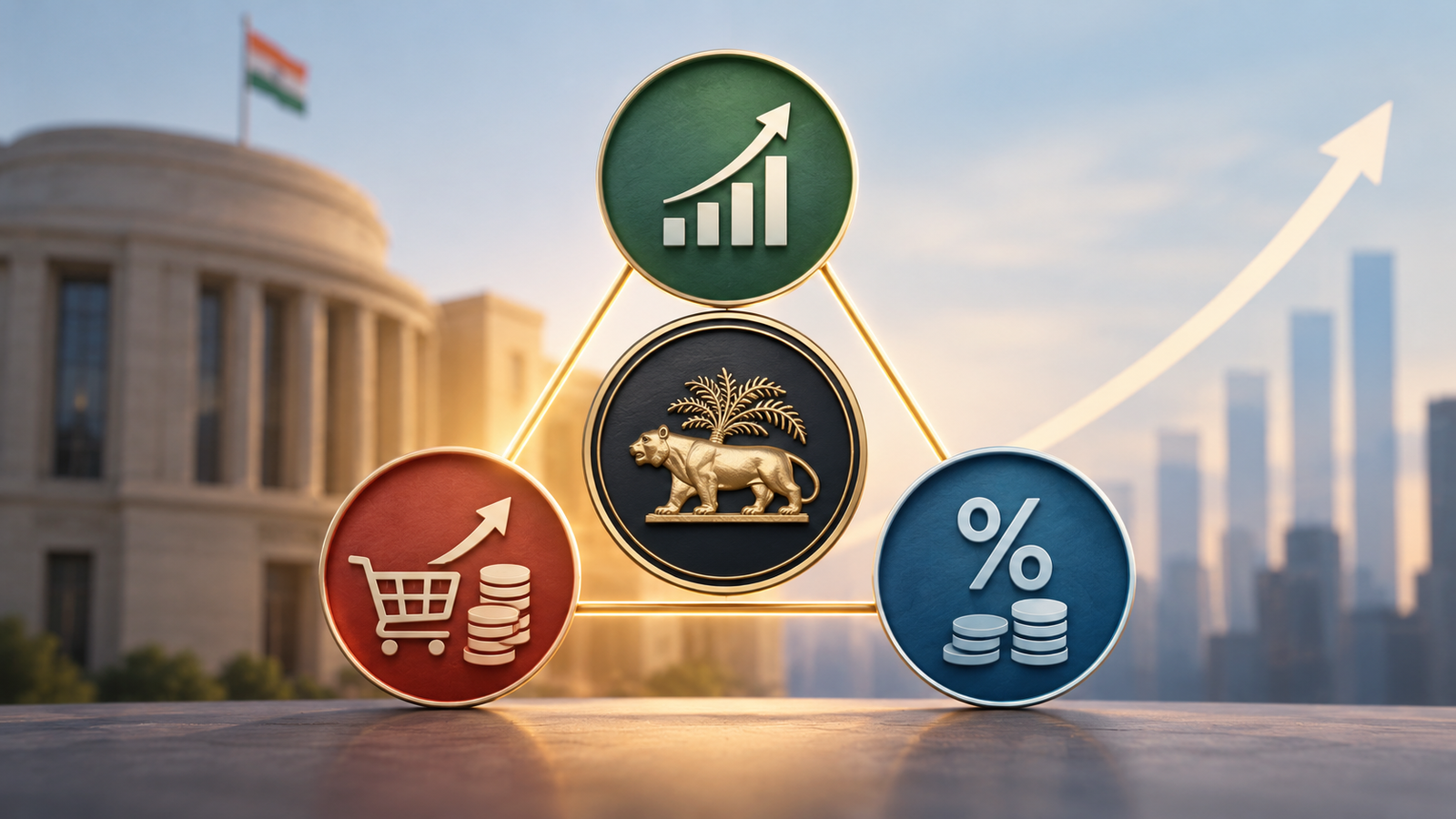
India’s economic story has changed in a short period. The Reserve Bank of India now faces a very different policy choice from the one it faced earlier in the year. Growth has proved stronger than expected, while inflation has started to rise. At the same time, the repo rate remains at 5.25%.
This creates a simple but important triangle: growth, inflation and interest rates. Each side affects the other two. When growth is weak, the RBI can cut rates to support demand. When inflation is high, it may need higher rates to cool the economy. But when growth is strong and inflation rises at the same time, the central bank has much less reason to provide more support.
The latest signals from the RBI suggest that India has moved closer to this difficult zone.
Growth Has Surprised on the Upside
The biggest change has come from economic growth. India’s real GDP grew 7.8% in the April-June quarter of FY27. This was much higher than the RBI’s earlier estimate of 7.0% and above the market expectation of about 7.1%. Growth was also strong across several parts of the economy.
The number is especially important because the previous quarter had recorded a revised 8.6% growth. So, although the economy did slow from that level, the pace remained very strong.
Investment was one of the major reasons behind the result. Capital formation rose to 34.3% in nominal terms, from 31.4% a year earlier. Private investment also showed a stronger trend. Manufacturing grew by 9.2%, while financial services recorded growth of about 12.1%. Consumer spending also stayed healthy, with private consumption up 7.1%.
This matters for monetary policy because the RBI does not need to rush to support an economy that already has strong demand.
The RBI’s Earlier Growth View Looks Conservative
Before the latest GDP data, the RBI had projected FY27 growth at 6.7%. Its quarterly estimates were 7.0% for Q1, 6.4% for Q2, 6.5% for Q3 and 6.8% for Q4. It also forecast 7.3% growth for Q1 FY28.
The actual Q1 result of 7.8% has therefore created an upside surprise.
Several economists have already raised their full-year growth estimates. Some forecasts now sit around 7% to 7.5% for FY27. This does not mean that every quarter will match 7.8%. Growth can slow later because of high oil prices, weather risks, weaker global trade or tighter global financial conditions. Still, the starting point for the year is much stronger than the RBI had expected.
That gives the RBI more freedom. It can wait for more evidence before it changes rates.
Inflation Is Now the Bigger Concern
The other side of the triangle is inflation.
Consumer price inflation rose to 4.4% in June 2026, after staying below the RBI’s target for 16 straight months. It then reached 4.45% in July, which is above the RBI’s medium-term target of 4%.
The RBI says the recent rise has mainly come from food and fuel. This is important. It means the central bank does not yet see a broad inflation problem across the whole economy.
Core CPI inflation, which excludes food and fuel, remained at 3.9% during May and June. When precious metals are also excluded, core inflation was even lower at 2.3% to 2.5%. These numbers suggest that basic demand pressure is still relatively contained.
So the inflation picture is not yet a simple story of overheating. Much of the pressure comes from supply factors.
Oil Has Become a Major Risk
Oil is perhaps the biggest threat to this relatively comfortable picture.
India imports around 85% of its crude oil needs. That makes the country highly sensitive to global oil prices. Higher crude prices raise the cost of fuel, transport and production. They can also put pressure on the rupee and increase the cost of imports.
The RBI has already warned about volatile global oil prices. The situation becomes more serious if higher fuel costs begin to affect other goods and services. That is what economists call a second-round effect.
For example, higher fuel costs can raise transport costs. Companies may then pass those costs to customers. Workers may seek higher wages if household expenses rise. Businesses may raise prices again. At that point, a temporary oil shock can become a wider inflation problem.
The RBI is not saying this has happened yet. But it is clearly watching for it.
The Weather Adds Another Layer of Risk
Food prices create another problem.
The RBI has pointed to the risk from El Niño and an uneven southwest monsoon. Poor rainfall can affect crop output and push food prices higher. Food inflation matters greatly in India because it affects household budgets and inflation expectations.
The central bank has also noted that government food stocks and supply measures can provide some protection. So the weather risk does not automatically mean a large inflation shock. But it adds uncertainty at a time when fuel prices are already a concern.
This is why the RBI wants more clarity before it makes another major rate decision.
Why the Repo Rate Is Stuck at 5.25%
The RBI kept the policy repo rate unchanged at 5.25% at its August 3-5 meeting. The decision was unanimous. It also kept the policy stance neutral.
The decision makes sense when the three sides of the triangle are viewed together.
Growth is strong, so there is less need for a rate cut. Inflation is above the 4% target, so another cut could add pressure. Yet core inflation remains moderate, so an immediate rate hike could be too aggressive.
A pause gives the RBI time to see which force becomes stronger.
If inflation falls again, the RBI can keep rates unchanged or consider easing later. If inflation spreads beyond food and fuel, the case for higher rates becomes stronger. If growth slows sharply, the RBI could also reconsider its position.
The neutral stance gives it room to move in either direction.
The Liquidity Problem Makes the Picture More Complex
There is another issue that could matter: excess liquidity in the banking system.
A special dollar deposit scheme attracted $127.23 billion, which helped create a liquidity surplus of about ₹9.70 trillion in the banking system. Too much liquidity can make financial conditions easier and can add to inflation pressure if money moves quickly into credit and demand.
The RBI has several ways to absorb this money without changing the repo rate. It can use tools such as variable rate reverse repo operations, dollar-rupee swaps, government securities and changes in the cash reserve ratio.
The current cash reserve ratio is 3%. A 50 to 100 basis point increase could absorb around ₹1.4 trillion to ₹2.8 trillion from the banking system.
This gives the RBI another way to manage financial conditions. It does not have to use the repo rate for every problem.
What the Triangle Means for Rate Cuts
The strongest message from the latest data is that the case for another rate cut has weakened.
Earlier, a central bank could argue that lower rates were needed to support growth. But a 7.8% quarterly growth rate changes that argument. The economy is already expanding at a fast pace, investment is stronger and domestic demand remains healthy.
A rate cut could still happen if inflation falls sharply and the growth outlook weakens. But the hurdle is now higher.
In simple terms, strong growth removes the urgency for a cut, while higher inflation creates a reason to wait.
That is why a prolonged pause looks more natural than immediate easing.
Could the RBI Raise Rates?
A rate hike is not the base case simply because inflation has crossed 4%. The RBI has made it clear that much of the recent rise comes from food and fuel, while core inflation remains moderate.
But the risk of a hike has clearly become more relevant.
The RBI’s own FY27 inflation forecast is 5.0%, with inflation at 4.7% in Q2, 5.9% in Q3 and 5.5% in Q4. It expects inflation to rise further before it later moderates.
If actual inflation moves well above these estimates, especially if core prices also rise, the RBI may have to reconsider its neutral stance.
Strong growth would make such a move easier to defend because the economy has more room to absorb higher borrowing costs.
The Real Test Comes Next
The next few inflation readings will matter more than the headline GDP number alone.
The RBI will watch food prices, fuel costs, core inflation, the rupee, oil prices and demand. It will also watch whether strong growth continues beyond the first quarter.
If growth remains above 7% while inflation stays close to or above 5%, the policy balance could move toward tighter conditions.
If inflation falls while growth remains healthy, the RBI may simply hold at 5.25% for an extended period.
If both growth and inflation weaken, the door to rate cuts could reopen.
The New Policy Balance
The inflation-growth-rate triangle is therefore no longer tilted toward growth support. It has moved toward caution.
India has a strong growth number of 7.8%, inflation at 4.45% in July, a 5.25% repo rate, and an RBI FY27 growth forecast of 6.7% with inflation at 5.0%. These numbers show why the central bank is in no hurry to change policy.
The key question is no longer whether the RBI can cut rates to help growth. The more important question is whether inflation remains a temporary food-and-fuel problem or becomes a wider price problem.
For now, the safest reading is simple: strong growth has reduced the need for rate cuts, while higher inflation has increased the risk of future tightening.
The RBI can afford to wait. And that may be the most important signal from its latest policy stance.
Also Read – SIP Growth Can Hide a Contribution Quality Problem