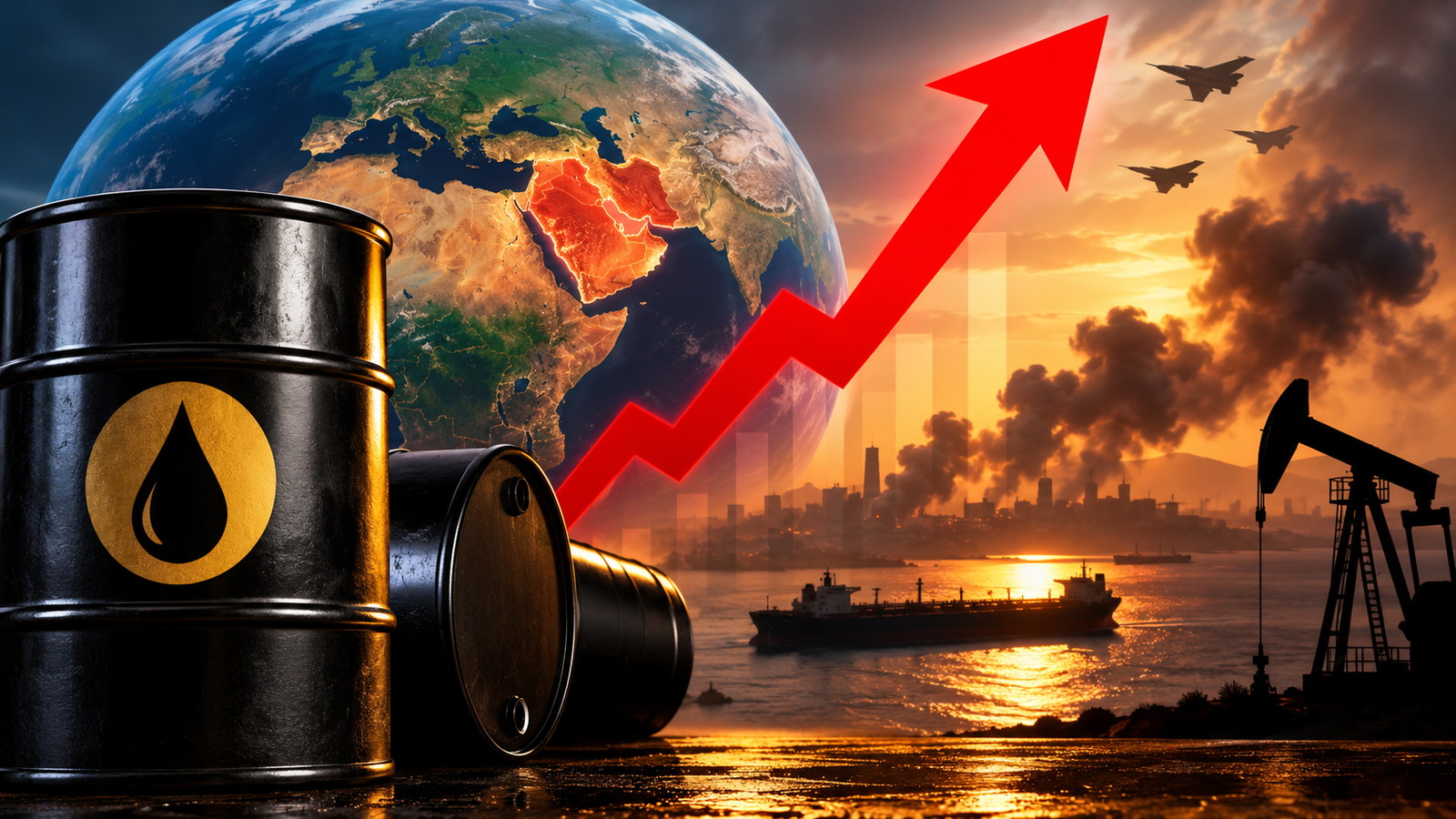
Oil prices have moved close to the important $100 per barrel level as tensions in the Middle East add fresh risk to the global energy market. Brent crude is around $96.45 per barrel, while West Texas Intermediate, or WTI, is around $91.85 per barrel.
The difference between the two prices reflects the separate role each benchmark has in the oil market. Brent is the main global oil price reference, while WTI is a major US benchmark. Both prices can react to changes in supply, demand, transport routes, inventories, economic activity and geopolitical events.
The current concern comes from the possibility that Middle East tensions could affect the flow of crude oil. The region has a major role in global energy supply. Any serious disruption to oil output or transport could reduce the amount of crude that reaches buyers. That could place extra pressure on prices.
At the same time, it is important not to treat a price near $100 as proof that Brent will reach or remain above $100. Oil markets can move very quickly in either direction. A reduction in geopolitical risk, a rise in available supply, weaker demand or a change in market expectations could reduce some of the price pressure.
The current data therefore point to a material risk, rather than a certain outcome.
Why the $100 level matters
The $100 level has strong importance in financial markets because it is a simple and widely watched price point. A move above it would not automatically create a global economic crisis. Its effect would depend on how high prices rise, how long they stay high and how governments, companies and consumers respond.
A short period near $100 could have a smaller effect than several months of crude prices at or above that level. The duration of the price shock matters because businesses need time to adjust costs, prices, budgets and supply plans.
Oil is also different from many other commodities because it affects a very large part of the economy. Fuel is used in road transport, air travel, shipping, farming, manufacturing and many other areas. Oil products also affect the cost of producing and moving goods.
As a result, a sustained oil price increase could reach consumers through several channels.
| Oil market data | Current level |
|---|---|
| Brent crude | $96.45/barrel |
| WTI crude | $91.85/barrel |
| Key psychological level | $100/barrel Brent |
These figures are the levels in the supplied market snapshot. Oil prices can change throughout the trading day, so they should not be treated as fixed prices.
Middle East tensions are the main risk factor
The central concern is the effect of Middle East tensions on the supply of oil and the routes used to move it. The region contains major oil producers and important energy routes. A serious disruption could affect the wider market even if the physical loss of crude is limited at first.
Oil traders often react to the possibility of future supply problems before an actual shortage occurs. This is because crude oil takes time to produce, transport and replace. If market participants believe that supply could become less secure, they may accept higher prices before a physical shortage appears.
This does not mean that every geopolitical event causes a lasting oil shock. Markets also assess the size of the threat, its expected duration and the availability of alternative supply.
For that reason, the next phase of the Middle East situation may be more important than the first price move itself. If tensions ease, part of the geopolitical risk premium in oil could decline. If tensions become wider or affect major energy routes, the market could face a larger supply concern.
The phrase “inflation risk” is therefore more suitable than a claim that inflation will definitely rise.
How higher oil prices can affect inflation
Oil has a direct and indirect link to inflation.
The direct effect comes from fuel. Higher crude prices can raise the cost of petrol, diesel, jet fuel and other petroleum products. The final effect on consumers depends on taxes, refining costs, currency movements, local fuel policy and other factors.
The indirect effect can be wider. A transport company may face a higher fuel bill. A manufacturer may face higher costs for energy and transport. A farmer may face higher fuel and machinery costs. A retailer may face a higher cost to move products from a supplier to a warehouse and then to stores.
Businesses can respond in different ways. Some may absorb part of the extra cost. Others may raise prices. Some may reduce expenses elsewhere. The final effect on inflation can therefore vary across countries and industries.
This process also depends on demand. If consumers have strong demand for goods and services, companies may have more ability to pass higher costs to customers. If demand is weak, companies may have less ability to raise prices.
The result is not a simple one-to-one relationship between crude oil and consumer inflation.
The risk of a growth shock
Higher oil prices can also affect economic growth.
When households spend more on fuel and energy, they may have less money for other goods and services. This can reduce demand in parts of the economy. Companies can face a similar problem when higher energy costs reduce profit margins.
For oil-importing countries, the effect can be more serious because more money may leave the domestic economy to pay for imported energy. The size of the effect depends on the country’s oil use, import dependence, currency value, government policy and ability to adjust to higher prices.
Oil-producing countries can face a different outcome. Higher crude prices can increase export income and government revenue. However, the benefit depends on the country’s production levels, domestic fuel policy and broader economic structure.
The global effect is therefore not uniform.
Why central banks may face a difficult choice
A sustained oil shock can create a difficult situation for central banks.
Higher energy costs can add to inflation at a time when policymakers may also worry about weaker economic growth. Central banks generally seek stable inflation and sustainable economic activity. A sharp rise in energy costs can make both goals harder to manage at the same time.
If inflation remains high, a central bank may have less room to reduce interest rates. In some circumstances, it may even face pressure to keep rates high for longer.
Higher interest rates can slow borrowing, investment and consumer demand. That can place pressure on economic growth.
This creates the risk of a difficult combination: higher inflation and weaker growth. Economists often use the term “stagflation” for such a situation. However, it would be premature to say that the current oil move alone means the global economy has entered stagflation.
The size and duration of the oil shock would matter greatly.
Brent and WTI do not tell the whole story
Brent and WTI are useful market indicators, but they are not a complete measure of the effect of oil prices on households or businesses.
A country may pay a different price for its imported crude because of crude quality, freight costs, insurance, exchange rates and contract terms. Local fuel prices can also differ because of taxes, subsidies, refining costs and government policy.
This means a move in Brent from $96.45 to $100 would not automatically mean petrol or diesel prices in every country would rise by the same percentage.
Currency movements can also matter. If a country’s currency weakens against the US dollar while crude prices rise, the local cost of imported oil may increase by more than the dollar price alone suggests.
For this reason, analysts should avoid a simple statement such as “$100 oil means inflation will rise by a fixed amount.” The actual result depends on many variables.
What markets may watch next
The next major issue is whether the oil move remains temporary or becomes a longer trend.
If the Middle East situation becomes less severe, the market may reduce its estimate of supply risk. In that case, Brent could move away from the $100 level.
If tensions continue or expand, traders may place a greater value on supply security. That could put further pressure on Brent and WTI.
The market will also watch physical oil supply. Production levels, inventories, refinery activity and transport routes can provide clues about whether the price move has a real supply effect behind it.
Demand is another important factor. A weaker global economy could reduce oil use and limit the rise in prices. Strong economic activity could have the opposite effect.
The US dollar also matters because crude oil is priced mainly in dollars. A stronger dollar can affect demand from buyers whose domestic currencies have weakened against it.
A simple scenario view
It is useful to consider several possible paths without treating any one of them as a forecast.
| Scenario | Possible market effect | Wider economic risk |
|---|---|---|
| Tensions ease | Oil risk premium could fall | Lower pressure on inflation |
| Tensions remain high | Brent could stay near elevated levels | Continued cost pressure |
| Major supply disruption | Oil could rise sharply | Greater inflation and growth risk |
| Global demand weakens | Oil demand could fall | Some pressure on prices may ease |
These scenarios are not predictions. They show why the same oil price can have different economic consequences depending on the cause and duration of the move.
Why a lasting move matters more than a one-day jump
Financial markets can react sharply to headlines. A one-day oil price jump, however, does not necessarily create a lasting economic shock.
Companies often work with budgets and contracts that provide some protection against short-term price changes. Some businesses also use financial contracts to manage fuel costs. These tools can reduce the immediate effect of a price move.
The situation can become more serious if higher prices persist. Over time, businesses may need to reset contracts, budgets and product prices. Households may also need to change spending patterns.
A prolonged period of expensive oil can therefore have a broader effect than a brief market spike.
This distinction is important when assessing the current Brent price of $96.45 per barrel. The level is close to $100, but the economic outcome will depend heavily on what happens after the initial move.
The risk to global markets
Oil is closely linked to financial markets because energy costs affect corporate profits, inflation expectations and interest-rate expectations.
Higher crude prices can hurt industries that use large amounts of fuel. Airlines, transport companies, manufacturers and other energy-intensive businesses may face higher costs. Oil producers can benefit from higher selling prices, although they may also face higher operating costs.
Equity markets can therefore show mixed reactions. Some sectors may face pressure while energy-related companies may benefit from stronger crude prices.
Bond markets can also react because investors may expect higher inflation. If inflation expectations rise, government bond yields may come under pressure in some market conditions.
Currencies can also respond. Countries that import large amounts of oil may face pressure if their energy bills rise sharply. Major oil exporters may receive more foreign currency from crude sales.
The final market response depends on the scale of the oil move and the wider economic environment.
The importance of policy
Governments can also affect the final economic impact.
Some countries hold strategic oil reserves. Others can adjust taxes, subsidies or fuel policies. Governments may also take steps to reduce the effect of higher energy costs on households or key industries.
Such actions can reduce the immediate effect on consumers, but they may also place pressure on government finances.
There is no single policy response that works equally well for every country. The right approach depends on the cause of the oil shock, the country’s fiscal position, its energy mix and the condition of its economy.
This is another reason why the same global crude price can produce different results across different markets.
What the current data can reasonably tell us
The supplied data show Brent crude at $96.45 per barrel and WTI at $91.85 per barrel. Brent is therefore $3.55 below $100, while WTI is $8.15 below $100.
| Measure | Value |
|---|---|
| Brent | $96.45 |
| Brent distance from $100 | $3.55 |
| WTI | $91.85 |
| WTI distance from $100 | $8.15 |
The figures show that Brent is closer to the $100 mark than WTI. This does not mean Brent must cross $100. It simply shows how close the benchmark is to that widely watched level.
The main analytical issue is therefore not whether $100 is a precise economic boundary. It is whether oil remains elevated for long enough to affect inflation, business costs and consumer behaviour.
A legally cautious interpretation
The current oil market should be viewed as a risk scenario, not a certainty.
It would be reasonable to say that Middle East tensions have the potential to place upward pressure on crude prices and create additional inflation risk. It would not be reasonable to state with certainty that Brent will reach a particular future price, that inflation will rise by a specific amount, or that the global economy will enter a recession solely because Brent is near $100.
Oil markets are affected by many variables at once. Geopolitical events are only one part of the picture. Supply from other producers, global demand, inventories, currencies, government policy and financial market expectations can all change the outcome.
The current price data should also be treated as a market snapshot rather than a permanent level. Crude prices can change rapidly after new information.
For investors, businesses and policymakers, the more useful question is not simply whether Brent crosses $100. The more important question is whether elevated oil prices remain in place and begin to affect wider economic behaviour.
Conclusion
Brent crude at $96.45 per barrel and WTI at $91.85 per barrel place the oil market close to a major psychological threshold. The Middle East tensions add a clear source of uncertainty because any serious disruption to oil supply or transport could create further price pressure.
The main economic concern is inflation. Higher crude prices can raise fuel and transport costs and may also increase costs across wider parts of the economy. If the price shock lasts for a long period, central banks may face a harder policy choice between controlling inflation and supporting economic growth.
At the same time, a move toward $100 should not be treated as proof of a larger crisis. The eventual effect will depend on the duration of the price increase, the scale of any physical supply disruption, global demand and the policy response.
The clearest conclusion from the current data is therefore simple: oil is close to $100, geopolitical risk is elevated, and the inflation risk deserves close attention. A sustained period of high crude prices would matter far more than a short-lived move around the $100 mark.
This analysis is for general information only. It is not financial, investment, legal or tax advice, and it does not predict future oil prices or market returns.
ALSO READ: Yen Strengthens as BOJ Rate Hike Bets Reshape Markets