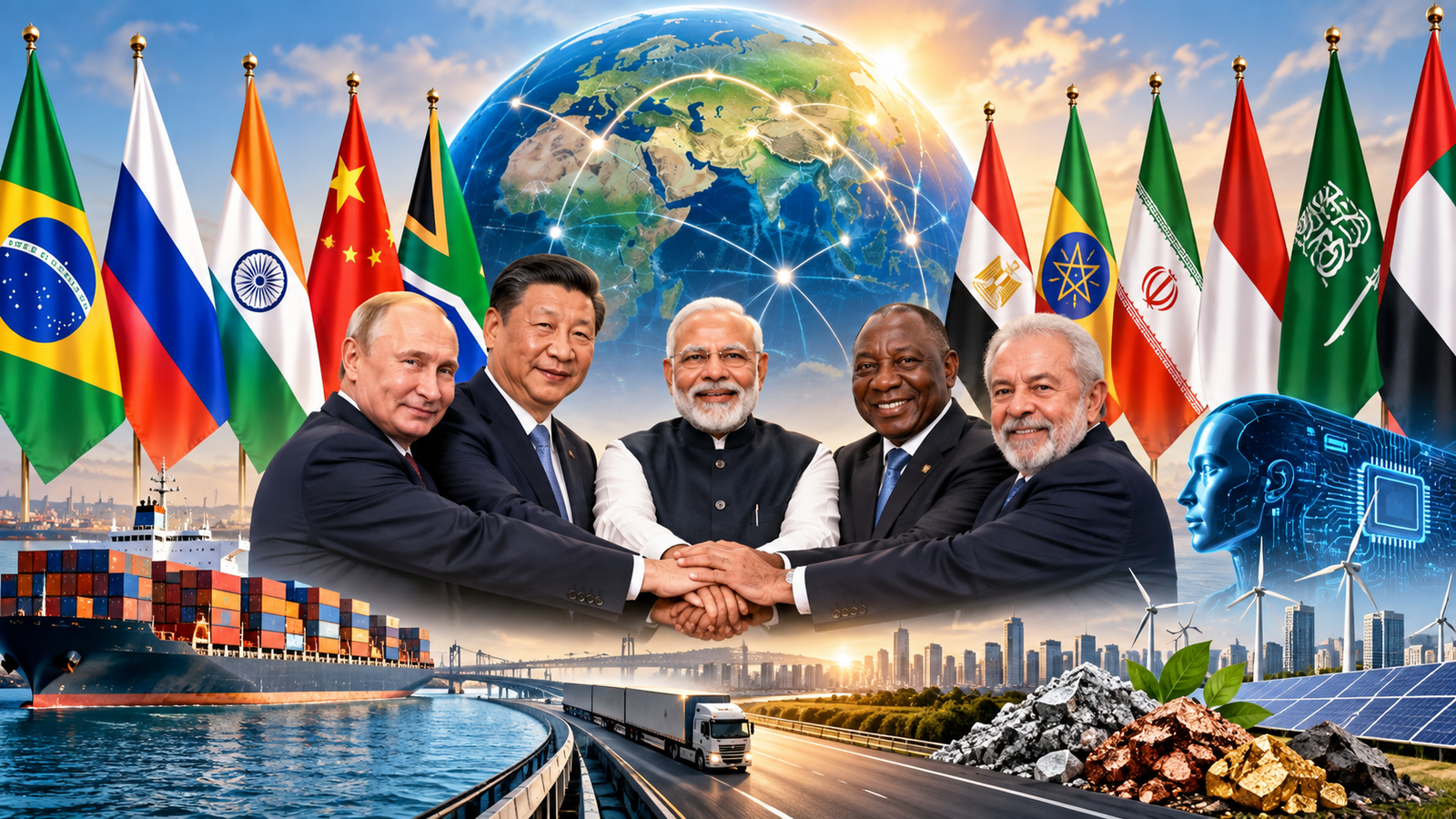
BRICS has moved into a new phase after its 18th summit in New Delhi on September 12 and 13, 2026. India hosted the meeting as the group faced major global issues such as trade pressure, wars, supply chain risks, energy concerns and changes in the world economy.
The group now has 11 members: Brazil, China, Egypt, Ethiopia, India, Indonesia, Iran, Russia, Saudi Arabia, South Africa and the United Arab Emirates. Together, these countries account for 49.5% of the world’s population, 40% of global GDP and 26% of global trade, according to Indian government data.
That size gives BRICS a much larger role than it had when the group first took shape. It also gives emerging economies a wider platform to discuss trade, finance, technology, energy and global politics.
The New Delhi summit showed that BRICS wants to turn this size into practical results. The group adopted a 140-point New Delhi Declaration, with a strong focus on economic cooperation and a greater voice for developing countries.
No Common BRICS Currency Yet
One of the biggest points from the summit concerns money and trade. There is still no common BRICS currency.
Instead, BRICS is focused on a more practical idea. Members want to make it easier to use their own national currencies for trade and investment. The BRICS Payment Task Force is also studying ways to make national payment and messaging systems work better with one another.
The aim is to make cross-border payments faster, cheaper, safer and easier to use. This could help companies that trade across BRICS markets and could reduce the need for some transactions to pass through dollar-based systems.
However, this is not a sudden move away from the US dollar. BRICS has not created a single alternative financial system. The work is still at a technical and policy stage in several areas.
India has also pushed for links between payment systems. Commerce Minister Piyush Goyal said India’s UPI is accepted in 11 countries and called for more links between BRICS payment systems and greater use of local currencies.
Why Local Currency Trade Matters
The push for local currencies has a simple reason. A trade deal between two countries can become easier if the buyer and seller can settle the payment through their own currencies.
For BRICS members, this could lower some costs and give businesses more payment choices. It may also help countries that face limits on access to traditional financial channels.
Still, major problems remain. Each country has different banking rules, currency markets and financial systems. A payment network that works well in one country may not work in another without changes.
The New Delhi Declaration itself recognises this problem. It says there is no single approach that can work for every BRICS member. The group therefore plans more technical work rather than a quick launch of one system.
India and China Move Closer
India and China remain central to the BRICS story. They are major economic powers, but they also have a history of strategic tension.
Chinese President Xi Jinping came to India for the summit, his first visit to the country in seven years. Prime Minister Narendra Modi and Xi held talks as both sides sought better ties.
Their relationship matters far beyond their borders. India and China together represent a huge share of Asia’s population, trade and economic activity.
A better relationship could help trade and business links. It could also make cooperation inside BRICS easier.
But the two countries remain competitors. Border concerns, trade differences and wider strategic issues have not disappeared. The latest talks therefore show a possible improvement in relations, not the end of their differences.
Russia Remains Important
Russia also remains a major BRICS partner for India.
Modi met Russian President Vladimir Putin during the New Delhi summit. The two leaders reviewed cooperation in political affairs, trade, defence, energy, space, skills and people-to-people ties.
They also discussed the first INNOPROM India industrial exhibition, which took place from September 9 to 11. The event was meant to support stronger industrial and trade links between India and Russia.
Energy remains one of the most important areas in this relationship. India needs reliable energy supplies for its large economy, while Russia remains a major global energy producer.
This makes India-Russia trade an important part of the wider BRICS economic story.
BRICS Takes a Stronger Diplomatic Role
The summit was not only about business.
BRICS leaders also had to deal with serious international conflicts. The New Delhi Declaration called for maximum restraint amid the worsening Middle East crisis and raised concerns about attacks on civilian and nuclear facilities.
The agreement was notable because BRICS includes countries with very different views on the conflict. Iran, Saudi Arabia and the UAE all have different interests in the region.
Despite these differences, members managed to reach a joint position.
That does not make BRICS a global peace-making body. Its members still disagree on many major issues. But the summit showed that the group can sometimes provide a place for countries with difficult relations to talk and find common ground.
AI Becomes a Major BRICS Issue
Artificial intelligence was another major subject at the summit.
China proposed a BRICS AI Open Source Zone. The plan aims to support cooperation on large language models, AI training and an open AI ecosystem.
The New Delhi Declaration also gave attention to safe, secure, reliable and inclusive AI. It stressed the needs of developing countries and called for wider access to AI resources.
This matters because AI needs huge amounts of data, energy, computing power and skilled workers. Countries that can build strong AI systems may gain an advantage in trade and industry.
For BRICS, cooperation in this area could help developing economies gain better access to new technology.
Critical Minerals and Supply Chains
Critical minerals are also becoming more important to BRICS.
These minerals are needed for batteries, electric vehicles, electronics, energy systems and many modern industries. Control over these resources has become a major part of global economic policy.
India has called for stronger trade in critical minerals, raw materials and skilled services within the wider BRICS network.
The group is also focused on stronger supply chains. China has proposed a BRICS Special Economic Zone partnership and plans to host a BRICS Service Trade Forum in 2027.
Such steps could help members build more trade links and reduce some supply risks.
A Bigger Voice for Emerging Economies
BRICS also wants changes in major global institutions.
Finance ministers and central bank governors from the group have called for greater representation for emerging and developing economies in the International Monetary Fund and World Bank.
Their argument is that the world economy has changed since these institutions were created. Emerging economies now have a much larger share of global output and trade, so their voice should reflect that change.
This fits with India’s wider goal for its 2026 BRICS chairship. India has presented BRICS as a platform for the Global South and has called for a fairer and more representative international system.
China Takes the Chair in 2027
India’s BRICS chairship now comes to an end after the New Delhi summit.
The group has given full support to China for the 2027 BRICS chairship and the next BRICS summit in China.
This could put greater attention on economic and technology cooperation. Xi has already proposed several new ideas, including the AI Open Source Zone, a Special Economic Zone partnership and a Service Trade Forum.
China will therefore have a chance to turn some of these ideas into practical projects during its chairship.
What Comes Next
The biggest BRICS story is not the arrival of a new currency. That has not happened.
The more important story is the slow creation of stronger links between major emerging economies. Local currency trade, payment links, development finance, AI, critical minerals, energy and supply chains are all part of this wider effort.
BRICS still has serious limits. Its members have different political goals, different economic systems and different views on global conflicts. These differences can make joint decisions difficult.
Yet the group has also shown that cooperation is possible even between countries with major disagreements.
The New Delhi summit therefore marks an important step, but not a finished project. BRICS is trying to build a larger economic and diplomatic network for emerging markets. If its plans lead to real payment links, more local-currency trade, stronger supply chains and useful technology partnerships, its influence could grow further.
For now, the message from New Delhi is clear. BRICS is not replacing the existing global financial system overnight. It is trying to create more choices for emerging economies, while giving them a stronger voice in the global system.
ALSO READ: Asian Shares Fall as Oil Rises and Rate Hikes Loom