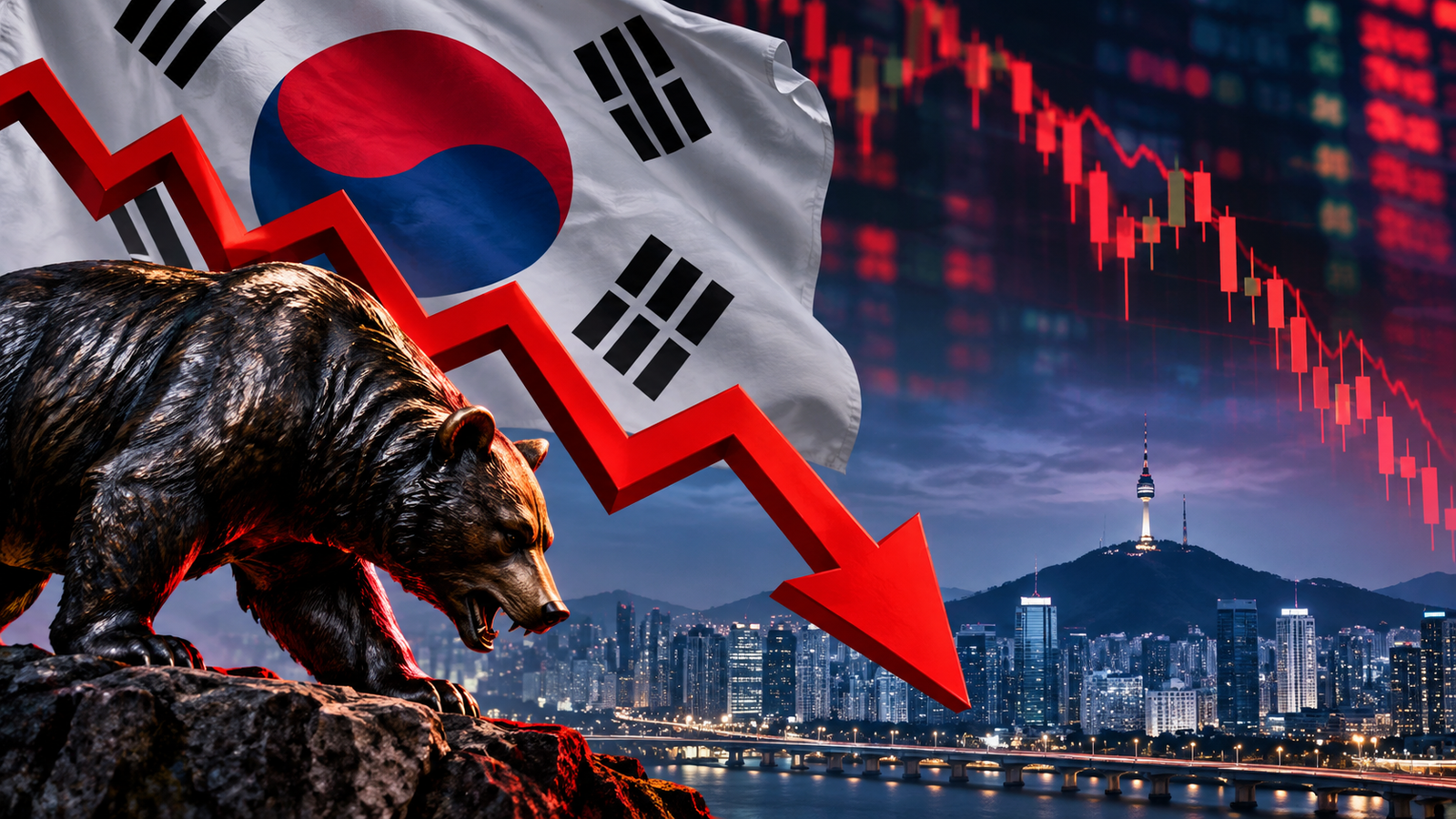
South Korea’s stock market faced a sharp fall on Monday, 14 September 2026. The KOSPI index opened at 6,692.61, down 217.30 points, or 3.14%, from the prior close.
The KOSDAQ also opened lower at 806.27, down 14.37 points, or 1.75%.
These figures relate to the market open on 14 September. They should not be treated as the final closing figures for the day. Share prices can change during the session, so the early figures provide only a view of the first stage of trade.
The main pressure came from large technology companies. SK Hynix and Samsung Electronics saw sharp early falls. Other major companies also faced pressure, which suggests that the market move was broad rather than limited to one company.
Several external factors affected investor sentiment at the same time. Concern about the Middle East pushed oil prices higher. Reports placed oil above $103 a barrel. At the same time, recent US inflation data raised concern about a possible US Federal Reserve rate increase.
Higher oil prices can add pressure to inflation. Higher interest rates can also reduce the appeal of risk assets. These factors can have a strong effect on large technology stocks because such companies often carry high market values.
The market also faced fresh concern about the pace of artificial intelligence growth. This added another source of uncertainty for semiconductor shares.
KOSPI Index
The KOSPI was the main market story on 14 September.
The index opened at 6,692.61, which was 217.30 points lower, equal to a 3.14% decline.
A fall of this size at the market open shows a strong change in short-term market sentiment. However, it does not by itself prove that the Korean market has entered a long-term decline.
The KOSPI has a large exposure to technology companies. Samsung Electronics and SK Hynix have a particularly large effect on the index. When both companies fall sharply at the same time, the effect on the wider index can be significant.
The KOSDAQ also fell, but its early decline was smaller. The index opened at 806.27, down 14.37 points, or 1.75%.
The difference between the two indexes is worth noting. The KOSPI has a greater weight in large companies, while the KOSDAQ has a larger share of smaller and mid-sized companies. The stronger KOSPI fall therefore shows the major effect of weakness in large-cap stocks.
SK Hynix
SK Hynix was one of the most important stocks on 14 September.
The company fell 5.24% at the open. Other reports placed the early fall at about 5.4% during the first part of trade.
SK Hynix has a major position in the global memory-chip market. Its business has also gained strong attention from the rise of artificial intelligence because advanced AI systems require large amounts of high-performance memory.
The sharp fall on 14 September does not by itself show that the company’s long-term business outlook has changed.
Instead, the move shows that investors were ready to reduce exposure to a major technology stock as global risk increased.
There was also a separate company development on the same day. SK Hynix and Samsung Electronics rejected a proposal from Korea Electric Power Corp. to prepay five years of electricity bills.
This corporate matter is separate from the share-price movement. It is still relevant as a same-day development for investors who follow the company.
Samsung Electronics
Samsung Electronics was another major source of pressure on the KOSPI.
Its shares fell about 3.4% during the first 20 minutes of trade, according to a same-day market report.
Samsung has a very large market value in South Korea. A sizeable move in its share price can therefore have a visible effect on the KOSPI.
The company also remains closely linked to the global semiconductor and artificial intelligence cycle.
The fall on 14 September came at a time when investors had to assess several risks at once. These included oil prices, interest-rate expectations, geopolitical concerns and the high valuation of some technology stocks.
It would be too strong to say that the fall proves a weaker long-term outlook for Samsung.
A same-day research view from KB Securities remained positive on the AI cycle. The brokerage forecast combined operating profit of 944 trillion won for Samsung Electronics and SK Hynix next year.
This creates an important difference between short-term market price action and long-term earnings expectations. A stock can fall sharply in one session even when analysts retain a positive view of future earnings.
Other Major KOSPI Stocks
The market weakness was not limited to semiconductor companies.
Samsung Biologics was also under pressure as the broader market faced heavy selling. The company is one of South Korea’s major healthcare names, but its share price can still react to a wider change in market risk.
Hyundai Motor also faced pressure. The automobile sector was part of the broader decline in Korean equities.
Kia was another major automobile name affected by the weak market mood.
LG Energy Solution also came under pressure. The company is one of South Korea’s most important battery companies and has close links to the global electric-vehicle market.
Hanwha Aerospace was another major stock to watch. Defence companies can sometimes receive support from geopolitical concerns, but a broad market sell-off can still affect their share prices.
This point is important. A particular industry may have a positive long-term story, but its share price can still fall when the wider market faces a sharp risk-off move.
Major Stocks on 14 September
| Company | Ticker | 14 September early move or relevance | Main factor |
|---|---|---|---|
| SK Hynix | 000660 | -5.24% at the open | Semiconductor and AI risk |
| Samsung Electronics | 005930 | About -3.4% early | Semiconductor and AI risk |
| Samsung Biologics | 207940 | Under broad market pressure | Risk-off mood |
| Hyundai Motor | 005380 | Under pressure | Broad equity sell-off |
| Kia | 000270 | Under pressure | Broad equity sell-off |
| LG Energy Solution | 373220 | Under pressure | Battery and market risk |
| Hanwha Aerospace | 012450 | Under pressure | Broad market risk |
The figures above refer to the early market period where a specific percentage is stated. They do not represent final closing returns for 14 September.
Why Did the Korean Market Fall?
The first major factor was Middle East uncertainty.
Geopolitical tension can affect financial markets through energy prices, trade routes and investor confidence. On 14 September, concern about the Middle East helped push oil prices above $103 a barrel in reports from the session.
Oil is important for South Korea because the country relies heavily on imported energy.
A higher oil price can increase costs for companies and consumers. It can also create wider inflation pressure. If inflation remains high, central banks may keep interest rates higher for longer or consider further rate increases.
The second major factor was the US interest-rate outlook.
Recent US inflation data increased concern about a possible Federal Reserve rate increase. Higher US rates can affect global capital flows. They can also place pressure on shares with high valuations.
The third factor was fresh caution about artificial intelligence.
Technology and semiconductor stocks had received strong support from expectations of rapid AI growth. When investors question the pace or cost of that growth, high-value semiconductor shares can face a sharp price response.
Reports also cited comments from Anthropic’s chief executive that suggested a slower approach to AI development. Such comments added to the concern around the very high expectations already built into parts of the technology sector.
These factors came together on the same day.
It would therefore be too simple to say that the KOSPI fell only because of AI concerns. It would also be too simple to blame the full decline only on Middle East tensions or oil prices.
The market reaction was the result of several risk factors at the same time.
Wise Planet IPO
The main IPO event directly tied to 14 September was Wise Planet Company.
Its public subscription began on 14 September and was set to continue through 15 September.
The final offer price was ₩12,000.
The reported institutional demand ratio was 1,248.47 times.
That is a very high institutional demand figure. It shows strong interest during the institutional price-discovery stage.
However, a high institutional demand ratio does not guarantee a strong post-listing share price.
An IPO price can move after listing because of market conditions, valuation, supply and demand, company results, investor sentiment and wider economic factors.
The timing of the Wise Planet subscription is also notable because it came on a day when the KOSPI faced a sharp decline.
That does not mean the IPO will perform poorly. It simply means that the wider market environment is one factor that investors may consider.
IPO Calendar for the Week
| IPO | Date relevant to 14 September | Key data |
|---|---|---|
| Wise Planet Company | Subscription starts 14 Sep | Final price ₩12,000 |
| Big Wave Robotics | Next IPO event | Retail subscription starts 15 Sep |
| Duksan NePCores | IPO process | Retail subscription starts 16 Sep |
| Global Technology | IPO process | Retail subscription starts 16 Sep |
| Brills | IPO process | Retail subscription starts 17 Sep |
Wise Planet is the most direct IPO story for 14 September because its retail subscription starts on that date.
Big Wave Robotics follows on 15 September.
Duksan NePCores and Global Technology have retail subscriptions set for 16 September.
Brills follows on 17 September.
These companies belong to the same weekly IPO calendar, but their individual subscription dates are different. This distinction is important when investors assess the immediate market impact.
AI and Semiconductor Outlook
The semiconductor sector remains the most important part of the Korean market story.
Samsung Electronics and SK Hynix have major positions in global memory and semiconductor supply. Both companies also have strong exposure to demand from artificial intelligence systems.
The market has placed high expectations on AI-related semiconductor demand.
This can create two different effects.
When demand forecasts rise, semiconductor shares can gain sharply.
When investors question the pace of future demand, those same shares can face strong selling.
The 14 September market move shows the second effect.
At the same time, the positive KB Securities forecast for combined operating profit of 944 trillion won for Samsung Electronics and SK Hynix next year suggests that some analysts still expect very strong earnings.
The difference between these two views is important.
Short-term share prices reflect current market sentiment.
Long-term share values depend more on future earnings, cash flow, competition, capital spending and other business factors.
Therefore, one weak trading session should not be used as proof that the AI semiconductor cycle has ended.
Shareholder Returns
Another important issue for Samsung Electronics and SK Hynix is shareholder returns.
Reuters reported that the two companies had announced more than 130 trillion won, or about $97 billion, in shareholder returns for 2026.
This is part of the wider debate about South Korea’s effort to improve corporate value and reduce the long-standing valuation gap between Korean companies and some overseas markets.
Large dividends and share buybacks can support shareholder value.
However, investors may also want broader changes in corporate governance and capital allocation.
The 14 September market weakness shows that shareholder-return measures do not remove all market risks.
Even companies with large shareholder-return plans can face strong price pressure when global risk rises.
What the 14 September Data Suggest
The available data show a strong risk-off session at the start of trade.
The KOSPI fell 3.14% at the open.
SK Hynix fell 5.24%.
Samsung Electronics fell about 3.4% during the first 20 minutes.
The weakness also affected Samsung Biologics, Hyundai Motor, Kia, LG Energy Solution and Hanwha Aerospace.
This broad decline suggests that investors were not focused on only one company.
The market faced a combination of geopolitical, energy, inflation, interest-rate and technology-related concerns.
At the same time, some longer-term business forecasts remained positive.
This difference matters when a market report uses the word “crash” or “collapse”. A sharp daily fall does not automatically mean that the underlying companies have suffered a similar decline in business value.
For that reason, a careful analysis should separate market price movement from company fundamentals.
What Investors May Watch Next
For the semiconductor sector, the key issue remains the strength of AI-related demand.
For the wider KOSPI, oil prices and global interest-rate expectations may remain important.
For Korean technology companies, the market may also focus on earnings forecasts and capital expenditure.
For the IPO market, Wise Planet’s subscription result and later listing performance may provide a useful measure of retail appetite during a weak market period.
The next few sessions may therefore provide more information than the opening move on 14 September alone.
A recovery after the sharp open could suggest that some investors view the decline as a short-term risk event.
A continued decline could show that the market has adopted a more cautious view of risk.
Neither outcome can be confirmed from the opening figures alone.
Conclusion
The main Korean market story on 14 September 2026 was a sharp decline in the KOSPI.
The index opened at 6,692.61, down 217.30 points, or 3.14%.
The KOSDAQ opened at 806.27, down 14.37 points, or 1.75%.
SK Hynix was one of the biggest sources of pressure, with a 5.24% fall at the open. Samsung Electronics fell about 3.4% during the first 20 minutes.
Other major names, such as Samsung Biologics, Hyundai Motor, Kia, LG Energy Solution and Hanwha Aerospace, also faced pressure.
The market had several reasons for caution. Middle East uncertainty pushed oil prices above $103 a barrel in reports from the session. Recent US inflation data raised concern about a possible Federal Reserve rate increase. Fresh questions about the pace of AI growth also placed pressure on semiconductor stocks.
The IPO side had a separate major event. Wise Planet Company began its public subscription on 14 September at a final offer price of ₩12,000. Its reported institutional demand ratio was 1,248.47 times.
The most balanced interpretation is that 14 September showed a sharp rise in short-term market risk. It does not, by itself, establish a long-term decline in the Korean economy, the semiconductor sector or any individual company.
The figures in this report relate to the information available for 14 September 2026, with price data clearly marked as opening or early-session data where applicable. They should not be treated as a guarantee of future price performance.
This article is for general information and market education only. It is not investment advice, a recommendation, an offer to buy or sell securities, or a promise of future returns. Investors should consider their own financial position, risk level, objectives and independent research before making any investment decision.
ALSO READ: Japan Stocks Face Fresh Pressure on Sept 14
Frequently Asked Questions
1. What happened to the KOSPI on 14 September 2026?
The KOSPI opened at 6,692.61, down 217.30 points, or 3.14%. The sharp fall showed strong selling pressure at the start of the session.
2. Why did the KOSPI fall on 14 September?
Several factors affected sentiment at the same time. These included Middle East uncertainty, higher oil prices, US interest-rate concerns and fresh caution around AI and semiconductor stocks.
3. How much did SK Hynix fall?
SK Hynix fell 5.24% at the open on 14 September. The stock was one of the main sources of pressure on the KOSPI.
4. How much did Samsung Electronics fall?
Samsung Electronics fell about 3.4% during the first 20 minutes of trade. The move added significant pressure to the KOSPI because of the company’s large market value.
5. Why is SK Hynix important to the Korean market?
SK Hynix is one of South Korea’s largest technology companies and a major global memory-chip producer. Its share price can have a meaningful effect on the KOSPI.
6. Why is Samsung Electronics important for the KOSPI?
Samsung Electronics has a very large market value and a major weight in the Korean stock market. A large move in its shares can therefore affect the overall KOSPI.
7. Did all Korean stocks fall on 14 September?
No. Market performance can differ between companies and sectors. However, the early session showed broad pressure across several major KOSPI companies.
8. Which other major stocks faced pressure?
Samsung Biologics, Hyundai Motor, Kia, LG Energy Solution and Hanwha Aerospace were among the major names affected by the wider market weakness.
9. What happened to the KOSDAQ?
The KOSDAQ opened at 806.27, down 14.37 points, or 1.75%. Its early decline was smaller than the KOSPI’s 3.14% fall.
10. Did oil prices affect Korean stocks?
Yes. Concern about the Middle East helped push oil prices above $103 a barrel in reports from the session. Higher oil prices can raise inflation and business-cost concerns.
11. Why do higher oil prices matter to South Korea?
South Korea relies heavily on imported energy. A higher oil price can increase costs for companies and consumers and may add pressure to inflation.
12. Did US interest rates affect the Korean market?
US interest-rate expectations were another source of concern. Recent US inflation data increased market concern about a possible Federal Reserve rate increase.
13. Did AI concerns affect Korean semiconductor stocks?
Yes. Fresh questions about the pace and cost of AI development added to pressure on semiconductor shares. This was one of several factors behind the weak market mood.
14. Does the fall in SK Hynix mean its long-term outlook has become weak?
Not necessarily. A one-day share-price fall does not prove a change in long-term business conditions. Investors also need to assess earnings, chip demand, competition and future industry conditions.
15. What was the main IPO event on 14 September?
Wise Planet Company began its public IPO subscription on 14 September. The subscription was set to continue through 15 September.
16. What was Wise Planet Company’s IPO price?
The final offer price was ₩12,000.
17. How strong was Wise Planet Company’s institutional demand?
The reported institutional demand ratio was 1,248.47 times. This shows very strong institutional demand during the price-discovery process.
18. Does strong IPO demand guarantee a higher listing price?
No. A high institutional demand ratio does not guarantee a profit after listing. The share price can depend on valuation, market conditions, supply and demand, company results and investor sentiment.
19. What other IPOs were scheduled after Wise Planet?
Big Wave Robotics had its retail subscription scheduled for 15 September. Duksan NePCores and Global Technology had subscriptions scheduled for 16 September, while Brills was scheduled for 17 September.
20. What should investors watch after the 14 September sell-off?
Investors may watch oil prices, US interest-rate expectations, semiconductor demand, AI-related forecasts, corporate earnings and the wider geopolitical situation. The next few trading sessions may provide more information about whether the 14 September fall was a short-term reaction or part of a wider market trend.
ALSO READ: Asian Shares Fall as Oil Rises and Rate Hikes Loom