
RBL Bank shares saw a strong rise in early May 2026 after the bank posted solid financial numbers for the fourth quarter of FY26. Investors reacted positively to better profit, lower bad loans, and healthy growth in loans and deposits. The stock moved close to its 52-week high as market confidence improved after many difficult years for the private lender.
The sharp move in the stock did not happen because of one reason alone. Several financial, business, and market factors came together at the same time. Better quarterly results, lower stress in the loan book, and fresh hope around future growth created a positive mood around the stock.
Strong Profit Growth Brought Fresh Confidence
One of the biggest reasons behind the rise in RBL Bank shares was the strong jump in quarterly profit. The bank reported a net profit of ₹230 crore for the fourth quarter of FY26. In the same quarter last year, the bank had posted a profit of only ₹69 crore.
This massive 234 percent rise in profit surprised many investors and analysts. The market viewed the result as a major sign that the bank had started to recover from earlier pressure. For a long time, RBL Bank struggled with weak earnings and stress in some parts of its business. Because of this, investors stayed cautious.
The latest profit numbers changed that view to some extent. Strong earnings usually help banks attract market attention because they show better business strength and better control over costs and risks. Investors often reward companies that show stable profit growth after a weak phase.
The jump in earnings also created hope that the bank could continue this trend in future quarters. That belief helped buying interest rise sharply in the stock market.
Better Asset Quality Reduced Fear in the Market
Another major reason behind the rally was the improvement in asset quality. Asset quality is one of the most important factors for any bank because it shows how healthy the loan book is.
RBL Bank reported a fall in gross non-performing assets, also called gross NPA. The gross NPA ratio came down to 1.45 percent from 1.88 percent in the previous quarter. Net NPA also improved and fell to 0.39 percent.
This decline in bad loans gave relief to investors. High NPAs usually create fear because banks may face losses if borrowers fail to repay loans. Lower NPAs show that the bank has better control over risky lending.
For many years, investors remained worried about stress in RBL Bank’s loan portfolio. The latest improvement suggested that the situation had become more stable. Market participants often react strongly when they see steady improvement in asset quality because it reduces future risk.
The lower NPA numbers also showed that the bank had improved recovery efforts and credit discipline. This strengthened confidence in the overall business.
Lower Provisions Helped Earnings Grow Faster
The bank also benefited from lower provisions during the quarter. Provisions are funds that banks keep aside for possible loan losses. Higher provisions usually reduce profit because banks need to reserve more money for future risk.
RBL Bank reported around 14 percent lower provisions compared to earlier levels. This directly supported earnings growth and improved overall profitability.
The fall in provisions suggested that stress in the loan book had started to ease. Investors viewed this as another positive sign because lower credit costs can support profit growth in future quarters as well.
When banks reduce provisions while asset quality improves at the same time, the market often sees it as proof that the worst phase may be over. That belief played an important role in the stock’s strong move during the period.
ALSO READ: Near 52-Week Highs vs Near Lows: A Split Market
Strong Loan Growth Showed Business Strength
Loan growth also played a key role in the rally. RBL Bank reported nearly 23 percent year-on-year growth in advances. This showed that the bank continued to expand its lending business despite earlier challenges.
Healthy loan growth is important for banks because loans help generate interest income. When lending activity rises at a steady pace, it usually supports revenue growth and future earnings.
The strong rise in advances showed that customer demand remained healthy. It also suggested that the bank had regained some confidence in the market after a difficult period.
Investors often prefer banks that can grow loans while also improving asset quality. In many cases, fast growth can create future stress if risk management becomes weak. However, RBL Bank managed to show both growth and better loan quality together, which improved investor sentiment.
The strong lending numbers also created hope that the bank could continue to expand market share in the coming quarters.
Deposit Growth Improved Stability
Apart from loan growth, deposit growth also remained strong. Deposits rose around 25 percent year-on-year during the quarter.
Strong deposit growth is very important for banks because deposits act as the main source of funds for lending activity. A stable deposit base helps banks reduce funding pressure and improve financial stability.
The market viewed this growth positively because it showed that customers continued to trust the bank. In the banking sector, customer confidence plays a major role in long-term success.
A healthy rise in deposits also gives banks more flexibility to grow loans without facing liquidity pressure. Investors usually pay close attention to this factor while judging the strength of a private sector bank.
The strong rise in both loans and deposits suggested that the overall business momentum remained healthy for RBL Bank during FY26.
Total Business Crossed a Major Milestone
RBL Bank also crossed an important business milestone during the period. The bank’s total business crossed ₹2.5 lakh crore after strong yearly growth.
This achievement helped improve market sentiment because it reflected the bank’s expanding scale. Large business growth often gives investors confidence that the company has entered a stronger phase of development.
The bank reported around 24 percent growth in total business compared to the previous year. This strong expansion added further support to the positive outlook around the stock.
For many investors, this growth became another sign that RBL Bank had started to move beyond its earlier weak period and entered a more stable phase.
RBL Bank Share Rally Shows Strong Market Confidence
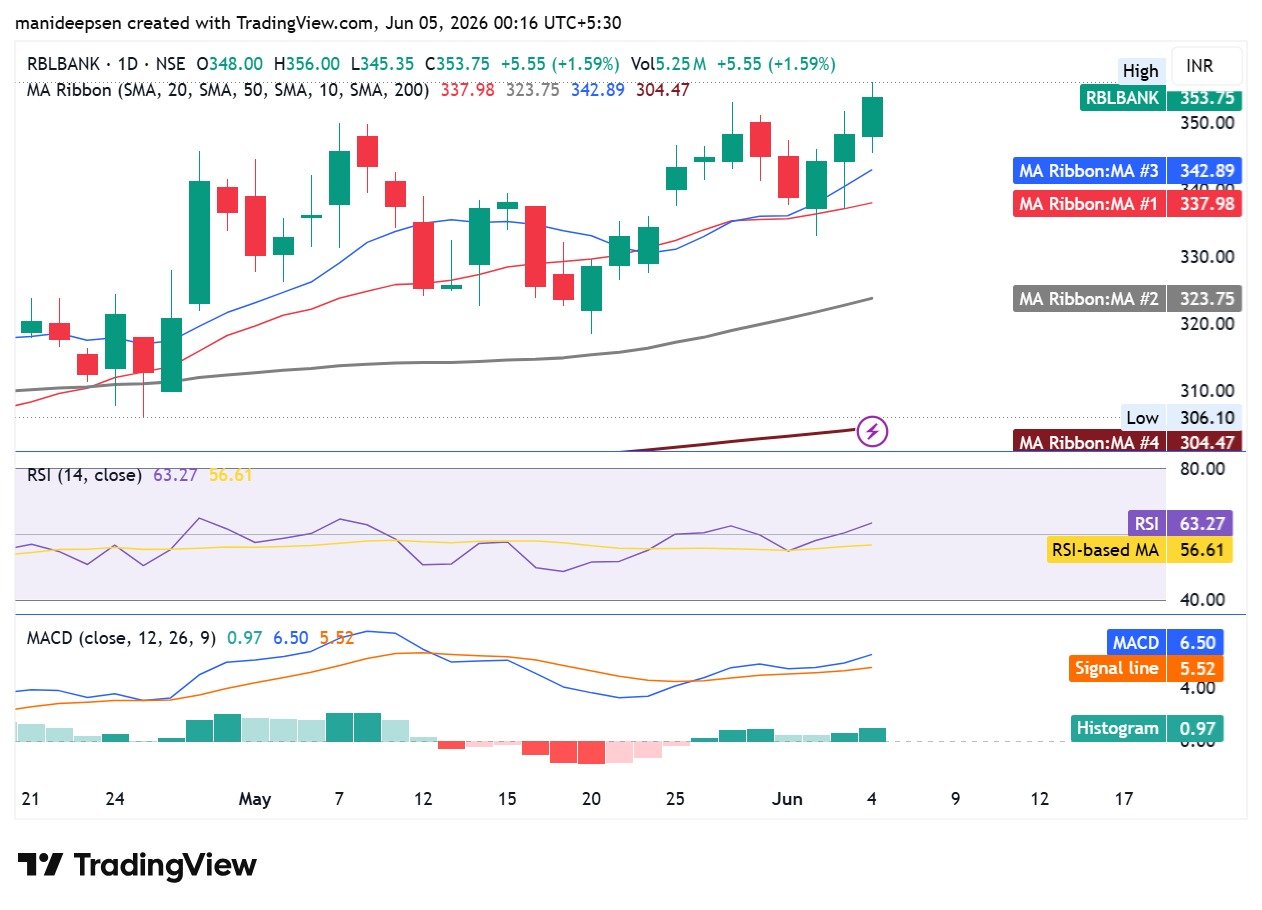
RBL Bank shares stayed in focus after the stock touched its 52-week high of ₹356 on 4 June 2026. The private sector lender saw strong investor interest after solid quarterly numbers, better asset quality, and steady business growth. Market participants also reacted positively to healthy loan expansion and lower stress in the balance sheet.
The stock closed near ₹353.75 after a strong move during the trading session. The day’s trading range stayed between ₹345.35 and ₹356.00. The stock also remained close to its previous close of ₹348.20, which reflected steady buying support in the market.
The latest move placed RBL Bank among the stronger performers in the private banking space during the recent period.
Stock Performance Stayed Strong Across Time Periods
The stock delivered healthy returns across most trading periods. In one week, the share price rose 1.65 percent. Over one month, the gain stood at 7.21 percent. The year-to-date return came at 12.27 percent, which showed steady strength in 2026 so far.
The biggest jump appeared in the one-year performance. RBL Bank shares climbed 66.61 percent during the last twelve months. This sharp rise reflected strong market confidence after a difficult phase in earlier years.
The stock also posted gains of 109.28 percent over three years. This data showed that long-term investors received strong returns despite periods of volatility.
Over five years, the stock rose 64.84 percent. While the gain remained lower compared to the three-year return, it still reflected recovery from earlier weakness in the banking business.
The benchmark comparison numbers remained lower during the same periods. This suggested that RBL Bank outperformed several broader market measures in recent months.
Strong Trading Activity Reflected High Investor Interest
Trading data also showed strong market participation. The traded volume stood at 52.55 lakh shares during the session. Traded value reached around ₹184.38 crore.
High trading activity usually reflects active participation from retail traders, institutional investors, and market participants. It may also suggest strong attention around recent business developments and quarterly earnings.
The impact cost remained at only 0.04. This number often reflects good liquidity in the stock. Lower impact cost usually means investors can buy or sell shares without large price swings.
The stock also recorded 36.26 percent deliverable quantity compared to total traded quantity. This figure suggested that a large section of investors preferred delivery-based buying instead of only short-term speculative trades.
Such trends often indicate stronger investor confidence in the company’s medium-term outlook.
Market Capitalisation Crossed ₹21,000 Crore
RBL Bank’s total market capitalisation stood at ₹21,917.48 crore. The free float market capitalisation came near ₹21,338.07 crore.
This reflected the bank’s strong market presence within the private banking sector. A higher market value often attracts more institutional attention because large funds generally prefer companies with stable liquidity and broader market participation.
The bank also remained part of the NIFTY Smallcap 100 index. Inclusion in important indices usually helps stocks receive steady investor interest from mutual funds and exchange traded funds.
The listing status stayed active and stable since the company entered the stock market on 31 August 2016.
Valuation Stayed at Moderate Levels
RBL Bank traded at a price-to-earnings ratio of 24.52. The adjusted P/E ratio also remained at 24.52.
The valuation suggested that investors expected stronger earnings growth in future quarters. In the banking sector, P/E ratios often move higher when markets expect improvement in profitability, lower bad loans, and stronger loan growth.
However, valuation alone does not guarantee future performance. Share prices may still react to changes in interest rates, loan growth, economic conditions, or business performance.
The current valuation reflected a balance between optimism and caution in the market.
Asset Quality Improvement Supported Sentiment
One of the biggest reasons behind the recent rally remained the improvement in asset quality. Gross non-performing assets fell to 1.45 percent, while net NPA dropped to 0.39 percent.
Lower bad loans usually reduce investor fear around future losses. This trend also reflected stronger credit discipline and better recovery efforts by the bank.
The decline in stressed assets helped improve confidence around the bank’s balance sheet. Investors often reward banks that show better control over loan quality after periods of uncertainty.
This improvement became one of the strongest support factors behind the stock’s upward movement.
ALSO READ: Hidden Signals Inside India’s Pre-Open Trade
Loan And Deposit Growth Added Strength
RBL Bank also reported healthy business expansion during FY26. Loan growth came near 23 percent year-on-year, while deposits rose around 25 percent.
Strong growth in both segments usually reflects healthy customer demand and stable banking operations. Deposits remain very important for banks because they provide the main source of lending funds.
The bank also crossed total business of ₹2.5 lakh crore after nearly 24 percent yearly growth. This milestone added further confidence around the company’s growth outlook.
Many investors viewed this data as proof that the bank entered a stronger business cycle after years of pressure.
Volatility Stayed Within Manageable Levels
Daily volatility in the stock stood at 2.24, while annualised volatility remained at 42.80.
Banking stocks usually show higher volatility compared to some defensive sectors because they react strongly to economic conditions, interest rates, and credit demand.
Despite this, the recent movement in RBL Bank shares appeared relatively controlled compared to earlier periods of sharp uncertainty.
The stock also traded without any formal price band restriction during the session. Upper band level stayed at ₹383, while the lower band remained at ₹313.40.
This wide trading range reflected active price discovery in the market.
Technical Position Improved Near 52-Week High
The stock touched its 52-week high of ₹356 on 4 June 2026. The 52-week low remained at ₹205.50, recorded on 6 June 2025.
This large difference between yearly high and low reflected the sharp recovery in investor sentiment over the last twelve months.
Stocks that trade near yearly highs often attract fresh market attention because traders and investors usually track momentum closely. Strong movement near important resistance zones may also increase trading activity.
However, experts often note that stocks near lifetime or yearly highs can also face profit booking after sharp rallies. Market conditions, earnings performance, and broader economic factors may continue to influence future price action.
Broader Sector Outlook Also Helped
The banking sector received support from healthy credit demand across retail and corporate segments during FY26. Stable economic activity and better business confidence helped many private banks report stronger growth.
RBL Bank benefited from this broader sector trend along with company-specific improvement in profitability and loan quality.
The market also reacted positively to lower provisions and stronger earnings growth during the recent quarter. Net profit rose sharply to ₹230 crore from ₹69 crore in the same period last year.
This large jump strengthened the recovery narrative around the stock.
Outlook Remains Linked To Future Business Execution
RBL Bank shares witnessed a strong rally after better financial performance and improved business indicators. The stock showed healthy gains across most time periods and traded close to its 52-week high.
At the same time, future performance may still depend on several factors such as asset quality, loan growth, deposit expansion, interest rate movement, and overall economic conditions.
Investors often track quarterly earnings, credit growth, and bad loan trends closely while evaluating banking stocks. Any major shift in these factors may influence market sentiment in future sessions.
The recent rise reflected stronger confidence in RBL Bank’s recovery story, though market conditions may continue to remain dynamic in the coming months.
Frequently Asked Questions
Why did RBL Bank shares rise sharply in May and June 2026?
RBL Bank shares saw a strong rise mainly because of better financial performance and improved business confidence. The bank reported a net profit of ₹230 crore in the fourth quarter of FY26 compared to ₹69 crore in the same quarter last year. This sharp jump in earnings improved market sentiment around the stock.
Apart from profit growth, investors also reacted positively to lower bad loans and better asset quality. Gross NPA fell to 1.45 percent while net NPA dropped to 0.39 percent. Strong loan growth of around 23 percent and deposit growth of nearly 25 percent also supported the rally.
The stock also moved close to its 52-week high of ₹356, which attracted fresh market attention. Higher trading activity and stronger confidence around the bank’s recovery story further helped the share price move higher.
Is RBL Bank financially stronger now compared to previous years?
Recent financial data suggests that RBL Bank appears to be in a better position compared to earlier years. The bank showed improvement across several important business areas during FY26.
Profit growth remained strong after a difficult period in the past. Asset quality also improved sharply as bad loan ratios moved lower. Reduced provisions suggested lower stress in the loan book, which helped support earnings growth.
The bank also reported healthy growth in loans, deposits, and overall business size. Total business crossed ₹2.5 lakh crore after around 24 percent yearly growth. These figures reflected stronger business momentum and better operational stability.
However, banking business conditions may still change due to economic factors, interest rates, and credit demand. Future performance may continue to depend on business execution and market conditions.
What does the rise in trading volume mean for RBL Bank shares?
The rise in trading volume reflected strong investor participation in the stock. RBL Bank recorded traded volume of 52.55 lakh shares and traded value of around ₹184.38 crore during the session.
Higher trading activity often shows that retail investors, traders, and institutions actively follow the stock. It may also suggest stronger interest after quarterly earnings and positive business updates.
The impact cost remained low at 0.04, which reflected healthy liquidity in the stock. Around 36.26 percent of traded quantity also resulted in delivery-based trades, which may indicate that many investors preferred holding shares instead of only short-term trading.
Strong volume alone does not guarantee future price movement, but it usually reflects higher market attention around a company.
Why is asset quality important for banking stocks like RBL Bank?
Asset quality is one of the most important factors for banks because it shows the health of the loan book. If borrowers fail to repay loans, banks may face losses. This is why investors closely watch gross NPA and net NPA numbers.
RBL Bank reported gross NPA of 1.45 percent and net NPA of 0.39 percent during the recent quarter. These numbers improved compared to earlier periods and helped reduce investor concerns around risky loans.
Lower bad loans usually improve confidence because they reduce future financial stress. Better asset quality may also support higher profit because banks may not need to keep large provisions for possible losses.
For this reason, improvement in NPA levels became one of the major reasons behind the positive movement in RBL Bank shares during 2026.
Can RBL Bank shares remain strong in the coming months?
Future movement in RBL Bank shares may depend on several business and market factors. Investors may continue to watch quarterly earnings, loan growth, deposit expansion, and asset quality very closely.
The stock already delivered strong returns over the last one year with gains of more than 66 percent. Shares also traded near the 52-week high of ₹356, which reflected strong market confidence.
If the bank continues to report healthy profit growth, stable bad loan levels, and steady business expansion, positive sentiment may continue. At the same time, banking stocks can also react to interest rates, economic conditions, inflation, and broader stock market trends.
Because of this, future price movement may remain dynamic and may change based on financial performance and overall market conditions.
ALSO READ: Coal India Shares Rise Near 52-Week High