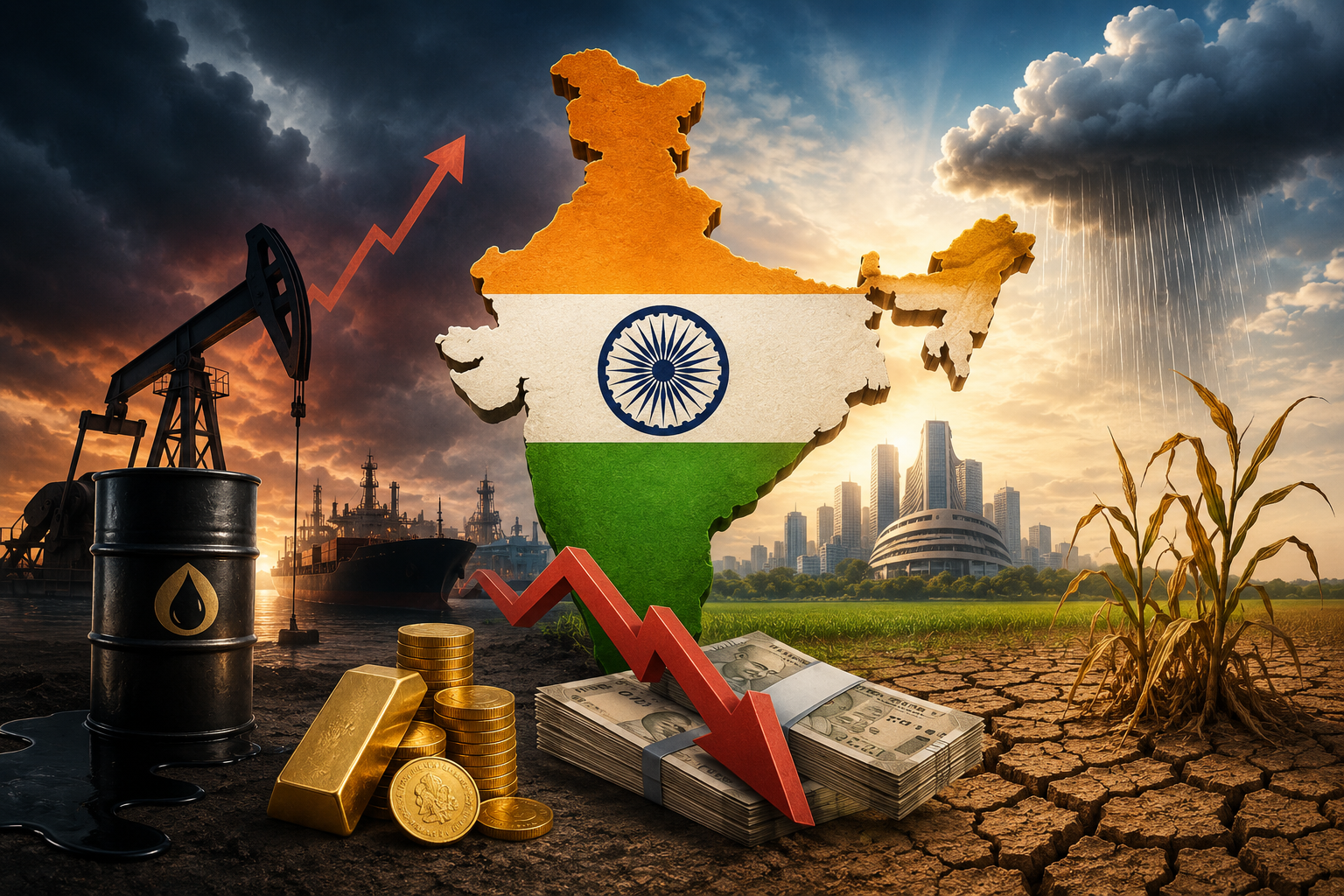
India stands at an important economic moment as the government has raised concerns about several major challenges that may affect the country in the coming months. Finance Minister Nirmala Sitharaman recently said that India faces uncertainty because of three serious issues. These include pressure on foreign exchange, rising oil prices, and the possibility of weak rainfall during the monsoon season.
While India remains one of the fastest-growing economies in the world, these problems could create difficulties for businesses, families, farmers, and the overall economy. Experts believe the country is not in crisis, but these risks deserve close attention because all three factors can directly affect inflation, spending, and economic growth.
Pressure on Foreign Exchange Creates Concern
One of the biggest concerns for India right now comes from foreign exchange uncertainty. Foreign exchange, often called forex, refers to the value of the Indian rupee compared with other global currencies, especially the US dollar.
The rupee often faces pressure when investors move money between countries because of global uncertainty. At present, geopolitical tensions in West Asia have created nervousness in international markets. This situation has caused unpredictable capital movement, which directly affects currency stability.
India also depends heavily on imports for several important products. The country imports large amounts of crude oil and gold every year. When the rupee becomes weak against the dollar, India pays more money for these imports.
A weaker currency usually makes imported goods more expensive. This affects products like electronics, machinery, fertilizers, and fuel. As import costs rise, prices inside the country also rise, which adds pressure on consumers.
Rising Oil Prices Bring Bigger Economic Risk
Another major concern for India comes from rising crude oil prices in the global market. India imports nearly 80 to 90 percent of its crude oil needs from other countries. Because of this heavy dependence, any rise in global oil prices quickly affects the Indian economy.
The recent increase in oil prices comes mainly from tensions in West Asia. Political conflict in the region has created fears about supply disruption. At the same time, shipping and insurance costs for transporting oil have also gone up.
Higher oil prices usually create immediate pressure on petrol and diesel prices. Even if fuel prices remain controlled for some time, the cost increase eventually spreads across the economy.
Transport companies pay more for fuel. Manufacturers spend more money on production and delivery. Businesses then raise prices to recover those costs. This pushes inflation higher and makes daily life more expensive for ordinary people.
Oil price increases do not affect only fuel. They also affect food prices, factory operations, logistics services, and household expenses. This is why economists treat oil price shocks as one of the biggest risks for countries like India.
Weak Monsoon Could Hurt Agriculture
The third concern comes from uncertainty around rainfall during the monsoon season. India still depends heavily on agriculture, and millions of people rely on farming for income.
A weak monsoon often creates serious economic pressure because poor rainfall affects crop production. Farmers receive less income when harvests become smaller. Rural families then reduce spending, which slows economic activity in many parts of the country.
Low rainfall can also reduce the supply of important crops. When supply falls, food prices rise. Products such as vegetables, grains, and pulses often become more expensive after weak monsoon periods.
Food inflation already remains a major concern for policymakers. Poor rainfall can make this problem worse and affect household budgets across the country.
The government has said that buffer food stocks remain strong. This means India has enough stored food reserves to manage immediate shortages if rainfall stays below expectations.
However, long-term pressure may still appear if crop output falls significantly during the season.
Why These Three Problems Matter Together
Each of these problems alone can affect the economy. But economists say the bigger concern comes when all three problems happen at the same time.
If the rupee weakens, imports become expensive. If oil prices rise, fuel and transport costs move higher. If monsoon rainfall remains weak, food prices begin to rise as well.
When these factors combine, inflation becomes harder to control.
Higher inflation means families spend more money on basic needs and reduce spending in other areas. Lower consumer spending can slow business activity. Companies may delay expansion plans if demand weakens.
This chain reaction can affect economic growth across the country.
Pressure on Government and RBI
These economic risks can also create pressure on the government and the Reserve Bank of India.
If fuel and food prices rise sharply, the government may need to increase subsidies to protect consumers. Higher subsidies usually increase government spending and can widen the fiscal deficit.
At the same time, the Reserve Bank of India faces a difficult situation. The RBI must control inflation while also supporting economic growth.
If inflation rises too fast, interest rates may stay high for longer. Higher interest rates often slow borrowing, investment, and consumer spending.
This balance becomes difficult when several economic risks appear at the same time.
India Still Has Important Strengths
Despite these challenges, India still has several strengths that provide some protection.
The country has strong foreign exchange reserves, which help support the rupee during difficult periods. The government has also introduced measures to attract foreign capital into government bonds.
India’s services sector continues to perform well and helps balance the trade deficit through strong export earnings.
Employment conditions and industrial demand also remain stable in several sectors of the economy.
These strengths reduce immediate danger and provide confidence that India can manage temporary global shocks.
The Road Ahead for India
The Finance Minister’s statement does not mean India faces an economic crisis. Instead, it serves as an early warning that several risks have appeared at the same time.
Global oil price uncertainty, pressure on the rupee, and concerns about monsoon rainfall may create a difficult environment for policymakers in the coming months.
India’s economy remains resilient, but the margin for error has become smaller.
The coming period will require careful planning from the government and close monitoring from the Reserve Bank of India.
For now, the message remains clear. India continues to grow, but external global pressure and domestic weather risks could make the economic path ahead more challenging than expected.


