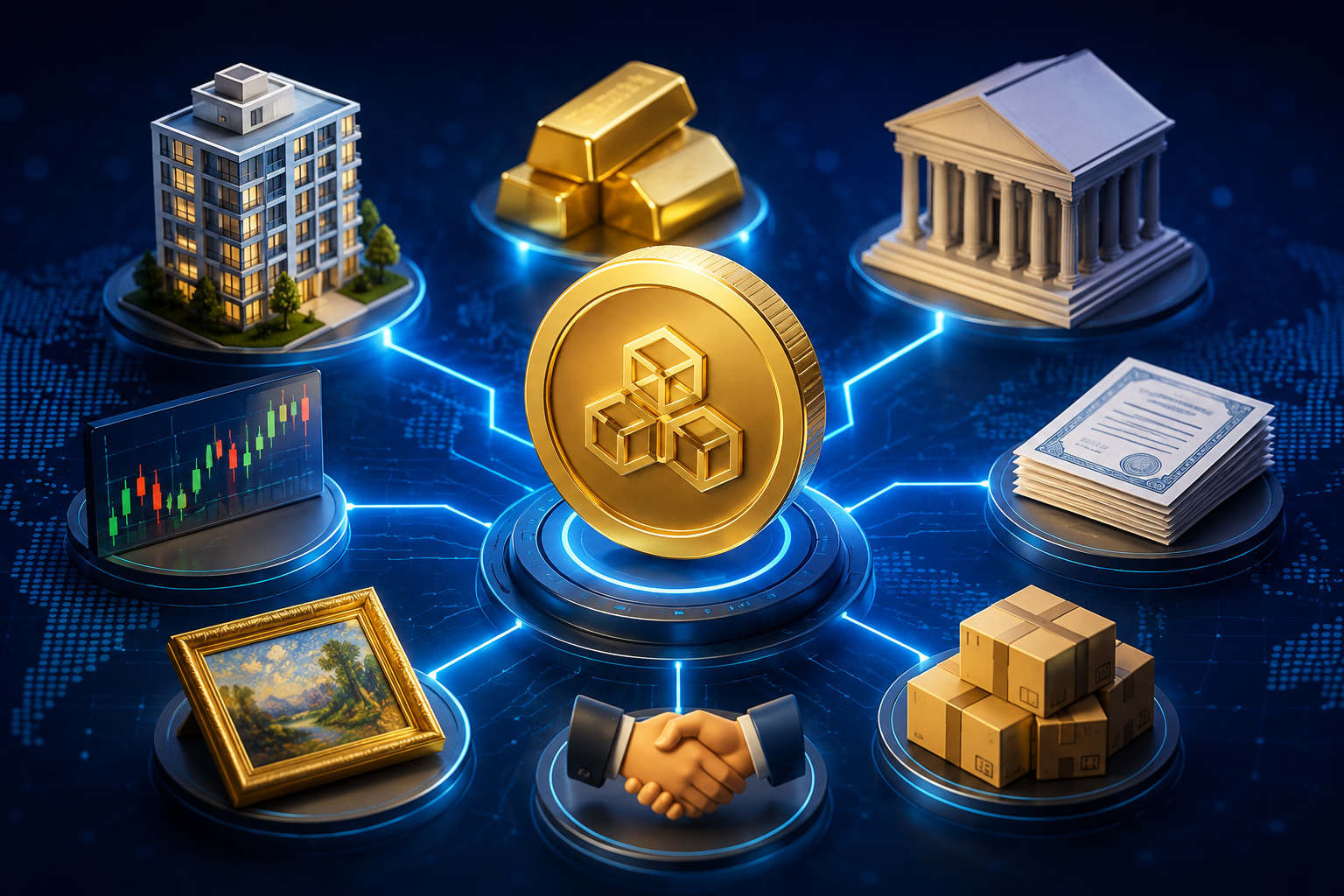
Real-World Assets, or RWAs, have become one of the most useful ideas in crypto. The basic idea is simple. A real asset, such as property, gold, a government bond, or a loan, can get a digital form on a blockchain. This digital token can show ownership, a right to income, a debt claim, or another legal right tied to the asset.
What Are Real-World Assets?
A Real-World Asset is an asset whose value comes from outside a blockchain. A house is a real-world asset. So is gold, a government bond, a company share, a loan, or an invoice. These assets already exist under traditional legal and financial systems.
An RWA token is a digital representation of such an asset or of a legal claim tied to it. The exact meaning of the token matters a lot. One token may give a person a share of an asset. Another may give a right to a part of the income from that asset. A third may represent a debt claim.
This means the token itself is not always the physical asset. A token does not automatically mean that the holder owns a piece of a building, for example. The legal documents must define what the holder owns and what rights come with that token.
What Is Tokenization?
Tokenization is the process of creating digital tokens that represent real-world assets or rights linked to them. The process usually starts with the asset itself. A legal structure then defines who owns the asset and what rights investors have.
A company may create a special-purpose vehicle, often called an SPV, to hold an asset. The SPV could own a property, bond, or other asset. Tokens can then represent shares, claims, or other rights tied to that structure.
Suppose a commercial property has a value of $10 million. Instead of one investor buying the whole property, a legal structure could divide the economic interest into 1 million tokens. If the legal structure gives each token a defined share of the property rights or income, investors could buy smaller portions.
Once the tokens exist, blockchain software can record transfers. Smart contracts can also enforce certain rules. For example, a contract may restrict transfers to approved investors. It may also help calculate or distribute payments under a defined structure.
This creates a simple chain: real asset, legal rights, custody and verification, token issuance, blockchain records, and investor access. Each part matters. If one part fails, the token may not provide the value that an investor expects.
What Assets Can Be Tokenized?
Many types of assets can take a token form. Real estate is one major example. A token could represent a defined interest in a house, office building, hotel, or other property. If the asset creates rent, that income could form part of the investment return.
Government bonds and Treasury bills are another important area. A tokenized Treasury product can give investors exposure to short-term government debt through blockchain-based infrastructure. This area has attracted attention because government debt already has clear value and established financial markets.
Gold and other commodities can also have token forms. In such a model, a token may represent a claim on a specific amount of a commodity held by a custodian. The holder must still trust the system that stores the underlying asset and verifies its existence.
Private credit is another major use case. A loan can produce interest and has a defined borrower and repayment schedule. A token may represent a claim on that loan or on a pool of loans.
How RWA Tokenization Works
A simple RWA model has several parts. First, there is the real asset. Next comes a legal structure that defines ownership and investor rights. A custodian or another trusted party may hold the asset. An issuer then creates tokens that represent the defined rights.
The tokens exist on a blockchain. Investors can acquire them through a platform that follows the required rules.
Once the tokens exist, blockchain software can record transfers. Smart contracts can also enforce certain rules. For example, a contract may restrict transfers to approved investors. It may also help calculate or distribute payments under a defined structure.
This creates a simple chain: real asset, legal rights, custody and verification, token issuance, blockchain records, and investor access. Each part matters. If one part fails, the token may not provide the value that an investor expects.
Why Tokenize Real Assets?
One major benefit is fractional ownership. A large asset can have a high price that keeps smaller investors away. Tokenization can divide an economic interest into smaller units. This does not guarantee access for everyone, because laws and platform rules may still limit who can buy the tokens.
Another benefit is faster settlement. Traditional asset transfers can involve banks, brokers, clearing systems, custodians, and other parties. Blockchain networks can provide a shared digital record and can operate outside normal market hours. This may reduce delays in some types of transactions.
Tokenization can also make financial rules more programmable. A smart contract can apply rules to transfers, payments, or other actions. This may reduce some manual work and lower certain operational costs.
RWA and Traditional Crypto
Traditional crypto assets and RWAs have an important difference. Bitcoin and Ether are native digital assets. Their value does not depend on a house, a bond, or a gold bar held outside the blockchain.
RWA tokens are different. Their value usually depends on something outside the crypto network. A token tied to a Treasury product depends on the underlying securities. A token tied to property depends on the property and the legal rights that connect the token holder to it.
There is also a middle ground. Stablecoins are digital tokens whose value is usually linked to an external asset, such as cash or short-term government securities. They show how blockchain tokens can connect digital markets with traditional financial assets.
The Oracle Problem
One of the biggest issues with RWAs is the oracle problem. A blockchain can prove that a token exists and that a transaction took place. It cannot, by itself, prove that a building exists, that gold sits in a vault, or that a borrower made a payment.
This creates a bridge between the digital world and the physical world. Someone must provide reliable information about the real asset. That may include proof of reserves, audits, valuations, custody records, legal documents, and other evidence.
Suppose a token claims to represent gold. The blockchain can show how many tokens exist. It cannot automatically prove that the same amount of gold sits in a vault. Investors must rely on the custodian, auditor, issuer, legal structure, and other checks.
This is why the quality of an RWA project depends on more than its blockchain. The connection between the token and the underlying asset is often the most important part of the system.
Legal and Regulatory Issues
RWA tokenization sits at the intersection of crypto and traditional finance. Securities law, property law, banking rules, tax rules, consumer protection, and anti-money-laundering requirements may all matter.
A token may qualify as a security, debt instrument, fund interest, commodity-related product, property interest, or another type of legal instrument. The answer depends on the asset, structure, rights, and laws of the relevant jurisdiction.
This leads to one of the most important questions for any RWA project: What legal right does the token holder actually have?
A project can have excellent technology and still have a weak legal structure. If the token does not give enforceable rights to the underlying asset or its cash flows, the blockchain record alone may not protect the investor.
For this reason, serious RWA systems need clear legal documents, reliable asset custody, identity checks, compliance controls, audits, and a process for handling disputes or failures.
Why Institutions Care About RWAs
Traditional finance contains enormous amounts of value, but many processes still rely on separate databases and several intermediaries.
A tokenized bond, for example, could have digital ownership records, automated settlement, programmed transfer rules, and digital payment flows. A tokenized fund could use similar tools for investor records and transactions.
Collateral is another area of interest. If an asset has a trusted digital form, it may become easier to track, value, transfer, or use within a financial system.
However, institutions are unlikely to adopt RWA technology simply because it uses blockchain. They need strong legal rights, security, compliance, privacy, reliable custody, and clear economic value. Technology must solve a real problem.
Where RWAs May Have the Most Value
Government debt is one strong area because Treasury bills and similar assets already have deep markets and clear economic value. A blockchain-based form can offer access to these assets within digital financial systems.
Private credit may also benefit. Loans can be hard to divide, transfer, and manage through traditional systems. Token-based structures could make parts of the process more digital and easier to track.
Funds are another possible area. A token can represent a fund interest while the fund continues to hold traditional assets. This may improve parts of the investor and settlement process.
Real estate has large potential because property is valuable but often difficult to divide and trade. Tokenization could make smaller economic interests possible. Yet property law, taxes, local rules, valuation, and liquidity make this area more complex than it may first appear.
Risks Investors Should Understand
RWA does not remove investment risk. It changes some of the places where risk exists.
The underlying asset can lose value. A property can fall in price. A borrower can fail to repay a loan. A bond can face market risk. Gold can change in price.
There is also counterparty risk. The issuer, borrower, custodian, or another important party could fail. If that party controls the asset, investors may face serious problems even if the blockchain works perfectly.
Legal risk is also important. Investors may assume that a token means direct ownership when it actually represents a contractual claim. The difference can become critical during a dispute or bankruptcy.
Liquidity is another common misunderstanding. A token can trade on a blockchain and still have very few buyers. Tokenization can make an asset easier to transfer, but it does not create demand by itself.
Smart contracts create technical risk. A software bug can lead to losses. Oracle failures can also create incorrect data or actions. Regulation can change as governments develop new rules for digital assets.
The Future of RWA Tokenization
RWA tokenization could become a major part of the next stage of digital finance. Its strongest value may not come from turning every asset into a token. It may come from using blockchain where a shared digital record, faster settlement, or programmable rules solve a clear problem.
The future could include tokenized government debt, private credit, funds, property interests, commodities, and other financial products.
The key question is simple: does the token provide a clear legal right, does the underlying asset exist, can its value be checked, and can investors trust the parties that connect the real world to the blockchain?
The Core Idea
The easiest way to understand RWAs is to see them as a bridge between traditional assets and blockchain systems. Tokenization does not magically place a house, bond, or gold bar inside a blockchain. Instead, it creates a digital token that represents a defined economic or legal right connected to that real-world asset.
Blockchain can help with records, transfers, settlement, automation, and transparency. It cannot replace laws, courts, custodians, audits, or trusted asset verification.
That is the real promise of RWAs. They can bring useful parts of traditional finance into a more digital and programmable environment. But their success depends on the quality of the legal structure, the underlying asset, the technology, and the institutions behind the token.
In simple terms, RWA tokenization turns real-world value into a digital form while keeping the link to the asset outside the blockchain. If that link is strong, clear, and legally enforceable, RWAs can become a powerful bridge between traditional finance and crypto.
This balance matters because technology alone cannot guarantee asset value or investor protection.
ALSO READ: Crypto Regulation and ETFs: What Each Investor Needs to Know