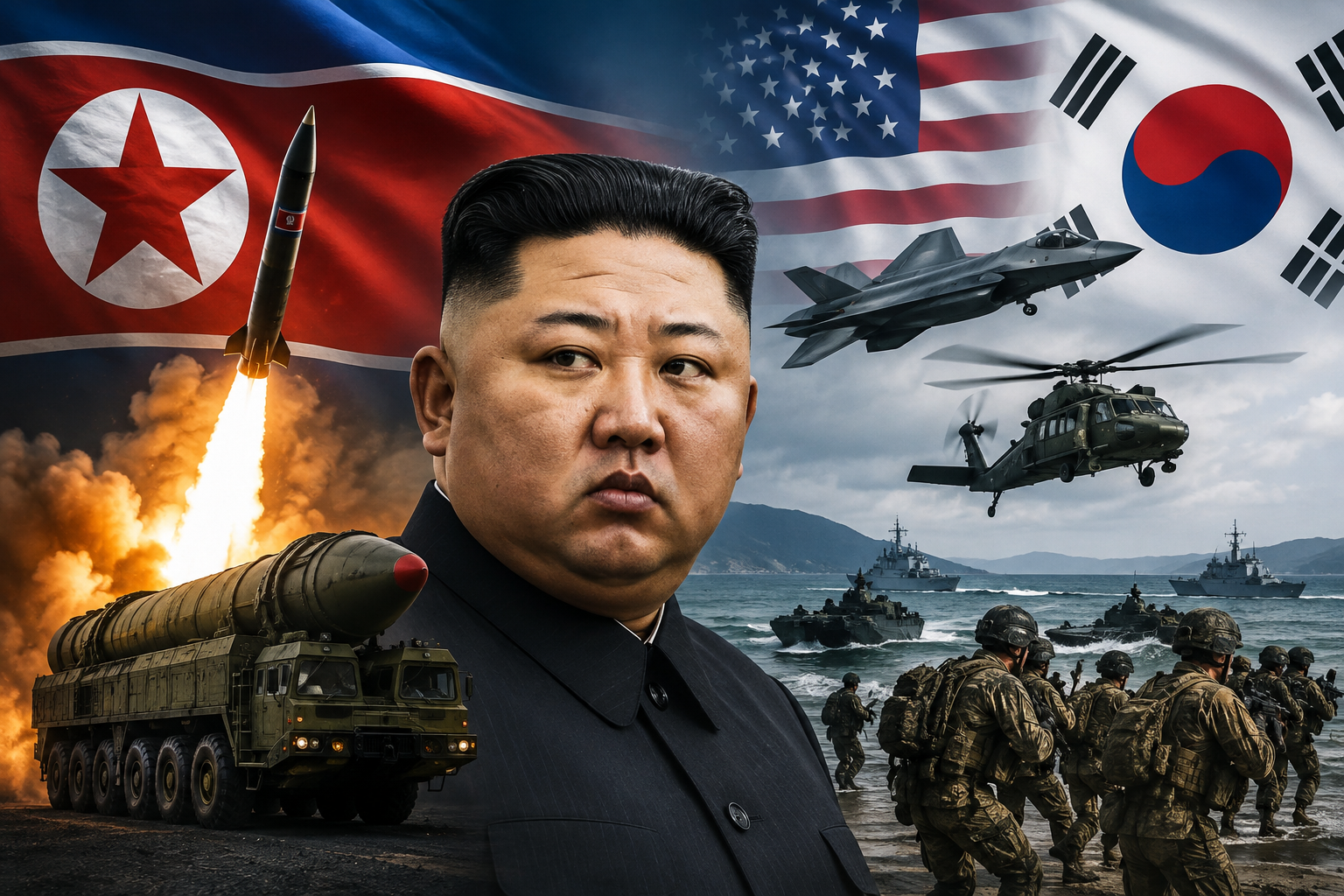
North Korea has warned that it could take self-defence measures in response to the latest military drills by the United States and South Korea. Pyongyang has called the exercises a serious threat and said it may respond with a stronger military deterrent.
The warning came before the annual Ulchi Freedom Shield drills. North Korean state media said the exercises were more provocative than last year’s drills. Pyongyang also accused the United States, South Korea and Japan of closer military cooperation that could create a new security threat.
North Korea’s Foreign Ministry said the country would respond to what it sees as a higher level of danger with a higher level of deterrence. The message has raised fresh concern about more missile tests or other military action from Pyongyang.
What Are the US-South Korea Drills?
Ulchi Freedom Shield is a major annual military exercise between the United States and South Korea. The drills are meant to test how the two allies would respond to a serious attack on South Korea.
The exercises also test command systems, emergency plans and the ability of the two countries to work together during a crisis. South Korea says the drills are defensive. Seoul has stressed that their purpose is to protect the country and its people, not to attack North Korea.
The 2026 exercise began on August 17 and is set to run until August 27. Reports before the drills said about 18,000 South Korean troops would take part, along with US forces based in the country. The United States has about 28,500 troops stationed in South Korea.
For North Korea, however, the drills look very different. Pyongyang has long viewed large US-South Korea exercises as a rehearsal for an attack. This has created a familiar pattern on the Korean Peninsula: the allies say they need exercises for defence, while North Korea sees them as proof that it must strengthen its own military forces.
North Korea Has Already Shown Its Military Power
The latest warning also comes after North Korea carried out ballistic missile launches. One missile was fired toward the sea off the east coast of the Korean Peninsula on Wednesday, August 12, only six days after another launch.
These launches matter because North Korea often uses periods of higher military tension to show its weapons capability. Missile tests can serve several purposes. They can send a political message, test military systems and remind the United States and South Korea that Pyongyang has weapons that can reach targets far beyond its borders.
North Korea has also continued to develop nuclear weapons and missile systems over many years. Its leadership says these weapons are needed to protect the country from outside threats.
The United States and South Korea take a different view. They say North Korea’s nuclear and missile programs create a direct threat to regional security and make strong defence plans necessary.
Trump Orders a Major Cut in the Drills
A major change came just before the exercises began. US President Donald Trump ordered the Pentagon to substantially reduce the joint military drills with South Korea.
Trump said he was unhappy with the exercises and described them as costly and hostile. He also pointed to his relationship with North Korean leader Kim Jong Un. Trump has said he has a good relationship with Kim and appears to see room for renewed contact with Pyongyang.
Trump also referred to South Korea’s decision not to take part in US military action against Iran as part of the wider dispute between Washington and Seoul.
The decision came as a surprise because the exercises had already been planned. South Korea’s Defence Ministry said the drills would proceed as previously announced and scheduled, while US and South Korean officials later discussed how the reduction would work in practice.
Seoul Wants Stronger Defence
South Korean President Lee Jae Myung has tried to send two messages at the same time. First, he has defended the importance of the US alliance. Second, he has called for South Korea to become more capable of defending itself.
Lee has said stronger South Korean defence and a strong US alliance do not have to conflict with each other. His government also wants progress on the transfer of wartime operational control from the United States to South Korea.
This issue is important because the US has played a major role in South Korea’s defence since the Korean War. A stronger South Korean military could give Seoul more control over its own defence decisions.
Lee has also backed plans for stronger military leadership, better command systems and work on nuclear-powered submarines. The sudden US decision to reduce the drills has added more urgency to the debate about how much South Korea should depend on American military power.
Why the Situation Is Sensitive
The Korean Peninsula has a long history of military tension. North and South Korea remain technically at war because the 1950–1953 Korean War ended with an armistice, not a peace treaty.
That history makes military exercises especially sensitive. A drill that Washington and Seoul view as a defensive test can look like preparation for war from Pyongyang.
The danger is not only a planned attack. A bigger concern is miscalculation. If one side sees a military move as preparation for an attack, it may respond with missiles, troop movements or other actions. The other side may then see that response as proof of hostile intent.
This can create a cycle that becomes harder to control.
For this reason, North Korea’s latest warning deserves attention even if it does not mean that a major conflict is about to start. Pyongyang has often used strong language during military exercises, and such statements do not automatically lead to war.
A New US Approach to North Korea
Trump’s decision also points to a possible change in US policy toward North Korea.
Previous US administrations have generally treated joint exercises with South Korea as an important part of deterrence. Trump, however, has again placed more attention on direct relations with Kim Jong Un.
His decision to reduce the drills suggests that he may see smaller exercises as a way to lower tension and create space for talks. Trump has also said that Kim has responded to his recent outreach.
The challenge is finding a balance. Smaller exercises may reduce one source of tension with North Korea, but they can also raise questions about military readiness and the strength of the US commitment to South Korea.
That concern has already appeared in South Korea, where officials and political groups are debating what the change means for the alliance.
What Could Happen Next?
The next few days will be closely watched for signs from Pyongyang. North Korea could respond with another missile test, stronger statements or other military activity. It could also choose not to take major action.
Much will depend on how North Korea reads the reduced US military role in the exercises. Pyongyang may see the change as a positive signal from Washington. It may also see the continued drills as proof that the basic US-South Korea security partnership remains in place.
For Seoul, the situation is more complex. South Korea wants to keep its alliance with Washington strong while also building greater independent defence power.
That could become one of the biggest long-term effects of the current dispute. A smaller US role may push South Korea to invest more in its own military systems, command structure and advanced weapons.
The Bigger Picture
The latest North Korean warning is part of a much larger security problem in East Asia. North Korea wants stronger military power to protect its regime. South Korea wants a reliable defence system against the North. The United States wants to deter North Korea while also managing its wider global commitments.
At the same time, China and Russia remain important factors in the region. North Korea’s military ties with Russia have also received greater attention, while Seoul continues to strengthen its security links with Washington and other partners.
For now, there is no clear sign that the latest crisis will lead to a major conflict. But the mix of missile tests, military exercises, nuclear weapons, strong threats and changes in US policy makes the situation worth close attention.
North Korea’s promise of self-defence is therefore more than another angry statement from Pyongyang. It shows that the basic security problem on the Korean Peninsula remains unresolved. The coming days will show whether the reduced US drills help lower tensions or simply create a new phase in the long struggle over military power and deterrence in the region.
ALSO READ: Centum Electronics Q1 Profit Jumps 2,122% on One-Time Gain