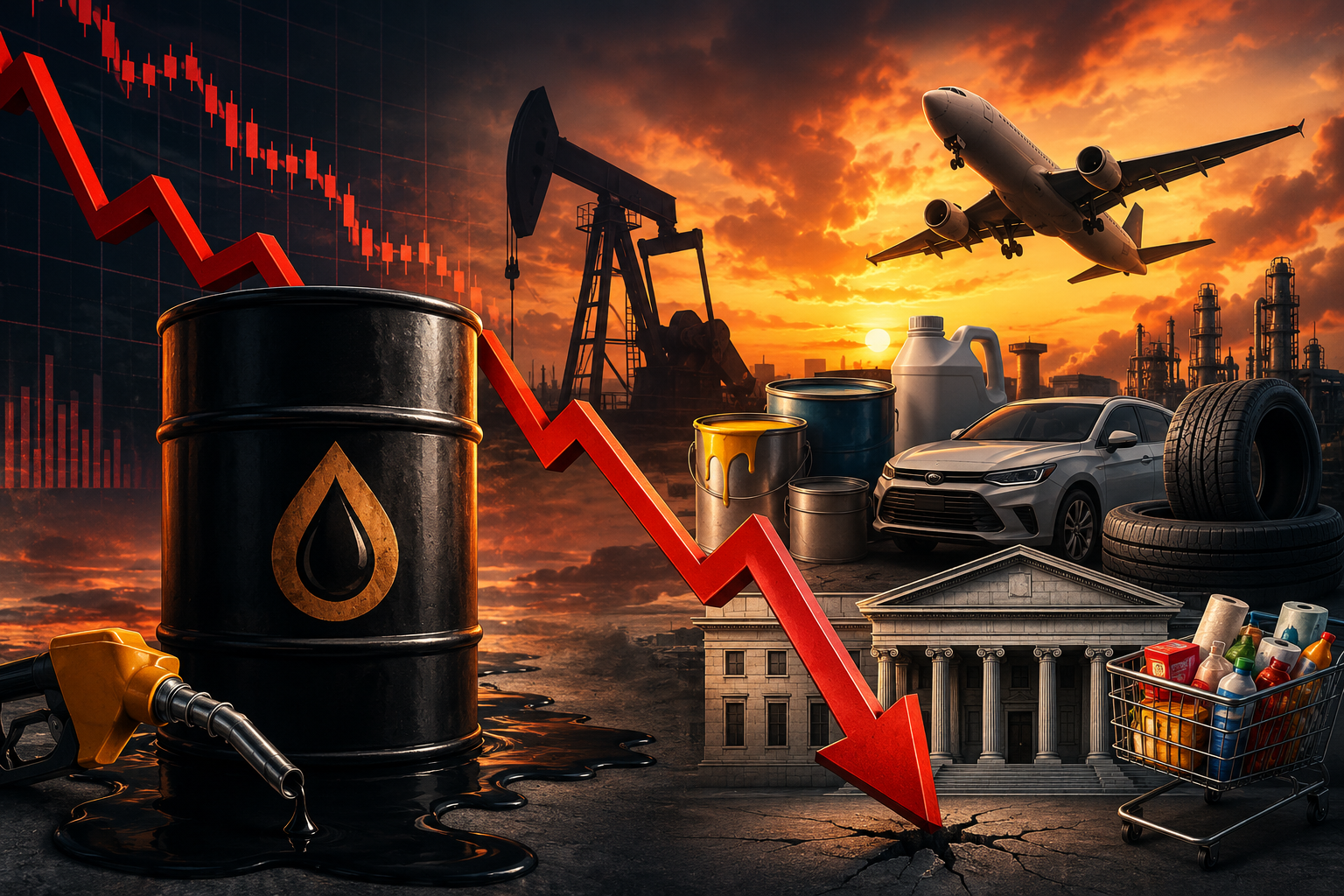
Crude oil has once again become a major concern for Indian stock markets. Brent crude moved above $92 a barrel after fresh tensions between the US and Iran raised fears of supply disruption. It later moved close to $95 and $96 a barrel. For India, this is a serious risk because the country depends heavily on imported oil.
India imports about 85% of its crude oil requirement. Other estimates put the figure closer to 85-90%. Crude oil imports also meet nearly 90% of domestic demand. This makes India far more sensitive to oil prices than many other large economies.
The effect of costly oil does not stop at petrol and diesel. It can raise transport costs, factory costs, air fares and prices of many raw materials. It can also put pressure on the rupee, inflation and interest rates.
That is why a short oil spike may not hurt the Nifty too much, but oil near $92 for many months could create a much larger problem.
Airlines Face the First Big Hit
Airlines are among the sectors most exposed to costly crude. Aviation turbine fuel, or ATF, is the single largest operating expense for an airline.
Fuel has usually made up about 35-50% of airline operating costs. The share reached 50-51% in the 2012-2014 period when Brent crude stayed above $100 a barrel. Fuel costs also came close to 48% of total airline operating expenses in fiscal 2023.
This creates a difficult choice for airlines. If they raise ticket prices, passengers may cut back on air travel. If they do not raise fares, profit margins can take the hit.
The problem can become worse if high oil prices last for several quarters. India had double-digit passenger growth in recent years, but high ATF costs and higher fares could slow traffic growth to about 4-6% this fiscal, according to CRISIL.
Oil Marketing Companies Have a Different Problem
Oil marketing companies, or OMCs, face a more complex risk.
Companies such as Indian Oil, Bharat Petroleum and Hindustan Petroleum buy crude at global prices and sell petrol and diesel in the domestic market. When crude rises sharply, their fuel purchase cost can rise much faster than the retail price.
That can hurt marketing margins.
ICRA has already warned that higher crude prices and supply disruption can put pressure on OMC profits. During the recent oil shock, marketing margins for petrol and diesel turned negative after a period of healthy margins.
The key issue is how much of the higher cost companies can pass on to customers. If retail fuel prices stay stable while crude remains high, OMC profits can come under pressure.
Paint Companies Are More Exposed Than They Look
Paint stocks may not appear to be oil-sensitive businesses, but crude has a direct role in their cost base.
Paint makers use several crude-linked materials, such as solvents and other chemical inputs. Crude-linked derivatives can account for about 30-35% of raw material costs for paint companies.
A sustained rise in oil can therefore put pressure on margins at companies such as Asian Paints, Berger Paints and Kansai Nerolac.
These companies can raise prices to protect profits, but there is a limit. If prices rise too much, customers may delay home work or shift to cheaper brands.
This makes the paint sector a clear example of the wider oil problem: the issue is not only the cost of crude, but also the ability to pass that cost to the customer.
Tyres and Auto Parts Could Feel the Pressure
Tyre makers also have a strong link to crude prices. Synthetic rubber and carbon black are major tyre inputs, and both have links to petroleum prices.
Tyre companies can face higher raw material costs when oil stays high. The impact can be large because crude-linked products can make up nearly half of tyre input costs.
Auto companies face a wider set of risks. Higher fuel prices can make vehicle ownership more expensive, which may hurt demand for petrol and diesel vehicles. At the same time, higher costs for tyres, plastics and other inputs can put pressure on margins.
This helps explain why auto stocks have shown weakness as oil prices rose. On September 1, the Nifty Auto index fell 1.2%, while Maruti Suzuki fell 4.4% after weaker August sales.
Chemicals and Petrochemicals Are Another Weak Spot
Chemicals have a close link to crude because many companies use petroleum-based feedstock.
Higher crude prices can raise the cost of products such as naphtha, benzene and propylene. Higher freight costs can add another layer of pressure.
ICRA has placed chemicals among the sectors under the highest pressure from higher fuel costs and supply disruption. CRISIL has also listed paints, specialty chemicals, flexible packaging and synthetic textiles among crude-linked sectors that could face stress.
Companies with strong brands and better pricing power may handle the shock better. Smaller firms with weak margins may have a harder time.
Cement and Construction Could Feel the Second Wave
Cement is not as directly tied to crude as airlines or paints, but energy remains a major cost for the sector.
Higher fuel and freight costs can raise the cost of cement production and delivery. Construction companies can also face higher costs for transport and several petroleum-based materials.
CRISIL expects manufacturing and construction to face some of the biggest pressure from a prolonged energy shock. Around 40% of costs in manufacturing, mining and construction are linked to energy and related inputs.
That matters for the wider economy because construction has a large role in jobs, investment and domestic demand.
FMCG May Face a Margin Problem
Fast-moving consumer goods companies may not suffer a direct shock from crude, but the impact can reach them through packaging, transport and consumer demand.
Plastic packaging uses crude-linked materials. Higher diesel prices can also raise the cost of moving goods from factories to distributors and shops.
There is another problem. When petrol, diesel and other household costs rise, consumers have less money for non-essential products.
Large FMCG firms may have better brands and stronger pricing power, which can help them protect margins. Smaller firms may face more pressure.
Banks Are a Second-Order Risk
Banks do not have a direct crude cost problem. Their risk comes from the wider economy.
A prolonged oil shock can raise inflation. Higher inflation can reduce the scope for lower interest rates and may even create pressure for tighter policy. Higher rates can then affect loans, investment and consumer demand.
This is why banks can become a second-order casualty of costly oil.
Recent market action already showed this pattern. On September 1, the Nifty banking index fell 1.1% as higher crude prices and bond yields raised concern about inflation and rates.
IT and Pharma Look Relatively Safer
IT and pharma have much less direct exposure to crude than airlines, paints, chemicals or tyres.
That does not mean they are immune. A global oil shock can hurt world economic growth and affect investor sentiment. A weaker rupee can also have mixed effects across different companies.
Still, their direct cost exposure to crude is much lower. ICRA has also described pharmaceuticals as relatively insulated from the direct effects of the current trade and energy shock.
This can make defensive sectors more attractive if oil stays high for a long period.
Reliance Is a Special Case
Reliance Industries is difficult to place in a simple “oil loser” category.
Its oil-to-chemicals business can face higher feedstock costs when crude rises. But its refining business can benefit if global fuel prices and refining margins rise at the same time.
That was visible on September 1, when Reliance shares rose 2.5% after Jefferies raised its price target on expectations of stronger refining earnings.
So higher crude does not affect every energy-related business in the same way.
What a Long Oil Shock Could Do to the Nifty
The real risk is not one month of $92 oil. The bigger concern is $92 oil for six to twelve months.
The chain is fairly simple. Higher crude raises India’s import bill. A larger import bill can put pressure on the rupee. A weaker rupee can make imported commodities more costly. Higher fuel and input costs can raise inflation.
At that point, interest rates become important.
Higher rates can hurt consumption, housing, investment and credit demand. Corporate margins can also come under pressure at the same time.
CRISIL estimates that a sustained energy shock could slow India’s GDP growth to 6.6% this fiscal from 7.7% last fiscal. It also notes that crude and petroleum products account for 8.4% of production costs, compared with 1.0% for natural gas.
The Sectors That Look Most Vulnerable
If Brent remains near $92 for several quarters, airlines and OMCs sit near the top of the risk list. Paints, chemicals, petrochemicals and tyres come next. Autos, cement, logistics and FMCG face a mix of direct cost pressure and weaker demand.
Banks face a later, second-order effect through inflation, rates and credit.
IT and pharma look more protected from the direct oil shock.
The bigger picture is also important. India’s economy remains strong. GDP rose 7.8% year on year in the April-June 2026 quarter, above expectations. But the country’s crude import bill rose 56% to $63.37 billion in the April-July period from a year earlier.
So the Nifty can absorb a temporary oil spike if domestic growth remains strong. A prolonged oil shock is different.
For investors, the key question is therefore not simply whether oil reaches $92. The real question is how long it stays there, whether the rupee weakens at the same time, and whether companies can pass higher costs to customers.
If all three factors move in the wrong direction, the oil shock can shift from a sector problem into a broad Nifty earnings problem.
ALSO READ: NSE IPO Watch: What Investors Should Compare Before Buying