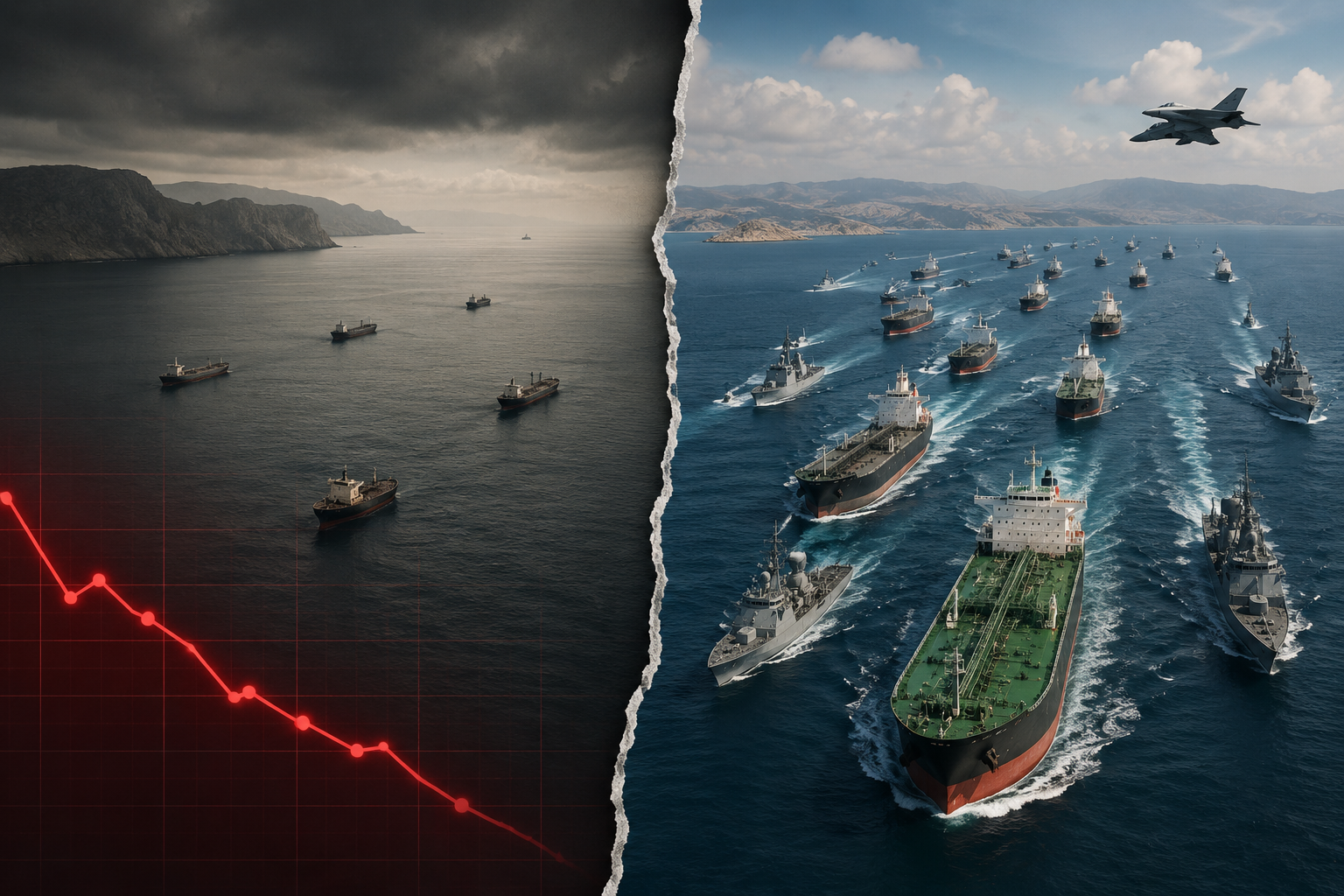
The Strait of Hormuz has become the center of a major dispute between public shipping data and claims from US President Donald Trump. The latest data from maritime analytics firm Kpler shows that only five confirmed vessels crossed the waterway on August 31. Kpler said this marked a 50% fall in traffic on that day.
The number is far below the figure Trump has cited in public. On August 31, Trump said that US naval help had allowed an average of 30 ships to pass through the strait each night. He also said the waterway was in “extremely good shape” and that the United States was taking control of the situation.
At first look, the two figures seem impossible to match. One side points to five confirmed crossings. The other says about 30 ships pass each night. Yet the difference may not be as simple as one number being true and the other being false.
Why the Strait Matters
The Strait of Hormuz is one of the most important oil routes in the world. It connects the Persian Gulf with the Gulf of Oman and the wider Arabian Sea. Large amounts of oil from Gulf producers normally pass through this narrow waterway.
Before the current war, about 20 million barrels of oil per day passed through the strait. That made Hormuz a key part of the world energy system. Any serious disruption can affect oil prices, fuel costs and inflation far beyond the Middle East.
The present crisis has reduced normal traffic by a large margin. Iran and the United States remain in conflict, and commercial ship operators face the risk of missile attacks, drones and other threats.
That risk has forced many shipping companies to avoid the area or use special routes and security measures.
Kpler’s Five-Vessel Figure
Kpler’s data gives one of the clearest views of the visible traffic. On August 31, it recorded five confirmed crossings. Four vessels entered the Middle East Gulf, while one left it.
Two of those vessels were described as shadow vessels. These ships can use methods such as turning off their tracking systems or using other ways to keep their movements less visible.
The five-vessel figure was also below Kpler’s earlier 10-day average of about 14 vessels. This shows that the August 31 result was not simply a normal day with a small change in traffic. It came at a time when visible commercial movement through Hormuz was already much lower than normal.
This is where the headline about a 50% fall comes from. But it is important to understand that the 50% figure refers to Kpler’s tracked traffic, not necessarily every ship that physically passed through the waterway.
Trump’s Claim of 30 Ships
Trump has offered a very different picture.
On August 31, he said the US Navy had helped an average of 30 ships pass through the Strait of Hormuz each night. He also said a large amount of oil was leaving the region and suggested that this was one reason oil prices had not risen as sharply as some experts had expected.
The US administration has also said that private shipping trackers do not show the full picture.
US officials argue that many ships have their tracking systems switched off for safety. If a ship turns off its Automatic Identification System, or AIS, normal public tracking services may not see its full journey.
That creates a serious problem for anyone who wants to count vessels from public data alone.
The Hidden Traffic Problem
The difference between the two sides becomes clearer when “dark” shipping is taken into account.
Some tankers now travel without active AIS signals. Others may take part in ship-to-ship transfers. In such cases, a tanker can load or move oil without leaving the same clear digital trail that it would leave during normal trade.
Kpler has itself revised its estimates after accounting for these less visible movements. A later Kpler estimate put crude oil flow through Hormuz at about 8.6 million barrels per day.
That is far higher than some of its earlier estimates. It also shows why a simple count of ships on public tracking systems can give an incomplete picture.
Still, 8.6 million barrels per day is less than half of the roughly 20 million barrels per day that passed through the strait before the war.
So even after the hidden traffic is taken into account, oil movement remains far below its normal level.
The US Says Much More Oil Is Moving
US officials have offered figures that suggest a much larger flow.
According to two US officials, the US military escorted 40 commercial vessels carrying 18 million barrels of oil through the Strait of Hormuz on Tuesday. They described it as a wartime high.
The officials said most, if not all, of those 40 ships had their transponders turned off to avoid detection. US forces also faced Iranian drone attacks and dealt with anti-ship cruise missiles during the operation.
This is an important detail.
If those 40 ships had their tracking systems off, public services would not necessarily show 40 ships crossing at the time. This gives the US explanation some support.
It also means the five ships recorded by Kpler cannot be treated as proof that only five vessels crossed the waterway.
A Previous US Estimate Adds More Context
The US position is also supported by earlier reports about a special shipping corridor.
In August, US officials said the military had set up a route through the southern part of the Strait of Hormuz. Officials said 15–20 tankers were entering and leaving the strait each night under the operation.
They also said close to 10 million barrels of oil per day were moving out of the Gulf through this system. On some nights, the amount reached 15 million–20 million barrels.
These figures are much closer to the newer oil estimates than the first public tracking numbers.
However, they are still below normal pre-war traffic.
Why the Numbers Do Not Match
The main issue is the difference between visible traffic and actual traffic.
Kpler and other tracking firms rely heavily on ship signals and other data sources. When ships switch off their AIS systems, their movements become harder to track.
The US military, by contrast, has direct knowledge of its own escort missions. It may know about ships that are deliberately invisible to public tracking services.
This means both sides may be measuring different things.
There is also another issue. A figure for ships “crossing the strait” may not mean the same thing as a figure for ships under US escort. Some vessels may travel through nearby routes, use the southern Omani corridor or take part in movements that are not easy to classify from public data.
So the gap between five confirmed crossings and 30 ships per night does not by itself prove that Trump’s figure is false.
But the Larger Picture Is Clear
Even with that explanation, one fact is hard to ignore: traffic and oil flow remain well below pre-war levels.
Kpler’s revised estimate of 8.6 million barrels per day is less than half of the earlier 20 million barrels per day level. US officials have cited higher figures, including a wartime record of more than 17 million barrels per day on Monday, according to Treasury Secretary Scott Bessent.
This tells us that the argument is not really about whether any ships can pass.
Ships clearly can pass.
The bigger question is how many ships and how much oil can pass safely and consistently.
That distinction matters because a single successful convoy does not mean that the waterway has returned to normal.
A Risky New Normal
The US military has made clear that it can protect commercial ships with aircraft, naval forces and other military assets. The reported 40-ship convoy shows the scale of that effort.
But this also shows how far conditions have moved from normal trade.
Before the war, shipping companies did not need a major military operation to move ordinary oil cargo through Hormuz. Today, ships may need escorts, special routes and careful timing.
That creates higher costs and greater risk for shipping companies.
Iran also continues to have the ability to threaten the route, even if it does not have complete control over every part of the waterway. Shipping firms remain cautious because one attack can have a major effect on confidence.
What the Dispute Really Tells Us
The 50% traffic fall is a real Kpler figure, but it should not be read as proof that only five ships crossed Hormuz.
At the same time, Trump’s claim of 30 ships per night should not be treated as proof that the strait has returned to normal.
The evidence points to a more complicated reality. Public tracking shows very low visible traffic. US officials say a large amount of movement is hidden because ships switch off their transponders. Kpler’s own later estimate also shows that the real oil flow is much higher than early tracking suggested.
Yet even the higher estimates remain far below normal levels.
The Strait of Hormuz, therefore, is not simply “closed” or “open.” It is partly active under severe military risk. Some ships and large oil volumes can pass, but the route remains far less active than it was before the war.
That is why the dispute over five ships versus 30 ships matters. The numbers show how difficult it has become to measure trade through a conflict zone. They also show that claims about control of Hormuz need to be judged not only by the number of ships that can pass on one night, but by whether safe and steady commercial traffic can continue over time.