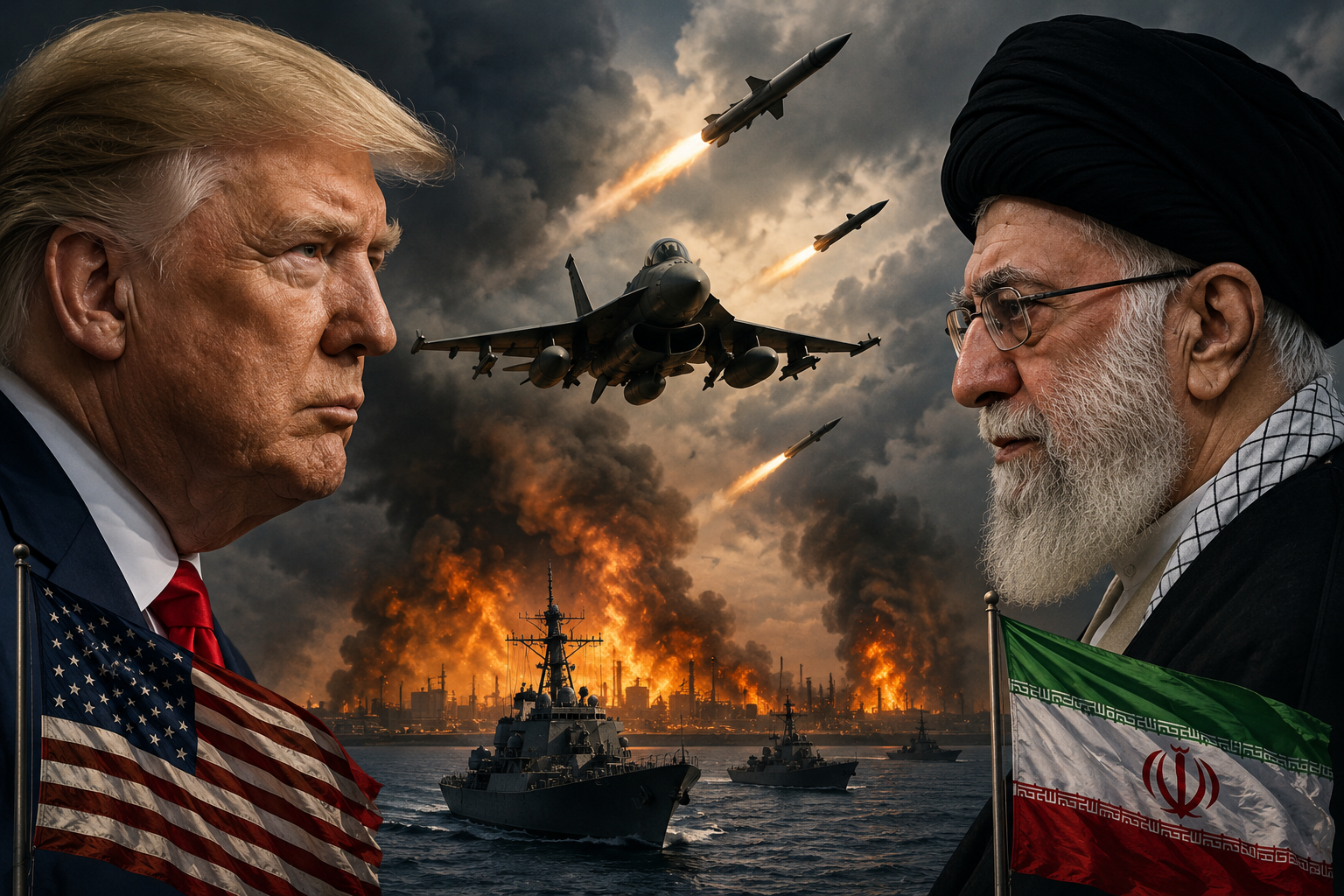
US President Donald Trump has warned Iran that the United States is ready for more military strikes at any time. His comments came after a major US attack on Iranian military sites and a strong Iranian response across parts of the Middle East.
Speaking at the White House on September 2, Trump said the latest US attack was a “very heavy attack” and said American forces were ready to carry out another strike “any time we want.”
Trump also said US forces had destroyed new Iranian military equipment near the Strait of Hormuz. He said the targets included radar and missile systems that Iran had tried to restore. He also said the US had destroyed a rocket that Iran was developing for mine attacks at sea.
His remarks have added to fears that the conflict could enter a more dangerous phase. Iran has already promised to respond to US attacks, while the United States has warned that any further Iranian action could lead to more US strikes.
A Major New Round of Attacks
The latest crisis came after a period of relative calm between Washington and Tehran. The two sides had mostly avoided direct attacks since late July, although their political conflict remained severe.
That calm ended after a weekend exchange of fire. On September 1, the United States launched a large group of airstrikes against Iranian military targets. The US Central Command said its forces hit air defense sites, radar systems, maritime assets, mine-laying facilities and communication sites linked to Iran’s Islamic Revolutionary Guard Corps, or IRGC.
The US said the attacks came after Iranian attempts to place sea mines in the Strait of Hormuz and attacks on US forces. Washington also said Iran had tried to target commercial ships and American military personnel.
The latest US attack was one of the most serious military actions in the conflict in recent weeks. It showed that the earlier period of relative calm had ended and that both sides still had the ability and the will to use force.
Iran Hits Back
Iran did not remain silent after the US strikes. Tehran launched missiles and drones at US-linked military sites and bases in several parts of the region.
Iran reported attacks against US assets in Jordan, Bahrain, Iraq and Kuwait. It also reported an attack on a US base in the United Arab Emirates. The attacks marked a clear response to the latest US action.
Jordan said 13 ballistic missiles entered its airspace. Its military said 10 were intercepted and destroyed, while three fell in remote areas away from population centers. No deaths or injuries were reported from that attack, based on the initial information.
Iranian officials have also used strong language against Washington. Tehran has warned that the US should expect further retaliation if attacks continue.
This creates a serious cycle. A US strike leads to an Iranian response. An Iranian response can then lead to another US strike. Each new attack can make the next step harder to control.
The Strait of Hormuz Is at the Center
One of the biggest reasons for the current crisis is the Strait of Hormuz. This narrow waterway links the Persian Gulf with the Gulf of Oman and is one of the world’s most important routes for oil trade.
Before the war, about one out of every five barrels of the world’s oil passed through the strait. The conflict has sharply reduced the amount of oil and other goods that move through the area.
The United States says Iran has tried to use mines and other military tools to restrict movement through the waterway. Tehran, however, says it will not allow the US to control the area while American forces attack Iran.
The US Central Command said its forces had ordered 86 commercial vessels to change course as part of its maritime operations. It also said three vessels were disabled and two were boarded for inspection.
The situation has created a major concern for global trade. If ships cannot pass through the strait with enough safety, oil supplies can face further pressure.
Oil Prices Rise as War Risk Grows
The conflict has already had a clear effect on oil prices. On September 3, Brent crude rose $1.66, or 1.7%, to $97.29 a barrel. US West Texas Intermediate rose $2.03, or 2.2%, to $93.04 a barrel. Both prices reached their highest level in about six weeks.
The rise reflects fears about future oil supplies. Investors are watching the Strait of Hormuz closely because even a short disruption could affect oil markets around the world.
The impact would not stop with crude oil. Higher oil prices can raise fuel costs, transport costs and the price of many goods. Countries that rely on imports could face extra pressure if the crisis lasts for a long time.
Trump, however, has said he does not expect the renewed conflict to last “too long.” He has also said oil prices will come down.
Civilian Deaths Add to the Crisis
The latest US strikes have also raised concern over civilian safety. Iranian officials said a US strike hit a wedding party near Sirik, a coastal area close to the Strait of Hormuz.
The Iranian Red Crescent first reported five deaths and 50 wounded. Iranian state media later reported that 68 people were hurt. A four-year-old child was among those reported dead.
Other reports have placed the civilian death toll from the latest US attacks at different levels. Reuters reported that at least 18 people had died and more than 100 had suffered injuries in the wider set of recent strikes.
The US military has said it does not target civilians. US Central Command said it was looking into the reports about the wedding site.
Civilian deaths can make any future peace effort much harder. Public anger can rise on both sides, while leaders may face more pressure to answer attacks with force.
The Ceasefire Has Become Fragile
The latest violence also puts the earlier ceasefire at greater risk. The US and Iran reached a deal in June, but the agreement soon fell apart as both sides disagreed over key issues.
Trump has shown little faith in another agreement. He said a deal with Iran was not worth the paper it was written on and said Tehran had received many chances.
Iran, on the other hand, has said it remains ready to return to a ceasefire if the United States does the same. That position shows that a path to diplomacy still exists, but the gap between the two sides remains very wide.
UN Secretary-General Antonio Guterres has called for an immediate end to military action and a return to talks. The United Nations has also stressed the need to protect civilians and follow international humanitarian law.
What Trump’s Warning Means
Trump’s statement does not mean that another US strike is certain to happen immediately. It does, however, show that Washington wants Iran to know that American military forces remain ready for another attack.
The United States has more than 50,000 service members across the Middle East, according to the US military. American forces remain on alert as the conflict continues.
Iran also has several ways to respond without a direct attack on the US mainland. It can target US bases and allies across the region, threaten shipping routes, or use missiles and drones against military targets.
That makes the next few days important. If both sides limit their actions, there may still be space for talks. If Iran launches another major attack and the US responds with a large strike, the conflict could grow much wider.
A Dangerous Moment for the Region
The latest US-Iran crisis has moved beyond a simple exchange between two countries. It now affects the Gulf states, shipping, oil markets and American military bases across the Middle East.
Trump says the United States is ready to strike Iran again at any time. Iran has promised to answer US attacks. The Strait of Hormuz remains a key pressure point, while oil prices have already reacted to the rising risk.
For now, the biggest question is whether both sides can step back before another attack creates a much larger war. Diplomacy remains possible, but every new strike makes that path more difficult.
The situation is therefore at a critical point. A short conflict could still end if both governments choose restraint and return to talks. But if the cycle of attack and retaliation continues, the effects could spread far beyond Iran and the United States, with consequences for the entire Middle East and the global economy.
ALSO READ: Strait of Hormuz Traffic Falls 50% as Claims Face Scrutiny