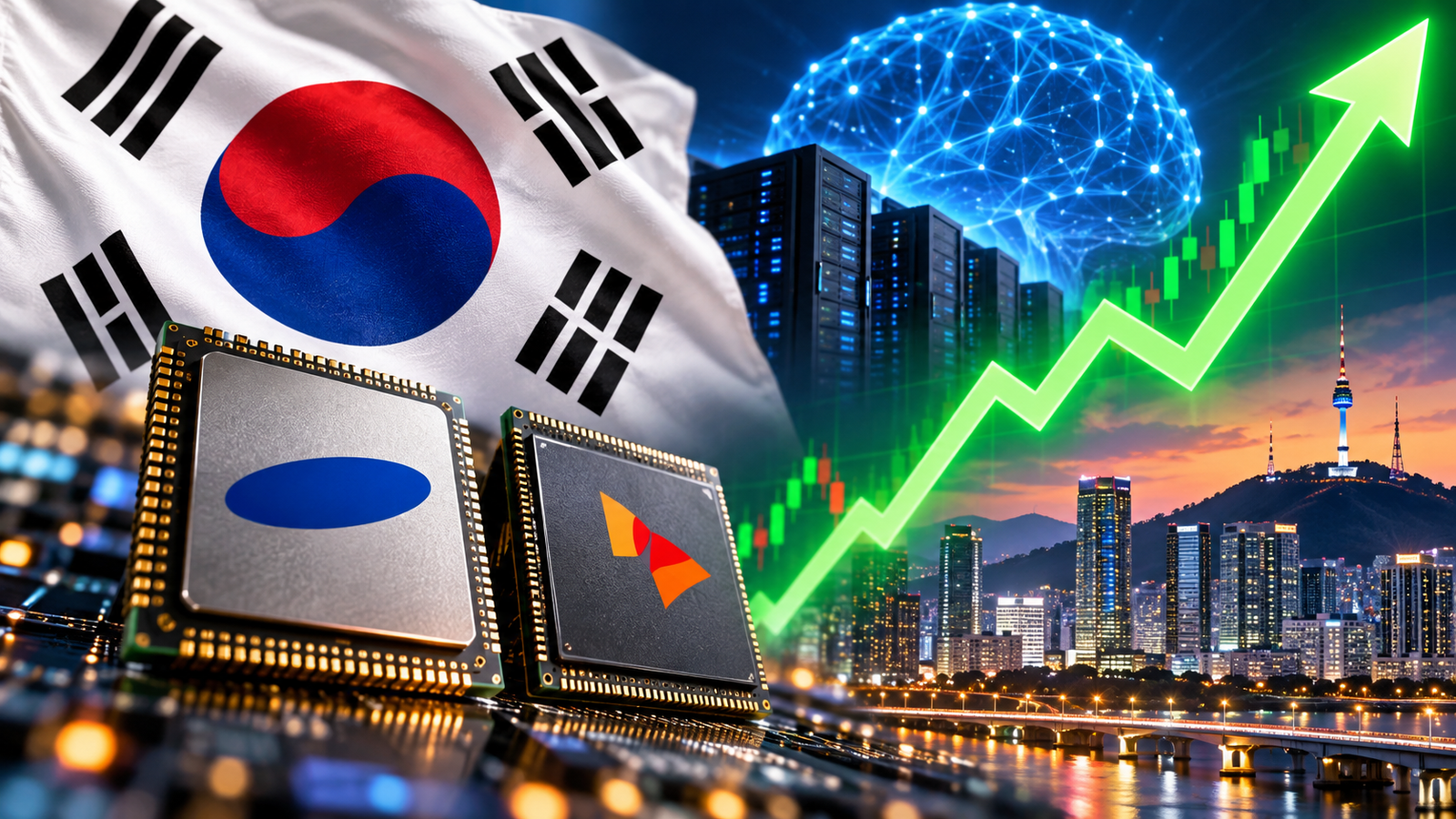
South Korea was the standout performer in the Asian equity market during the latest session. The country’s main stock index, the KOSPI, rose by about 1.3–1.4%. The final reported gain was 1.40%, which took the index to 7,051.64. The move also placed the KOSPI above the 7,000 level for the first time since July.
The rise came at a time when several wider market risks remained in place. Geopolitical concerns continued to affect investor sentiment, while higher oil prices created another source of pressure for global markets. Against that background, South Korea’s stronger performance was notable.
A major reason for the move was the strength of the country’s semiconductor sector. Samsung Electronics and SK Hynix remained central to the market story. Both companies have a major role in the global memory-chip industry, which has become closely linked to the expansion of artificial intelligence infrastructure.
The market response does not, by itself, prove that the semiconductor sector has entered a permanent period of higher growth. Stock prices can move ahead of confirmed changes in company earnings, and investor expectations can change quickly. The recent rise is therefore better viewed as a sign of stronger market confidence in the AI and memory-chip outlook rather than as proof of a certain future result.
KOSPI Performance
The KOSPI ended the session at 7,051.64, a gain of 1.40%. This was broadly in line with the earlier estimate of a 1.3–1.4% rise.
The move above 7,000 has some market importance because major index levels often receive attention from investors. However, the level itself should not be treated as evidence that the index must continue higher. Market direction depends on many factors, including corporate earnings, interest rates, currency conditions, global demand and geopolitical events.
The stronger performance of South Korean equities also needs to be viewed within the wider Asian market. While several markets faced pressure from concerns about oil prices and geopolitical developments, Korean technology and semiconductor shares provided support to the domestic index.
This created a clear difference between the broader macroeconomic picture and the performance of one important part of the Korean equity market. Semiconductor optimism helped offset some of the concerns that affected other sectors.
Semiconductor Stocks Take the Lead
The semiconductor sector was the main source of attention. SK Hynix gained 3.51%, making it one of the clearest beneficiaries of the positive market mood.
Samsung Electronics also formed an important part of the story. The company had traded higher during the session but finished roughly flat. This detail matters because it shows that the KOSPI’s advance was not the result of an equal rise across all major semiconductor names.
The two companies have different business mixes, but both have substantial exposure to memory semiconductors. Their market performance is therefore often affected by expectations about memory prices, supply conditions, data-centre investment and demand for AI-related hardware.
The recent price action suggests that investors have placed greater value on the possibility of strong future demand for advanced memory products. That view has received support from the rapid expansion of AI systems, which require large amounts of computing power and memory capacity.
Still, share-price performance should not be confused with confirmed business results. A rise in a company’s stock price reflects market expectations at a particular point in time. It does not guarantee higher revenue, profit or cash flow in the future.
The AI Demand Factor
Artificial intelligence has become one of the most important forces behind the current semiconductor market cycle. Modern AI systems require large data centres, advanced processors and substantial memory capacity. As companies expand their AI infrastructure, demand for certain types of memory can also rise.
This has created a positive narrative around major memory producers such as Samsung Electronics and SK Hynix. Investors appear to expect AI-related demand to remain strong and to support the broader memory market.
The important issue is whether this demand will remain strong enough to support higher production, better prices and stronger company earnings. That question cannot be answered by a single market session.
AI investment is also subject to changes in corporate budgets, technology choices and economic conditions. A company may increase its spending on AI at one point and later change its plans. In addition, improvements in chip efficiency could affect the amount and type of hardware required for future systems.
For these reasons, the recent rally can reasonably be described as a market response to stronger AI expectations. It would be less appropriate to describe it as proof that semiconductor earnings will rise by a specific amount.
OpenAI and the Korean Chip Industry
Another part of the semiconductor story involves OpenAI. OpenAI has said that its cooperation with Samsung on next-generation chips is making significant progress.
Samsung and SK Hynix have also been associated with agreements to supply memory for OpenAI’s Stargate project. These developments have added another layer to the market’s AI narrative.
The potential importance is straightforward. Large AI infrastructure projects require substantial semiconductor capacity. If such projects proceed at the expected scale, suppliers of advanced memory and other components could benefit from additional demand.
At the same time, commercial agreements and cooperation announcements should not be treated as guarantees of future revenue or profit. The final economic effect depends on the size, timing and terms of actual orders, as well as on production capacity and market conditions.
This distinction is important for a legally cautious analysis. A statement that a company has a relationship with an AI company is different from a statement that the relationship will produce a particular level of earnings.
Why Memory Chips Matter
Memory chips have a central role in modern computing. AI workloads can require large amounts of high-speed memory because models must process substantial volumes of data.
One important category is high-bandwidth memory, often called HBM. It is designed to provide high data transfer rates for advanced computing systems. Demand for such products has received considerable attention as AI data-centre capacity has expanded.
South Korea is home to two of the world’s most important memory-chip manufacturers. This gives the country’s stock market a direct connection to a major part of the global AI hardware supply chain.
The market’s positive response therefore has a clear economic basis. If AI infrastructure investment remains strong, demand for advanced memory could remain strong as well. However, the outcome also depends on supply. If manufacturers increase production too quickly, excess supply could place pressure on prices.
This is one of the key risks that investors and analysts need to consider. Strong demand alone does not determine profitability. The balance between demand, supply, production costs and selling prices also matters.
Market Data at a Glance
| Measure | Reported figure |
|---|---|
| KOSPI closing level | 7,051.64 |
| KOSPI daily gain | 1.40% |
| Earlier estimated gain | Roughly 1.3–1.4% |
| SK Hynix daily gain | 3.51% |
| Key companies | Samsung Electronics, SK Hynix |
| Main market theme | AI and semiconductor demand |
| Important AI development | OpenAI cooperation with Samsung |
| Related project | OpenAI Stargate |
| Key external concern | Geopolitical risk and higher oil prices |
| Brent crude reference | Toward $100 |
The table shows why the session attracted attention. The KOSPI gained 1.40%, while SK Hynix posted a larger 3.51% rise. This difference indicates that the semiconductor theme had greater strength than the index as a whole.
Geopolitical Risk Remains Relevant
The semiconductor rally took place despite wider geopolitical concerns. This is important because semiconductor companies do not operate in isolation from global events.
Geopolitical tensions can affect trade, shipping, energy costs, supply chains and business confidence. Semiconductor production also relies on a complex international network that includes equipment makers, material suppliers, chip designers and customers across several countries.
A change in trade policy or restrictions on technology exports could therefore affect companies in the sector. The exact impact would depend on the nature of any policy change and on the markets involved.
Higher oil prices also present a separate risk. The reference to Brent crude moving toward $100 reflects concern about energy costs. Higher energy prices can raise costs for businesses and households and may also affect inflation expectations.
This creates a mixed market environment. On one side, AI-related semiconductor demand provides a strong growth theme. On the other side, geopolitical and energy risks can create pressure on the wider economy.
Why the Rally Matters
The most important point is not simply that Korean stocks rose. The more significant issue is the reason for the rise.
The session suggests that investors were willing to place greater weight on the semiconductor and AI outlook, even while wider risks remained present. This can be viewed as a sign that AI-related demand continues to have a strong influence on market sentiment.
SK Hynix’s 3.51% gain is especially relevant because of its direct exposure to the memory market. Samsung’s roughly flat close provides a useful reminder that the rally was not uniform across the major Korean technology names.
The market therefore appears to have responded more strongly to selected semiconductor opportunities than to the Korean market as a whole.
That distinction can help explain why the KOSPI rose 1.40% without every major technology stock recording a similar gain.
What Could Support the Trend
The semiconductor outlook could remain positive if AI infrastructure investment stays strong. Continued demand for advanced computing systems could support demand for high-performance memory.
Large technology companies may also continue to expand their data-centre capacity. If that expansion results in higher orders for Korean memory producers, the market could retain confidence in the sector.
New commercial agreements could provide another source of support if they lead to meaningful production orders. The reported progress between OpenAI and Samsung may therefore remain relevant to the market narrative.
However, these factors depend on actual business activity. Announcements, partnerships and expectations do not always translate into immediate earnings growth.
What Could Challenge the Rally
There are several factors that could weaken the positive view.
A slowdown in AI infrastructure spending could reduce expected semiconductor demand. A sharp increase in memory supply could also place pressure on chip prices. Both factors could affect the earnings outlook for memory manufacturers.
Global economic weakness presents another risk. If businesses reduce capital expenditure, demand for technology hardware could fall.
Geopolitical developments are also difficult to predict. New trade restrictions, supply-chain disruption or higher energy prices could affect the semiconductor sector directly or indirectly.
Interest rates also remain relevant. Higher borrowing costs can reduce the value that investors place on future corporate earnings, while lower rates can have the opposite effect.
These factors mean that the current rally should be assessed as part of a wider market cycle rather than as a stand-alone event.
A Cautious Interpretation
The recent Korean market move provides a useful example of how a strong industry theme can dominate short-term investor sentiment.
The KOSPI rose 1.40% to 7,051.64, while SK Hynix gained 3.51%. Samsung Electronics finished roughly flat after earlier strength. AI demand and expectations for continued semiconductor investment appear to have helped support the market.
The OpenAI and Samsung cooperation story adds further interest because large AI projects require substantial semiconductor resources. The connection with the Stargate project also adds to expectations around future memory demand.
Even so, the available information does not establish a guaranteed path for company earnings or share prices. The market can change direction if demand expectations weaken, supply rises, geopolitical conditions deteriorate or energy prices remain elevated.
The most balanced conclusion is therefore that South Korean semiconductor stocks are benefiting from renewed confidence in AI-related demand, but the sustainability of the rally remains dependent on actual demand, supply conditions, company results and the wider global economic environment.
This is an analytical assessment rather than a prediction or recommendation. Past market performance and current investor expectations cannot establish what a security, index or company will do in the future. Any investment decision would require separate review of company financial statements, valuation, risk factors, market conditions and the individual’s circumstances.
ALSO READ: China Stocks Rise, but Recovery Still Faces Doubts